

PACES Competition, with military sportsmen from Iraq, UAE, Palestine, concludes in Lahore

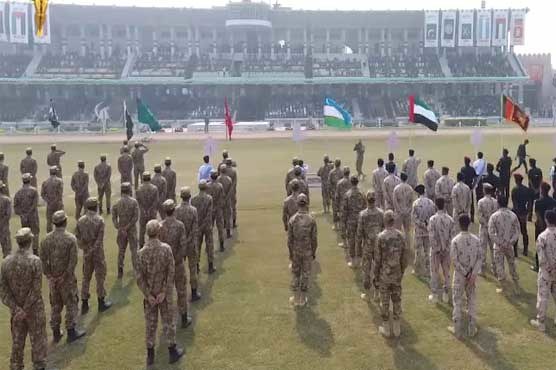
The concluding ceremony of the third International PACES (Physical Agility and Combat Efficiency System) Competition 2021 in Lahore on November 7, 2021. (Photo courtesy: Social Media) 
Short Url
Updated 07 November 2021
Follow

PACES Competition, with military sportsmen from Iraq, UAE, Palestine, concludes in Lahore

  • 101 international military sportsmen from six countries participated
  • Egypt, Indonesia, Japan and Myanmar came as observers

ISLAMABAD: The closing ceremony of the third International PACES (Physical Agility and Combat Efficiency System) Competition was held at Ayub Stadium in Lahore on Sunday, an Inter Services Public Relations press release said.

101 international military sportsmen from six countries including Iraq, Jordan, Palestine, Sri Lanka, the UAE and Uzbekistan participated in the contest while Egypt, Indonesia, Japan and Myanmar came as observers. Nine teams from the Pakistan army also competed.

“In International Teams Category, Sri Lanka secured gold medal while UAE and Uzbekistan jointly won Silver medal,” the army’s media wing said. “Bronze medal was shared by Palestine, Jordan and Iraq.”

In the individual category, Warrant Officer Mubarek from UAE and Sapper Ahmed Raza from Engineers Center secured gold medals in the 3.2 km race.

The chief guest at the event, Commander Lahore Corps Lt. Gen. Muhammad Abdul Aziz, awarded prizes to the winning teams and individuals and “congratulated them for excellent display of physical fitness, endurance and sportsmanship.”

“He lauded the performance of Pakistan Army Teams and complimented them for the highest standards of physical fitness displayed by them,” the military said. “Successful completion of 3rd international PACES Championship at Lahore reflects positively on Pakistan’s image as a peaceful nation which is completely safe and secure for conduct of international sports events.”


Pakistan cuts interest rate despite IMF caution, citing space to support growth

Updated 9 sec ago
Follow

Pakistan cuts interest rate despite IMF caution, citing space to support growth

  • Central bank lowers policy rate by 50 bps after four consecutive holds
  • Business groups say cut is too small to ease cost pressures on industry

KARACHI: Pakistan’s central bank on Monday cut its key policy interest rate by 50 basis points to 10.5 percent, resuming monetary easing after four consecutive meetings, in a move that surprised markets and came despite International Monetary Fund guidance to maintain an “appropriately tight” policy stance to anchor inflation expectations.

The decision by the State Bank of Pakistan (SBP) follows a year-long stabilization effort under an IMF Extended Fund Facility, during which authorities relied on tight monetary and fiscal policies to rein in inflation, rebuild foreign exchange reserves and stabilize the balance of payments after the country narrowly avoided default in 2023.

Most analysts had expected the central bank to hold rates steady. In a survey conducted by Karachi-based brokerage Arif Habib Limited ahead of the decision, 72 percent of respondents predicted no change, citing fading base effects in inflation and emerging external pressures, while only 28 percent anticipated a cut.

“The Monetary Policy Committee (MPC) has decided to decrease the policy rate,” the SBP said in a statement following the meeting of its rate-setting body in Karachi.

“While ensuring the ongoing price stability, the MPC noted the available space to reduce the policy rate to support sustainable economic growth.” 

Pakistan’s consumer inflation eased to 6.1 percent in November from 6.2 percent in October, remaining within the SBP’s medium-term target range of 5–7 percent, according to official data.

“The Committee noted that inflation on average remained within the target range of 5–7 percent during July–November FY26, though core inflation is proving to be relatively sticky,” the MPC said, adding that economic activity was gaining traction despite a challenging global environment for exports.

The central bank said food, energy and core inflation had broadly converged in recent months, while inflation expectations remained anchored due to a “prudent monetary policy stance” and fiscal discipline. However, it warned that inflation could rise above the target range toward the end of the current fiscal year due to low base effects, before easing again in FY27.

The MPC also cited labor market pressures to justify the rate cut, pointing to the Labour Force Survey 2024–25, which showed an increase in unemployment compared with 2020–21, despite faster employment growth.

Pakistan’s foreign exchange reserves have climbed above $15.8 billion following the release of a $1.2 billion IMF tranche after a successful program review, the central bank said, while consumer confidence has improved and fiscal balances recorded surpluses in the first quarter of FY26.

“The real policy rate remains adequately positive to stabilize inflation within the target range of 5–7 percent over the medium term and contribute toward sustainable economic growth,” the MPC said.

It projected real GDP growth in FY26 to remain in the upper half of its earlier forecast range of 3.25–4.25 percent. The government has since revised its growth target to 3.9 percent, down from 4.2 percent, citing damage estimated at $1.3 billion from monsoon floods.

On the external front, the central bank said Pakistan’s current account deficit of $0.7 billion during July–October FY26 was in line with expectations, though exports remained under pressure due to a sharp decline in food shipments, particularly rice.

Exports fell 6.4 percent to $12.8 billion in the first four months of the fiscal year, while imports rose 13.3 percent to $28.3 billion, widening the trade deficit by 37 percent to $15.5 billion, according to the Pakistan Bureau of Statistics.

“Going forward, global headwinds, especially from evolving trade dynamics, are likely to constrain exports, though lower global oil prices may contain import growth,” the MPC said, adding that foreign exchange reserves were projected to rise to $17.8 billion by June 2026 with the realization of planned official inflows.

“SURPRISING MOVE“

Analysts described the rate cut as unexpected but measured.

“The 50 basis points cut is a surprising move signaling greater emphasis on supporting growth despite lingering inflation and external account risks,” Muhammad Waqas Ghani, head of research at JS Global Capital Limited, told Arab News.

“Importantly, the quantum of the cut is modest, suggesting a cautious approach, the SBP is signaling flexibility while remaining mindful of inflation risks and external account vulnerabilities,” he added.

Business groups, however, expressed disappointment, saying the reduction would do little to ease financing costs.

“Such a token adjustment falls far short of what is urgently required to revive Pakistan’s fragile economy and restore business confidence,” Karachi Chamber of Commerce and Industry President Muhammad Rehan Hanif said in a statement.

He said borrowing costs in Pakistan remained among the highest in the region despite easing inflation.

“Regional economies such as China, India, Bangladesh, Vietnam, Indonesia and Sri Lanka maintain single-digit interest rates, enabling their industries to access affordable financing, expand capacity, and remain competitive in global markets,” Hanif said.

Pakistan’s industries continue to face high energy tariffs, fuel costs, taxation, logistics expenses and regulatory pressures, he added, warning that a prolonged high-interest-rate environment would discourage investment and suppress economic activity.