

Amid gas crisis, Pakistan accepts costliest-ever LNG cargo from Qatar Petroleum Trading

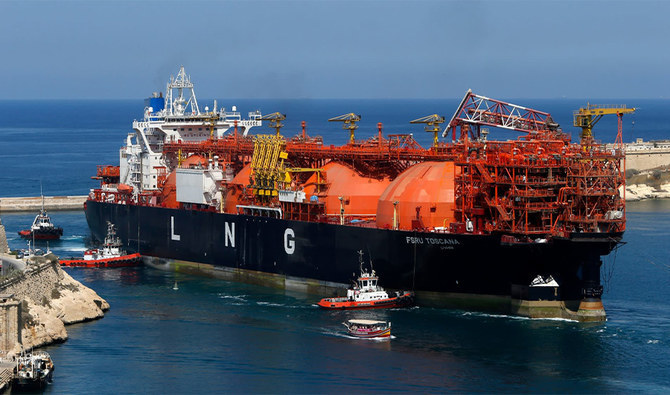
An offshore LNG regasification terminal, the FSRU Toscana, is towed into Valletta's Grand Harbour July 1, 2013. (REUTERS/File)
Short Url
Updated 08 November 2021
Follow

Amid gas crisis, Pakistan accepts costliest-ever LNG cargo from Qatar Petroleum Trading

  • Pakistan will import LNG cargo at $30.65 per million British thermal units from Qatar Petroleum Trading Company for end-November delivery 
  • Price impact of higher priced imported cargo when blended with existing stock would average at around $14-15 per mmbtu 

KARACHI: Pakistan will import liquefied natural gas (LNG) at the highest ever price of $30.65 per mmbtu (Million British Thermal Units) from Qatar Petroleum for late November delivery to avert a looming gas crisis in the winter month of December. 

Pakistan LNG Limited (PLL) documents seen by Arab News showed the bid price. The contract has been awarded to Qatar Petroleum Trading Company, PLL confirmed.

Last week, media reported that PLL was seeking two liquefied natural gas cargoes for delivery in November through an emergency tender after its term suppliers canceled delivery of cargoes. Commodities trader Gunvor could not supply the cargo because of force majeure at Equatorial Guinea’s LNG plant. Italian energy group ENI could not deliver a cargo due to a default by its backend supplier.

A PLL official said the company was “engaged with both suppliers [Gunvor and ENI] as per the contractual provisions.” 

A sharp increase in gas prices has caused power shortages in many parts of the world, including China, amid a global energy crunch.

In response to the tender floated for two cargoes, Vitol Bahrain submitted the lowest bid at $29.89 per mmbtu for deliveries on November 19-20, 2021, while Qatar Petroleum submitted a bid at $30.65 per mmbtu for deliveries on November 26-27, bidding documents posted on the PLL website showed. 

As the bids were invited for cargoes to be supplied between Nov 19-20 and Nov 26-27, PLL decided not to entertain the bids submitted by Vitol Bahrain as the country needed deliveries for December utilization when the country expects a sharp mercury drop, the PLL official said.

Analysts say the impact of higher priced imported cargo when blended with the existing stock would be averaged at around $14-15 per mmbtu. 

“Pakistan would have around 9 cargoes ... the price impact would be around $14-15 per mmbtu for local consumption,” Samiullah Tariq, Director Research at Pakistan Kuwait Investment, told Arab News on Sunday. 

Pakistan meets more than half of its LNG requirement through long-term import contracts while the gap is met through spot cargo purchases. 

The situation is expected to improve in January 2922 when a new 10-year deal between Pakistan and Qatar is expected to be materialized for the supply of around 200 mmcf. 

Pakistan’s estimated annual demand growth for gas is expected to be around 100-200 mmcfd. 


Pakistan, Japan discuss boosting trade, investment and cooperation in key sectors

Updated 8 sec ago
Follow

Pakistan, Japan discuss boosting trade, investment and cooperation in key sectors

  • The Pakistani side highlighted various opportunities in sectors minerals and mining, agricultural and agri-food products, and IT sectors
  • The development comes as Pakistan steps up economic diplomacy to expand trade, investment ties after emerging from a financial crisis

ISLAMABAD: Pakistan and Japan have held talks on improving bilateral trade and investment and expanding cooperation in key sectors, Pakistan’s Press Information Department said on Saturday.

Both countries held the 8th Pakistan–Japan Government–Business Joint Dialogue and the Pakistan Business Forum in Tokyo on Friday, marking the first convening of the dialogue in the Japanese capital since Dec. 2018.

The dialogue was co-chaired by Prime Minister Shehbaz Sharif’s aide on commerce Rana Ihsaan Afzal Khan and Takuo Komori, Japan’s parliamentary vice-minister of economy, trade and industry, according to the PID.

The two sides exchanged views on strengthening bilateral economic relations, with a focus on improving the trade and investment environment and advancing practical cooperation.

“The Pakistani side outlined Pakistan’s economic priorities and highlighted opportunities for collaboration in sectors such as minerals and mining, agricultural and agri-food products, and information technology,” the PID said in a statement.

“The Japanese side shared perspectives on the operating environment for Japanese companies in Pakistan and discussed areas where continued engagement and follow-up could further facilitate business activity.”

Pakistan steps up economic diplomacy to expand trade ties and attract foreign capital after emerging from a prolonged financial crisis that nearly pushed it into default in mid-2023. Islamabad has since set up the Special Investment Facilitation Council (SIFC), a civil-military body designed to cut red tape and provide a one-window operation for businesses, as it navigates a long path to economic recovery under a $7 billion International Monetary Fund (IMF) program.

Pakistan and Japan established diplomatic and economic relations in 1952. Since then, Japan has been a major development partner, financing infrastructure such as roads, power plants and water systems, while extending technical assistance and yen loans.

The Pakistan–Japan Government–Business Joint Dialogue brought together senior officials and private-sector representatives from both countries, including members of the Pakistan–Japan Business Forum (PJBF) and the Japan–Pakistan Business Co-operation Committee (JPBCC).

Participants reaffirmed the importance of sustained government-to-government engagement, supported by close coordination with the private sector, to advance mutually beneficial economic cooperation between Pakistan and Japan, according to the statement.

Following the Joint Dialogue, the Pakistan Business Forum, co-organized by the Embassy of Pakistan in Tokyo and the Japan External Trade Organization (JETRO), was held in Tokyo that was attended by Japanese and Pakistani business leaders.

The Forum featured selected sectoral presentations highlighting practical cooperation between Japanese and Pakistani partners. It included a presentation by the Trade and Investment Counsellor of the Embassy of Pakistan in Tokyo on “From Trade to Investment: Building Japan–Pakistan Joint Value Chains.”

“The Forum concluded with closing remarks by Mr. Abdul Hameed, Ambassador of Pakistan to Japan, who highlighted the importance of sustained engagement, trust-building, and long-term partnership in advancing Pakistan–Japan economic cooperation,” the PID added.