

Attempt to assassinate Iraqi PM draws global condemnation

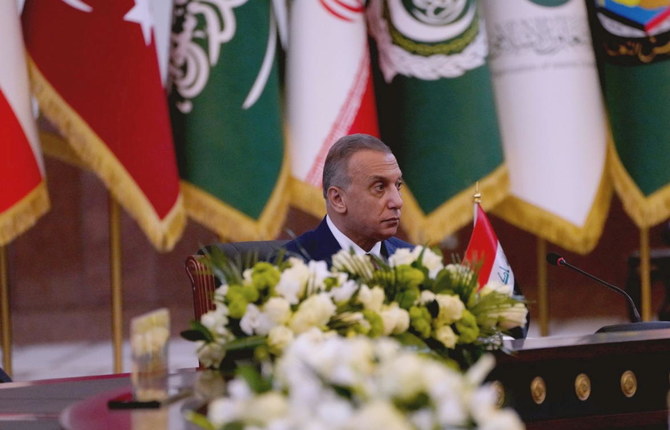
Iraqi Prime Minister Mustafa Al-Kadhimi attends the Baghdad summit in Baghdad, Iraq, August 28, 2021. (Reuters)
Short Url
Updated 08 November 2021
Follow

Attempt to assassinate Iraqi PM draws global condemnation

  • UAE, Kuwait, Qatar, Jordan and Arab League all echo Saudi Arabia’s statement
  • The Muslim World League also strongly condemned the failed assassination bid against Iraq’s prime minister

JEDDAH: Saudi Arabia joined a torrent of global condemnation on Sunday after an attempt to assassinate Iraqi Prime Minister Mustafa Al-Kadhimi.

Al-Kadhimi escaped unhurt after three explosives-laden drones targeted his residence inside the heavily fortified Green Zone in Baghdad. Two of the drones were intercepted and destroyed but a third hit the building and detonated, injuring six members of the prime minister’s personal protection force.

The Saudi Foreign Ministry said the attack was a “cowardly terrorist act,” and the US offered assistance with the investigation. “I strongly condemn the terrorist attack targeting the residence of Iraqi Prime Minister Kadhimi,” US President Joe Biden said.

“I am relieved the prime minister was not injured and commend the leadership he has shown in calling for calm, restraint, and dialogue to protect the institutions of the state and strengthen the democracy Iraqis so richly deserve.”

Al-Kadhimi appeared in a video footage published by his office on Sunday chairing a meeting with top security commanders to discuss the drone attack.

“The cowardly terrorist attack that targeted the home of the prime minister with the aim of assassinating him is a serious targeting of the Iraqi state by criminal armed groups,” Al-Kadhimi’s

office said.

No one admitted carrying out the attack, but the finger of blame was immediately pointed at Iran-backed armed groups who have been angered by Kadhimi’s rejection of Iranian interference in Iraq.

Opinion

This section contains relevant reference points, placed in (Opinion field)

The Hashd Al-Shaabi armed factions and their Fatah political bloc suffered a humiliating defeat in legislative elections in Iraq in October, and threatened violence unless the results were overturned.

The attack came two days after violent clashes in Baghdad between government forces and Hashd Al-Shaabi supporters. Protesters pelted police with stones near the Green Zone, injuring several officers. The police responded with tear gas and live gunfire, killing at least one demonstrator. Al-Kadhimi has ordered an investigation.

Independent analysts say the election results were a reflection of anger toward the Iran-backed armed groups, which are widely accused of involvement in the killing of at least 1,000 protesters who took to the streets in anti-government demonstrations that began in October 2019.

President Barham Salih condemned Sunday’s attack as a heinous crime against Iraq. “We cannot accept that Iraq will be dragged into chaos and a coup against its constitutional system,” he said.

The influential Shiite cleric Moqtada Al-Sadr, whose party was the biggest winner in last month’s election, called the attack a terrorist act against Iraq’s stability that aimed to “return Iraq to a state of chaos to be controlled by non-state forces.”

The Muslim World League also strongly condemned the failed assassination bid against Iraq’s prime minister on Sunday.

“Such terrorist acts that aim to destabilize Iraq, harm its security, and terrorize its people are destined to fail. With God’s help, the great and strong Iraq will continue to defeat such attempts and move forward with achieving progress and prosperity, and strengthening its national cohesion,” the secretary-general of the MWL Sheikh Mohammed bin Abdul Karim Al-Issa said.

Al-Issa expressed full support for the Iraqi government and people facing terrorism, in all its forms and manifestations.


Iraq’s political future in limbo as factions vie for power

Updated 2 sec ago
Follow

Iraq’s political future in limbo as factions vie for power

BAGHDAD: Political factions in Iraq have been maneuvering since the parliamentary election more than a month ago to form alliances that will shape the next government.
The November election didn’t produce a bloc with a decisive majority, opening the door to a prolonged period of negotiations.
The government that eventually emerges will be inheriting a security situation that has stabilized in recent years, but it will also face a fragmented parliament, growing political influence by armed factions, a fragile economy, and often conflicting international and regional pressures, including the future of Iran-backed armed groups.
Uncertain prospects
Prime Minister Mohammed Shia Al-Sudani’s party took the largest number of seats in the election. Al-Sudani positioned himself in his first term as a pragmatist focused on improving public services and managed to keep Iraq on the sidelines of regional conflicts.
While his party is nominally part of the Coordination Framework, a coalition of Iran-backed Shiite parties that became the largest parliamentary bloc, observers say it’s unlikely that the Coordination Framework will support Al-Sudani’s reelection bid.
“The choice for prime minister has to be someone the Framework believes they can control and doesn’t have his own political ambitions,” said Sajad Jiyad, an Iraqi political analyst and fellow at The Century Foundation think tank.
Al-Sudani came to power in 2022 with the backing of the Framework, but Jiyad said that he believes now the coalition “will not give Al-Sudani a second term as he has become a powerful competitor.”
The only Iraqi prime minister to serve a second term since 2003 was Nouri Al-Maliki, first elected in 2006. His bid for a third term failed after being criticized for monopolizing power and alienating Sunnis and Kurds.
Jiyad said that the Coordination Framework drew a lesson from Al-Maliki “that an ambitious prime minister will seek to consolidate power at the expense of others.”
He said that the figure selected as Iraq’s prime minister must generally be seen as acceptable to Iran and the United States — two countries with huge influence over Iraq — and to Iraq’s top Shiite cleric, Grand Ayatollah Ali Al-Sistani.
Al-Sudani in a bind
In the election, Shiite alliances and lists — dominated by the Coordination Framework parties — secured 187 seats, Sunni groups 77 seats, Kurdish groups 56 seats, in addition to nine seats reserved for members of minority groups.
The Reconstruction and Development Coalition, led by Al-Sudani, dominated in Baghdad, and in several other provinces, winning 46 seats.
Al-Sudani’s results, while strong, don’t allow him to form a government without the support of a coalition, forcing him to align the Coordination Framework to preserve his political prospects.
Some saw this dynamic at play earlier this month when Al-Sudani’s government retracted a terror designation that Iraq had imposed on the Lebanese Hezbollah militant group and Yemen’s Houthi rebels — Iran-aligned groups that are allied with Iraqi armed factions — just weeks after imposing the measure, saying it was a mistake.
The Coalition Framework saw its hand strengthened by the absence from the election of the powerful Sadrist movement led by Shiite cleric Muqtada Sadr, which has been boycotting the political system since being unable to form a government after winning the most seats in the 2021 election.
Hamed Al-Sayed, a political activist and official with the National Line Movement, an independent party that boycotted the election, said that Sadr’s absence had a “central impact.”
“It reduced participation in areas that were traditionally within his sphere of influence, such as Baghdad and the southern governorates, leaving an electoral vacuum that was exploited by rival militia groups,” he said, referring to several parties within the Coordination Framework that also have armed wings.
Groups with affiliated armed wings won more than 100 parliamentary seats, the largest showing since 2003.
Other political actors
Sunni forces, meanwhile, sought to reorganize under a new coalition called the National Political Council, aiming to regain influence lost since the 2018 and 2021 elections.
The Kurdish political scene remained dominated by the traditional split between the Kurdistan Democratic Party and Patriotic Union of Kurdistan parties, with ongoing negotiations between the two over the presidency.
By convention, Iraq’s president is always a Kurd, while the more powerful prime minister is Shiite and the parliamentary speaker Sunni.
Parliament is required to elect a speaker within 15 days of the Federal Supreme Court’s ratification of the election result, which occurred on Dec. 14.
The parliament should elect a president within 30 days of its first session, and the prime minister should be appointed within 15 days of the president’s election, with 30 days allotted to form the new government.
Washington steps in
The incoming government will face major economic and political challenges.
They include a high level of public debt — more than 90 trillion Iraqi dinars ($69 billion) — and a state budget that remains reliant on oil for about 90 percent of revenues, despite attempts to diversify, as well as entrenched corruption.
But perhaps the most delicate question will be the future of the Popular Mobilization Forces, a coalition of militias that formed to fight the Daesh group as it rampaged across Iraq more than a decade ago.
It was formally placed under the control of the Iraqi military in 2016 but in practice still operates with significant autonomy. After the Hamas-led attack in southern Israel on Oct. 7, 2023 sparked the devastating war in Gaza, some armed groups within the PMF launched attacks on US bases in the region in retaliation for Washington’s backing of Israel.
The US has been pushing for Iraq to disarm Iran-backed groups — a difficult proposition, given the political power that many of them hold and Iran’s likely opposition to such a step.
Two senior Iraqi political officials, who spoke on condition of anonymity because they weren’t authorized to comment publicly, said that the United States had warned against selecting any candidate for prime minister who controls an armed faction and also cautioned against letting figures associated with militias control key ministries or hold significant security posts.
“The biggest issue will be how to deal with the pro-Iran parties with armed wings, particularly those... which have been designated by the United States as terrorist entities,” Jiyad said.