Lahore anti-terror court grants bail to several leaders of banned TLP party 

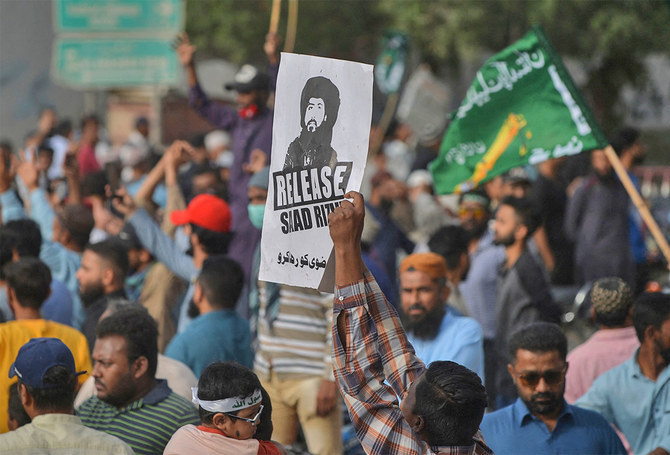
Supporters of Tehreek-e-Labbaik Pakistan (TLP) party take part in a protest in Karachi on October 24, 2021, demanding the release of their leader Hafiz Saad Hussain Rizvi, son of late Khadim Hussain Rizvi. (AFP)
Short Url
Updated 07 November 2021
Follow

Lahore anti-terror court grants bail to several leaders of banned TLP party 

  • Cases were registered against supporters and leaders of religious political party following violent protests
  • The government’s special prosecutor Abdul Rauf Watoo argued against the granting of bail

ISLAMABAD: An anti-terrorism court in the Pakistani city of Lahore on Saturday granted bail to several leaders of the banned Tehreek-i-Labbaik Pakistan (TLP) religious political party, local media reported.

TLP began a protest march last month calling for the release of the group’s leader Hafiz Saad Hussain Rizvi, who has been under arrest since April. The group also wants the expulsion of France’s ambassador over the publication of anti-Islam caricatures in a French satirical magazine last year.

Last Sunday, the group reached a deal with the government, ending more than a week of clashes with police that left at least six policemen dead and scores injured on both sides. The details of the pact have not been shared with the public by either side but it has been widely reported that the agreement includes a commitment by the government to release TLP leaders and supporters who are under arrest. 

Cases were registered against several TLP leaders following the latest round of violent protests. 

“Those who were granted bail included Maulana Farooqul Hassan, Ghulam Ghaus Baghdadi, Pir Zahirul Hassan, Maulana Sharifuddin, Engineer Hafeezullah Alvi, Maulana Abdul Razzaq, Mohammad Badar Munir, Qari Ashraf, Mohammad Akbar, Muzaffar Hussain, Mohammad Umar and Muzammil Hussain,” Dawn reported. “The court directed all the TLP leaders to submit bail bonds of Rs100,000 each.”

The government’s special prosecutor Abdul Rauf Watoo argued against the granting of bail.

TLP was founded in 2015 to tackle actions it considers blasphemous to Islam and has mounted multiple protest marches marred by bloodshed that have twice brought Islamabad to a standstill.

The government banned TLP in April this year after violent protests by the group in which at least six policemen were killed and 800 people were injured, according to government figures. After the protests, the government also agreed to have a parliamentary vote on kicking out the French ambassador but backtracked, with Prime Minister Imran Khan saying to take such action would isolate Pakistan internationally.

This Thursday, the provincial government of Punjab sent a summary to the provincial cabinet seeking its approval to lift the ban on TLP as early as possible: “If the opinion/approval will not be received from any minister in three days, it shall be deemed that the minister has accepted the recommendations contained in the summary,” the document read.

“Some 2,100 TLP activists have been released from police custody after the federal government-TLP agreement, the revocation of the group’s proscribed status will automatically remove around 8,000 TLP activists from the Fourth Schedule — a list on which suspects of terrorism and sectarianism are placed under the Anti-Terrorism Act (ATA) 1997,” Dawn said. 


Walnut tree remains ‘under arrest’ for over a century, living symbol of colonial power in Pakistan

Updated 4 sec ago
Follow

Walnut tree remains ‘under arrest’ for over a century, living symbol of colonial power in Pakistan

  • British officer is said to have ordered chaining of the tree in 1898, a reminder of the absolute authority and psychological control enforced under colonial rule in Khyber Pass region
  • Locals and historians say the shackled tree survives as a physical memory of the Frontier Crimes Regulation era, when even nature could be punished to discipline subjects and display power

LANDI KOTAL, KHYBER: In the military cantonment of Landi Kotal, close to Pakistan’s Torkham border crossing with Afghanistan and the mouth of the historic Khyber Pass, a single walnut tree stands bound in heavy iron chains.

It has been this way for more than a century, a surreal, almost absurd monument to the power structures and punitive imagination of the British Empire’s rule in the tribal frontier.

Black shackles still brace parts of its branches, giving it the appearance of a theatrical installation. To locals, it is a wound that never fully healed, a reminder that even nature could be punished when authority wished to show dominance.

Local oral histories trace the origin of this bizarre imprisonment to 1898, when a British officer named James Squid, allegedly intoxicated, believed the tree was moving toward him and instantly ordered it arrested. Soldiers carried out the instruction and the walnut tree has never been freed since.

Muhammad Sardar, the caretaker who oversees the site today, recounted the story as it has been passed down for generations.

“This British military official at that time was drunk and thought this walnut tree was moving toward him to attack him,” he told Arab News. “The officer ordered to arrest this tree, hence the soldiers had to obey the order and arrest this tree.”

Whether the event unfolded exactly as described is impossible to verify, but historians and residents agree on what the continued chaining represented: the unquestionable authority of colonial power.

A LAW THAT COULD BIND PEOPLE — AND TREES

Landi Kotal was one of the most militarized points of the British-controlled frontier, a strategic chokepoint along the Khyber Pass, a route armies, traders and empires have used for thousands of years. To control the region, the British introduced the Frontier Crimes Regulation (FCR), a law that denied locals the right to appeal, hire lawyers or challenge government decisions. Entire tribes could be punished for the suspected action of one member.

The chained walnut tree is often interpreted as a physical embodiment of that era: a warning made visible.

Dr. Syed Waqar Ali Shah, Assistant Professor of History at the University of Peshawar, said the symbolism was deliberate.

“It was an assertion of their [British] authority, it was a symbol of their power. Right. It’s a funny thing as well, because it’s something which was under the influence of some intoxication,” he explained.

“The officer behaved or gave orders for the imprisonment of that particular tree under the influence of some intoxicants.”

Dr. Shah continued:

“It was something which was a symbol of colonial authority, assertion of their authority, of bureaucratic diplomacy, a symbol of their bureaucratic strength and power, and maybe some cultural encounter as well.”

He added that such displays endured because “it was a cultural link between the locals and the colonial power. So it was a reflection of that. But later on, they continued with it in the presence of FCR (Frontier Crimes Regulation) and regulations like this.”

Even once the officer sobered, the chains remained.

Dr. Shah believes that was intentional: psychological messaging meant to instill conformity and fear in people living under colonial law.

“Their objective and purpose was to make it a symbol of discipline for the masses. It was an exhibition of power, a sheer exhibition of power, a symbol that if we can do this to something which was inhuman … if they can deal with a tree like this, so the general public, they should be aware that discipline is very important.”

Landi Kotal’s older residents say their fathers and grandfathers retold the story long before Pakistan existed and long before independence movements dismantled the Raj.

Usman Khan Shinwari, a 26-year-old shopkeeper, said the story continues to live in households like a family inheritance.

“My grandfather would often narrate this story of the arrested tree,” he recalled. “My grandfather would say that it shows how the then rulers were treating the locals and what our ancestors had endured.”

Over a century later, long after the end of British rule and the formal abolition of the Frontier Crimes Regulation in 2018, the walnut tree remains exactly where it was chained, part spectacle, part scar.

Tourists sometimes come to photograph it. Others stand silently before it.

But for many in Khyber, it is neither attraction nor curiosity.

It is proof that power once flowed one way only. A tree could be punished, so people learned not to resist.