Lahore anti-terror court grants bail to several leaders of banned TLP party 

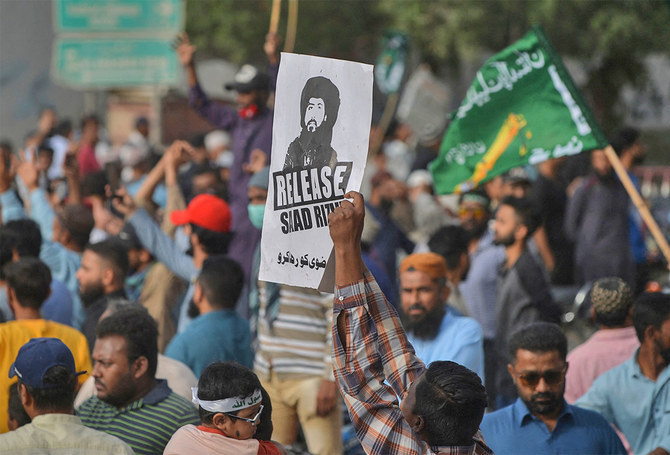
Supporters of Tehreek-e-Labbaik Pakistan (TLP) party take part in a protest in Karachi on October 24, 2021, demanding the release of their leader Hafiz Saad Hussain Rizvi, son of late Khadim Hussain Rizvi. (AFP)
Short Url
Updated 07 November 2021
Follow

Lahore anti-terror court grants bail to several leaders of banned TLP party 

  • Cases were registered against supporters and leaders of religious political party following violent protests
  • The government’s special prosecutor Abdul Rauf Watoo argued against the granting of bail

ISLAMABAD: An anti-terrorism court in the Pakistani city of Lahore on Saturday granted bail to several leaders of the banned Tehreek-i-Labbaik Pakistan (TLP) religious political party, local media reported.

TLP began a protest march last month calling for the release of the group’s leader Hafiz Saad Hussain Rizvi, who has been under arrest since April. The group also wants the expulsion of France’s ambassador over the publication of anti-Islam caricatures in a French satirical magazine last year.

Last Sunday, the group reached a deal with the government, ending more than a week of clashes with police that left at least six policemen dead and scores injured on both sides. The details of the pact have not been shared with the public by either side but it has been widely reported that the agreement includes a commitment by the government to release TLP leaders and supporters who are under arrest. 

Cases were registered against several TLP leaders following the latest round of violent protests. 

“Those who were granted bail included Maulana Farooqul Hassan, Ghulam Ghaus Baghdadi, Pir Zahirul Hassan, Maulana Sharifuddin, Engineer Hafeezullah Alvi, Maulana Abdul Razzaq, Mohammad Badar Munir, Qari Ashraf, Mohammad Akbar, Muzaffar Hussain, Mohammad Umar and Muzammil Hussain,” Dawn reported. “The court directed all the TLP leaders to submit bail bonds of Rs100,000 each.”

The government’s special prosecutor Abdul Rauf Watoo argued against the granting of bail.

TLP was founded in 2015 to tackle actions it considers blasphemous to Islam and has mounted multiple protest marches marred by bloodshed that have twice brought Islamabad to a standstill.

The government banned TLP in April this year after violent protests by the group in which at least six policemen were killed and 800 people were injured, according to government figures. After the protests, the government also agreed to have a parliamentary vote on kicking out the French ambassador but backtracked, with Prime Minister Imran Khan saying to take such action would isolate Pakistan internationally.

This Thursday, the provincial government of Punjab sent a summary to the provincial cabinet seeking its approval to lift the ban on TLP as early as possible: “If the opinion/approval will not be received from any minister in three days, it shall be deemed that the minister has accepted the recommendations contained in the summary,” the document read.

“Some 2,100 TLP activists have been released from police custody after the federal government-TLP agreement, the revocation of the group’s proscribed status will automatically remove around 8,000 TLP activists from the Fourth Schedule — a list on which suspects of terrorism and sectarianism are placed under the Anti-Terrorism Act (ATA) 1997,” Dawn said. 


Pakistan, global crypto exchange discuss modernizing digital payments, creating job prospects 

Updated 05 December 2025
Follow

Pakistan, global crypto exchange discuss modernizing digital payments, creating job prospects 

  • Pakistani officials, Binance team discuss coordination between Islamabad, local banks and global exchanges
  • Pakistan has attempted to tap into growing crypto market to curb illicit transactions, improve oversight

ISLAMABAD: Pakistan’s finance officials and the team of a global cryptocurrency exchange on Friday held discussions aimed at modernizing the country’s digital payments system and building local talent pipelines to meet rising demand for blockchain and Web3 skills, the finance ministry said.

The development took place during a high-level meeting between Finance Minister Muhammad Aurangzeb, Pakistan Virtual Assets Regulatory Authority (PVARA) Chairman Bilal bin Saqib, domestic bank presidents and a Binance team led by Global CEO Richard Teng. The meeting was held to advance work on Pakistan’s National Digital Asset Framework, a regulatory setup to govern Pakistan’s digital assets.

Pakistan has been moving to regulate its fast-growing crypto and digital assets market by bringing virtual asset service providers (VASPs) under a formal licensing regime. Officials say the push is aimed at curbing illicit transactions, improving oversight, and encouraging innovation in blockchain-based financial services.

“Participants reviewed opportunities to modernize Pakistan’s digital payments landscape, noting that blockchain-based systems could significantly reduce costs from the country’s $38 billion annual remittance flows,” the finance ministry said in a statement. 

“Discussions also emphasized building local talent pipelines to meet rising global demand for blockchain and Web3 skills, creating high-value employment prospects for Pakistani youth.”

Blockchain is a type of digital database that is shared, transparent and tamper-resistant. Instead of being stored on one computer, the data is kept on a distributed network of computers, making it very hard to alter or hack.

Web3 refers to the next generation of the Internet built using blockchain, focusing on giving users more control over their data, identity and digital assets rather than big tech companies controlling it.

Participants of the meeting also discussed sovereign debt tokenization, which is the process of converting a country’s debt such as government bonds, into digital tokens on a blockchain, the ministry said. 

Aurangzeb called for close coordination between the government, domestic banks and global exchanges to modernize Pakistan’s payment landscape.

Participants of the meeting also discussed considering a “time-bound amnesty” to encourage users to move assets onto regulated platforms, stressing the need for stronger verifications and a risk-mitigation system.

Pakistan has attempted in recent months to tap into the country’s growing crypto market, crack down on money laundering and terror financing, and promote responsible innovation — a move analysts say could bring an estimated $25 billion in virtual assets into the tax net.

In September, Islamabad invited international crypto exchanges and other VASPs to apply for licenses to operate in the country, a step aimed at formalizing and regulating its fast-growing digital market.