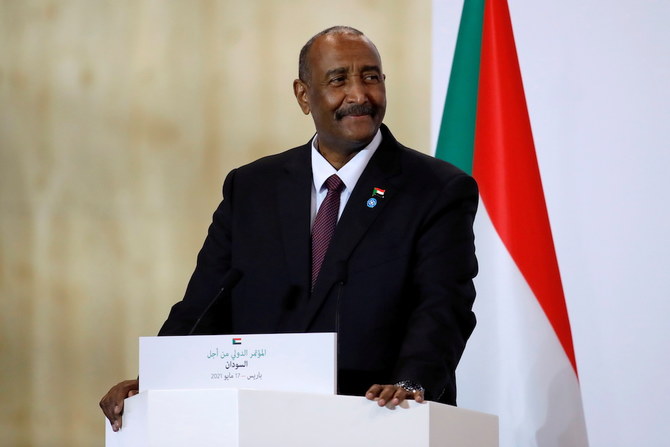
NEW YORK/CAIRO: Sudanese army chief Abdel Fattah Al-Burhan ordered the release of four civilian members of the ousted government of Abdallah Hamdok, state television said on Thursday.
Ministers Hamza Baloul, Ali Jiddo, Hashim Hasabalrasoul and Yousef Adam were ordered released, it added.
The move came following a call with UN Secretary-General Antonio Guterres, where he urged Burhan to release “Hamdok and other civilians arbitrarily detained in Sudan,” a UN spokesperson said.
Speaking during the call, Guterres said he encouraged the developments of all efforts toward resolving the political crisis in the north African country, and called to urgently restore the constitutional order and Sudan’s transitional process.
The secretary-general reaffirmed that the UN “will continue to stand with the people of Sudan as they strive to fulfill their aspirations for a peaceful, prosperous and democratic future.”
Burhan pledged to “maintain the peace and inevitability of the democratic transition and to complete the transition process in a manner that preserves the security of the country, the gains of the revolution, and to reach an elected civilian government,” Sudan’s state news agency reported.
Meanwhile, the UN special envoy for Sudan said talks had produced the contours of a potential deal on a return to power-sharing, including restoration of the ousted prime minister, but it had to be agreed in “days not weeks” before the positions of both sides harden.
The UN has been coordinating efforts to find a way out of the country’s crisis following a coup by the military on Oct. 25 in which top civilian politicians were detained and Hamdok was placed under house arrest.
Disclosing the “contours” of a potential deal publicly for the first time, the envoy, Volker Perthes, said these included: the return of Hamdok to office, the release of detainees, the lifting of a state of emergency, as well as adjustments to some transitional institutions and a new technocratic cabinet.
“The longer you wait the more difficult it is to implement such an agreement and get the necessary buy in from the street and from the political forces,” Perthes, special representative of the Secretary General and head of the UN’s Integrated Transition Mission in Sudan (UNITAMS), said in an interview.
“It will also become more difficult for the military, as pressures to appoint some government, whatever its credibility, will increase. And the positions of both sides would harden. We are speaking of days not of weeks,” he added.
“Now the question is, are both sides willing to commit to that. Here we still have at least a few hiccups,” Perthes told Reuters.
The talks effectively represented “the last chance,” for the military to come to a negotiated deal, Perthes said, adding that there appeared to be discussions inside the military on whether or not to take advantage of it.
(With Reuters)


![]()

Sudan’s Burhan orders release of 4 civilian cabinet ministers after call with UN chief
Short Url
https://arab.news/rmuds
Sudan’s Burhan orders release of 4 civilian cabinet ministers after call with UN chief
- Antonio Guterres urges the restoration of constitutional order and the transitional process
- UN special envoy says Sudan deal under discussion, needed in ‘days not weeks’


Latest updates


Recommended


© 2026 SAUDI RESEARCH & PUBLISHING COMPANY, All Rights Reserved And subject to Terms of Use Agreement.