



Bubble is a web proximity-based solution where users can have simultaneous conversations. Audio sharpens as you approach others and fades away as you move away; Just like real life. It is used for meetings, conferences, training, classrooms and more.
Last Link is a Technology and Production virtual event company that was established in June 2020. It came up with the idea for Bubble in May 2021.
Their biggest client in the kingdom today is Ithra in their yearly thematic innovation program, Creative Solutions.
It was founded by Taqi Sleel, the firm's Chief Operating Officer, and his fellow co-founders Vish Kashi and Pavan Thanai.
The concept of Bubble is new and first of its kind in the Kingdom, although a few similar companies exist in Europe and North America.
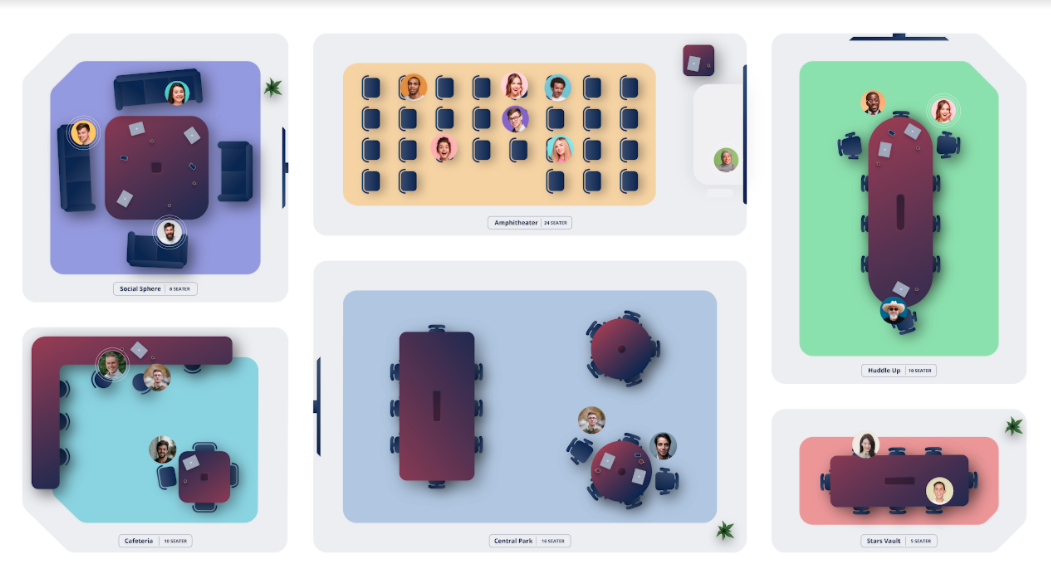
Bubble recreates real-life experience in training or workshops where participants walk into a room and move around freely to interact with one another all virtually.
Multiple participants can simultaneously form different groups, all in one room. They can see each other but only hear those who are close to them.
“Since the pandemic thrusted virtual solutions on us, the shift towards virtual events has been a struggle for many - not the least for the training and workshop organizers,” Sleel told Arab News.
He explained that for such events, engagement is an important factor, but has been difficult to achieve in a way that is similar to the pre-pandemic era.
“The future is already being shaped where many enterprises have already adopted virtual training and workshops, and are in the process of going fully virtual or hybrid. Not to mention, enterprises are already seeing the benefits of remote work, remote learning and virtual events.,” he said.
Since September 2020, Last Link has worked with more than 40 clients and produced more than 300 training workshops.
“Our experience has taught us what is lacking and what needs to be improved. We know that engagement is an important factor in such settings, but virtually it is difficult for participants to engage properly,” he said.
Bubble allows multiple presentations to be held at once. Other useful tools offered by Bubble are pinning different types of files, use of whiteboards, a megaphone to allow announcements, and chat.
“As an example, we recently produced a training workshop for twenty participants and two instructors. Participants joined Bubble in a specific lobby area assigned by the instructors. At this stage, all users appear as bubbles with their video on. The instructors used the megaphone, which enabled them to speak to all participants irrespective of where in the lobby the bubbles (participants) were,” he explained.
“Upon informing the participants about the task, they formed small groups in each corner of the lobby and embarked on the task. The instructors could easily oversee the work, and move effortlessly among the groups to follow the discussions as well as provide support for the participants. When the participants finished the task they moved to the center of the lobby,” he added.
Bubble is currently in beta and has more than 25 enterprises using the product today and is officially launching in January 2022.


