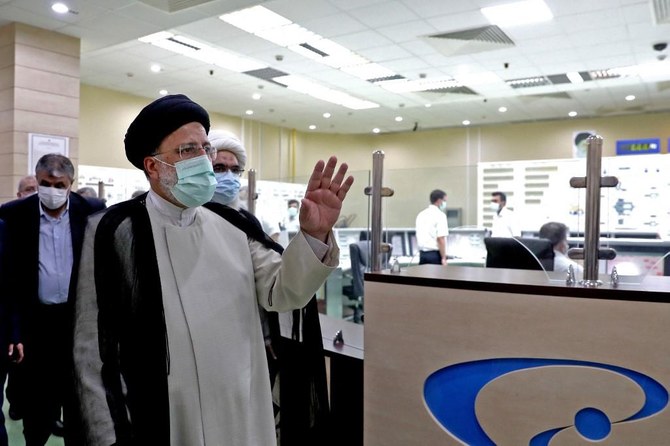
TEHRAN: Iranian President Ebrahim Raisi warned Western governments Thursday he would accept no “excessive demands” in nuclear talks set to resume later this month after a five-month gap.
Diplomats on Wednesday finally announced the November 29 start date for renewed negotiations after a protracted delay since the June election of Raisi, an ultraconservative.
“We will not walk away from the negotiating table but we will also oppose any excessive demands that would end up harming the interests of the Iranian people,” Raisi said.
“We will not retreat in any way when it comes to interests of the Iranian people but will continue our efforts to neutralize the oppressive sanctions and are taking action to have them lifted.”
Raisi was speaking at a ceremony in the city of Semnam, east of the capital, marking the anniversary of the 1979 seizure of the US embassy in Tehran by radical students, an episode that still clouds relations.
The nuclear talks, which are being brokered by European mediators as Tehran refuses to deal with US negotiators directly, are aimed at bringing Washington back into a 2015 agreement with Iran that was abandoned by former president Donald Trump.
President Joe Biden has said he is ready to rejoin the deal under which Iran agreed to strict limits on its nuclear activities in exchange for relief from sweeping sanctions, but the two sides remain at odds over the details.
Iran wants a lifting of all US sanctions but the Biden administration says that it will only negotiate measures taken by Trump over the nuclear program, such as a unilateral ban on oil sales – not steps imposed on other concerns such as human rights.
Iran also wants commitments that the United States will remain bound by the deal – an unlikely proposition in Washington, where Trump’s Republican Party fiercely opposes Biden’s diplomacy with Iran.
Washington insists that Tehran must return to full compliance with the limits on its nuclear program it agreed in 2015 and has warned repeatedly that the window of opportunity for a deal is fast closing.


Iran’s Raisi warns West against ‘excessive’ nuclear demands
https://arab.news/ptrtq
Iran’s Raisi warns West against ‘excessive’ nuclear demands

- ‘We will not walk away from the negotiating table but we will also oppose any excessive demands that would end up harming the interests of the Iranian people’


Syria’s leader set to visit Berlin with deportations in focus
- Sharaa is scheduled to meet his counterpart Frank-Walter Steinmeier, the German president’s office said
BERLIN: Syrian President Ahmed Al-Sharaa is expected in Berlin on Tuesday for talks, as German officials seek to step up deportations of Syrians, despite unease about continued instability in their homeland.
Sharaa is scheduled to meet his counterpart Frank-Walter Steinmeier, the German president’s office said.
Chancellor Friedrich Merz’s office has yet to announce whether he would also hold talks with Sharaa during the visit.
Since ousting Syria’s longtime leader Bashar Assad in late 2024, Sharaa has made frequent overseas trips as the former Islamist rebel chief undergoes a rapid reinvention.
He has made official visits to the United States and France, and a series of international sanctions on Syria have been lifted.
The focus of next week’s visit for the German government will be on stepping up repatriations of Syrians, a priority for Merz’s conservative-led coalition since Assad was toppled.
Roughly one million Syrians fled to Germany in recent years, many of them arriving in 2015-16 to escape the civil war.
In November Merz, who fears being outflanked by the far-right AfD party on immigration, insisted there was “no longer any reason” for Syrians who fled the war to seek asylum in Germany.
“For those who refuse to return to their country, we can of course expel them,” he said.
- ‘Dramatic situation’ -
In December, Germany carried out its first deportation of a Syrian since the civil war erupted in 2011, flying a man convicted of crimes to Damascus.
But rights groups have criticized such efforts, citing continued instability in Syria and evidence of rights abuses.
Violence between the government and minority groups has repeatedly flared in multi-confessional Syria since Sharaa came to power, including recent clashes between the army and Kurdish forces.
Several NGOs, including those representing the Kurdish and Alawite Syrian communities in Germany, have urged Berlin to axe Sharaa’s planned visit, labelling it “totally unacceptable.”
“The situation in Syria is dramatic. Civilians are being persecuted solely on the basis of their ethnic or religious affiliation,” they said in a joint statement.
“It is incomprehensible to us and legally and morally unacceptable that the German government knowingly intends to receive a person suspected of being responsible for these acts at the chancellery.”
The Kurdish Community of Germany, among the signatories of that statement, also filed a complaint with German prosecutors in November, accusing Sharaa of war crimes, genocide and crimes against humanity.
There have also been voices urging caution within government.
On a trip to Damascus in October, Foreign Minister Johann Wadephul said that the potential for Syrians to return was “very limited” since the war had destroyed much of the country’s infrastructure.
But his comments triggered a backlash from his own conservative Christian Democratic Union party.


