

Pakistan to register thousands of grocery stores to disburse $700 million relief package — minister

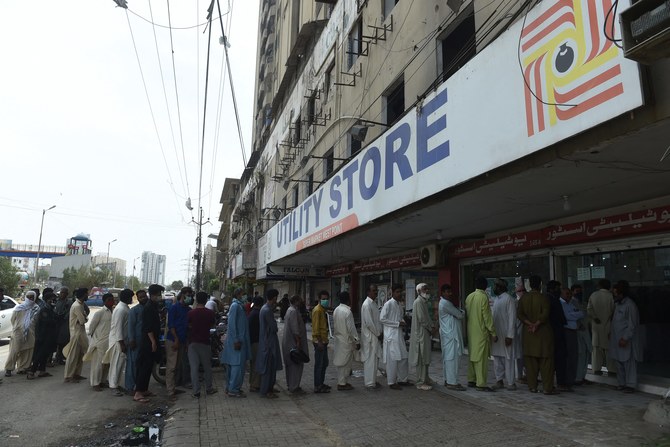
People stand in a queue outside a state-run utility store to buy groceries in Karachi, Pakistan on March 25, 2020. (AFP/File)
Short Url
Updated 05 November 2021
Follow

Pakistan to register thousands of grocery stores to disburse $700 million relief package — minister

  • Disbursement would be made on direct purchase from grocery stores across the country 
  • Pakistan’s ‘biggest’ relief program to reach 20 million families, mitigate inflation caused by rising commodity prices 

KARACHI: Pakistan will register thousands of grocery stores across the country to disburse over Rs120 billion ($700 million) under the government’s new relief package, the information minister said on Thursday.

Prime Minister Imran Khan on Wednesday announced the package as the “biggest welfare program in Pakistan’s history” to mitigate the impact of surging commodity prices due to the global price hikes and rising inflation.

The prime minister’s announcement came as the statistics bureau announced that Pakistan’s annual inflation rate rose to 9.2 percent in October, compared with 9 percent in the previous month and 8.9 percent in October 2020.
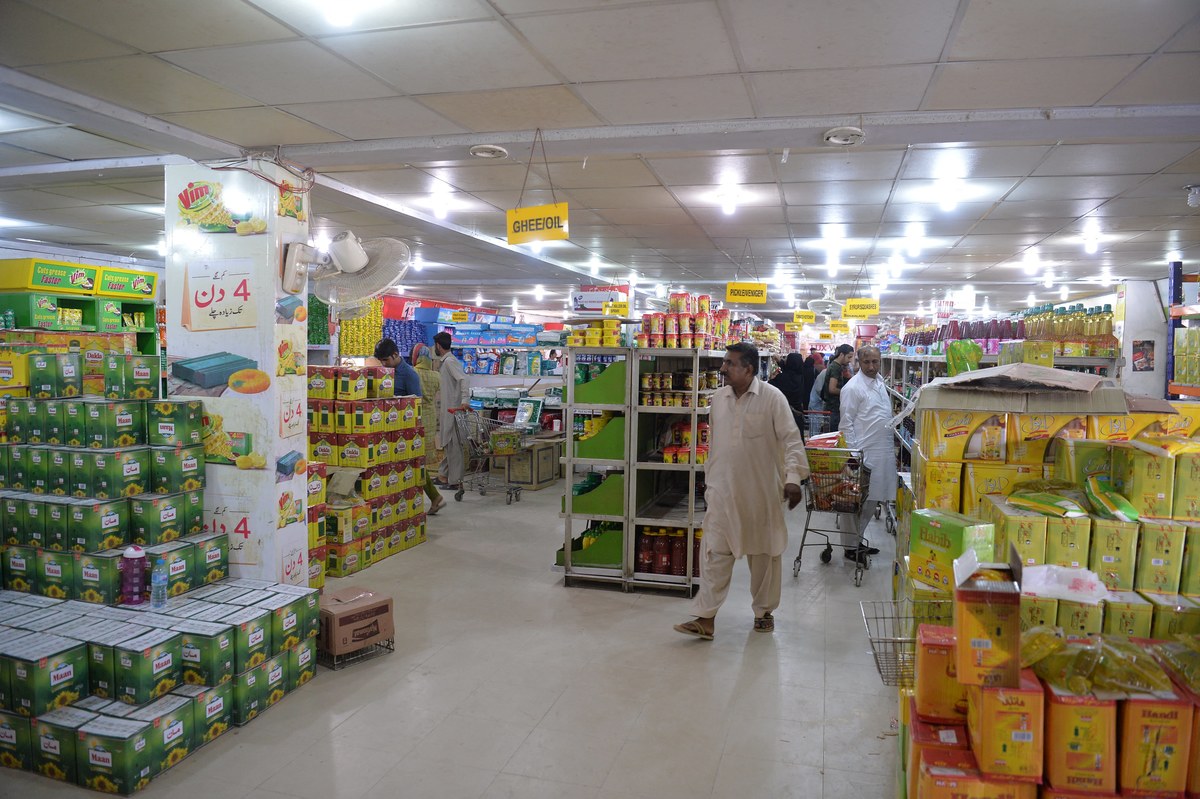


Pakistanis buy food items at a utility store with government-controlled prices in Islamabad on May 16, 2018. (AFP/File)

The subsidy is expected to provide relief to 20 million families, or 130 million people, offering them a 30 percent discount on per unit purchases of three basic edible items: ghee, wheat, and pulses for six months. 

“The national bank will register karyana (grocery) stores,” Information Minister Fawad Chaudhry told Arab News. “Thousands of karyana stores will be registered.”

“The eligibility would be that the store owner would have his own bank account and should have at least a smartphone on which he would download an app.”

The stores, Chaudhry said, will be linked with the government’s poverty alleviation Ehsaas program database, which has identity data of individuals eligible to receive aid.

“The store owner will feed the National Identity Card number of the person through the app and if the person’s identity card matches with the Ehsaas database information, he will get subsidy on three items, flour, ghee and pulses,” Chaudhry said. 

“The amount (of subsidy) will be transferred from the Ehsaas account to the store owner account directly.”
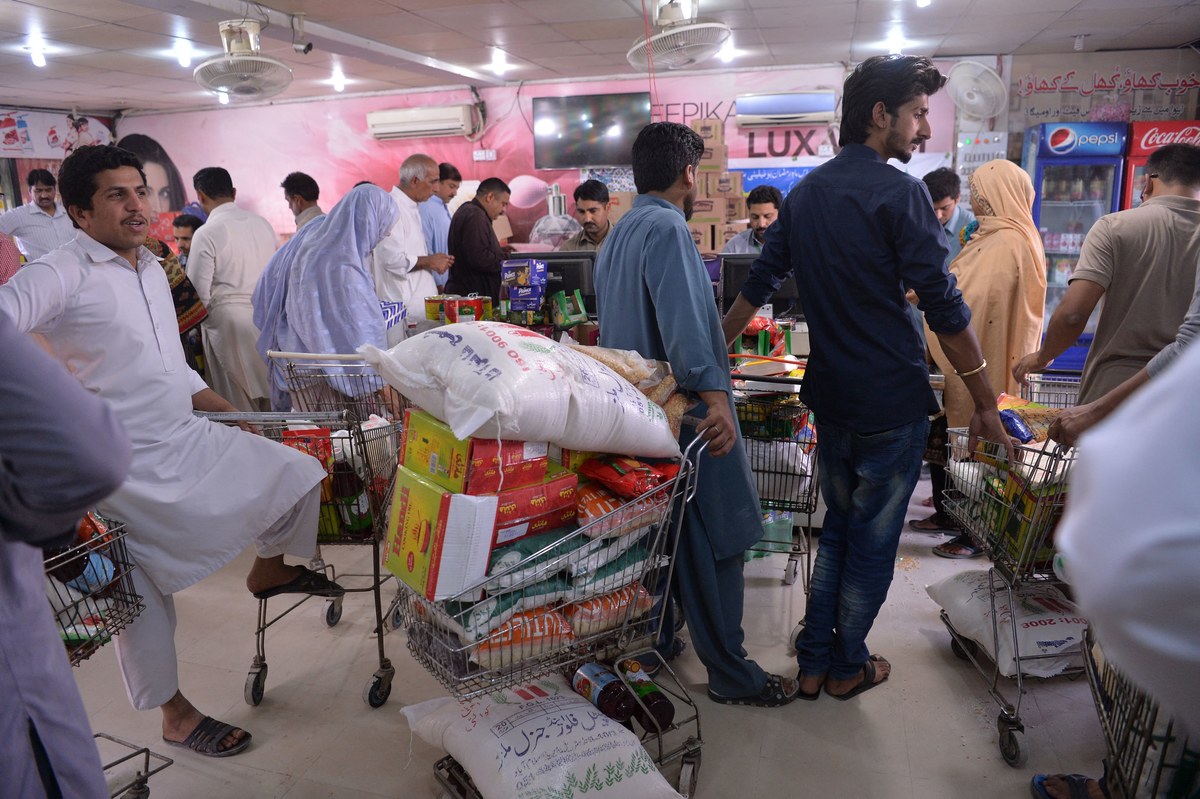


People buy food items at a government-run utility store in Islamabad, Pakistan, on May 16, 2018. (AFP/File)

Analysts say the prime minister’s new relief package will provide a cushion to people affected by high prices and decreasing purchasing power. 

Samiullah Tariq, research director at Pakistan Kuwait Investment, said the targeted subsidy is a “good attempt to insulate bottom tier of population from inflation.” 

Tahir Abbas, the head of research at Arif Habib Limited, a Pakistani securities brokerage and investment banking firm, told Arab News the program will “cushion the lower strata of the society by providing them essential items at subsidized rates.”

“With the high inflation, societies in general witnessed a significant dip in the purchasing power. This announcement will counter that problem,” he said, but added that allocating an additional Rs 120 billion for the purpose “will put pressure on the fiscal side.”
 
Some, however, raise concerns over the program’s implementation.

Khurram Schehzad, chief executive of financial advisory firm Alpha Beta Core, told Arab News the relief package was a “good initiative,” but “the implementation of the package will be a key challenge.”

For Dr. Umair Javed from the Lahore University of Management Sciences (LUMS), the disbursement of aid would be better through cash.

“The implementation challenges remain in almost every such initiative, the most suitable way would be to implement it through cash subsidies to the targeted families,” he said. “With Rs120 billion, it would be hard to fight the commodity inflation and the most effective mechanism is to give them cash in their hands.”

Senior economist Dr. Farrukh Saleem said the aid amount may be also too small to provide relief.

“If we calculate the disbursement, the amount would be Rs5 per person per day,” he said. “This is too small as compared to the inflation rate.”

But Dr. Sajid Amin Javed, senior economist at the Sustainable Development Policy Institute, said that regardless of the amount, the initiative was positive, as he also argued that direct cash transfers would be more effective as they would cut down the implementation cost.

“Irrespective of the amount it is positive step that people are getting some relief amid price spike. Social protection is the prime responsibility of government,” he said. “The duration should be extended beyond six months because inflation is going to stay for at least a year.”


Imran Khan’s party shutdown draws mixed response; government calls it ‘ineffective’

Updated 14 min 48 sec ago
Follow

Imran Khan’s party shutdown draws mixed response; government calls it ‘ineffective’

  • Ex-PM Khan’s PTI party had called for a ‘shutter-down strike’ to protest Feb. 8, 2024 general election results
  • While businesses reportedly remained closed in Khyber Pakhtunkhwa, they continued as normal elsewhere

ISLAMABAD: A nationwide “shutter-down strike” called by former prime minister Imran Khan’s party drew a mixed response in Pakistan on Sunday, underscoring political polarization in the country two years after a controversial general election.

Khan’s Pakistan Tehreek-e-Insaf (PIT) opposition party had urged the masses to shut businesses across the country to protest alleged rigging on the second anniversary of the Feb. 8, 2024 general election.

Local media reported a majority of businesses remained closed in the Khyber Pakhtunkhwa (KP) province, governed by the PTI, while business continued as normal in other provinces as several trade associations distanced themselves from the strike call.

Arab News visited major markets in Islamabad’s G-6, G-9, I-8 and F-6 sectors, as well as commercial hubs in Rawalpindi, which largely remained operational on Sunday, a public holiday when shops, restaurants and malls typically remain open in Pakistan.

“Pakistan’s constitution says people will elect their representatives. But on 8th February 2024, people were barred from exercising their voting right freely,” Allama Raja Nasir Abbas Jafri, the PTI opposition leader in the Senate, said at a protest march near Islamabad’s iconic Faisal Mosque.

Millions of Pakistanis voted for national and provincial candidates during the Feb. 8, 2024 election, which was marred by a nationwide shutdown of cellphone networks and delayed results, leading to widespread allegations of election manipulation by the PTI and other opposition parties. The caretaker government at the time and the Election Commission of Pakistan (ECP) both rejected the allegations.

Khan’s PTI candidates contested the Feb. 8 elections as independents after the party was barred from the polls. They won the most seats but fell short of the majority needed to form a government, which was made by a smattering of rival political parties led by Prime Minister Shehbaz Sharif. The government insists the polling was conducted transparently and that Khan’s party was not denied a fair chance.

Authorities in the Pakistani capital deployed a heavy police contingent on the main road leading to the Faisal Mosque on Sunday. Despite police presence and the reported arrest of some PTI workers, Jafri led local PTI members and dozens of supporters who chanted slogans against the government at the march.

“We promise we will never forget 8th February,” Jafri said.

The PTI said its strike call was “successful” and shared videos on official social media accounts showing closed shops and markets in various parts of the country.

The government, however, dismissed the protest as “ineffective.”

“The public is fed up with protest politics and has strongly rejected PTI’s call,” Pakistan’s Information Minister Attaullah Tarar said on X.

“It’s Sunday, yet there is still hustle and bustle.”

Ajmal Baloch, All Pakistan Traders Association president, said they neither support such protest calls, nor prevent individuals from closing shops based on personal political affiliation.

“It’s a call from a political party and we do not close businesses on calls of any political party,” Baloch told Arab News.

“We only give calls of strike on issues related to traders.”

Khan was ousted from power in April 2022 after what is widely believed to be a falling out with the country’s powerful generals. The army denies it interferes in politics. Khan has been in prison since August 2023 and faces a slew of legal challenges that ruled him out of the Feb. 8 general elections and which he says are politically motivated to keep him and his party away from power.

In Jan. 2025, an accountability court convicted Khan and his wife in the £190 million Al-Qadir Trust land corruption case, sentencing him to 14 years and her to seven years after finding that the trust was used to acquire land and funds in exchange for alleged favors. The couple denies any wrongdoing.