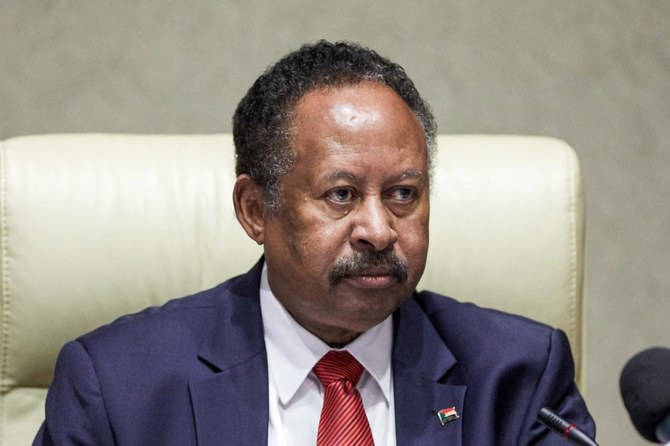
CAIRO: The Sudanese army is still negotiating with the prime minister ousted in a coup last week over an agreement that could see him return as premier, sources close to him said on Wednesday.
The souces denied a report that Abdalla Hamdok had agreed to return to lead a government.
Hamdok has been under house arrest since his government was toppled by military chief General Abdel Fattah al-Burhan in the coup which derailed a transition towards civilian rule and led Western donors to freeze aid.
Mediation efforts have been underway for several days in search of a negotiated way out of the crisis.
The source close to Hamdok said on Wednesday no agreement had been reached between him and military leaders and talks were still going on.
Earlier, the Saudi-owned al Arabiya TV, quoting unnamed sources, said Hamdok had agreed to return to lead a government.
In a separate report, a media outlet affiliated with al Arabiya, al Hadath TV, said Hamdok wanted political detainees released as a condition for agreeing to lead a government.
Sources who met with Hamdok last week said he was seeking the reversal of the coup and the release of detainees before the possibility of further talks.

Sudan’s ousted PM Hamdok and army still in talks, no deal yet, sources say
https://arab.news/g7dgf
Sudan’s ousted PM Hamdok and army still in talks, no deal yet, sources say
- Hamdok agreed to make the move on the condition that political detainees were released
The UN says Al-Hol camp population has dropped sharply as Syria moves to relocate remaining families
- Forces of Syria’s central government captured the Al-Hol camp on Jan. 21 during a weekslong offensive against the SDF, which had been running the camp near the border with Iraq for a decade
DAMASCUS: The UN refugee agency said Sunday that a large number of residents of a camp housing family members of suspected Daesh group militants have left and the Syrian government plans to relocate those who remain.
Gonzalo Vargas Llosa, UNHCR’s representative in Syria, said in a statement that the agency “has observed a significant decrease in the number of residents in Al-Hol camp in recent weeks.”
“Syrian authorities have informed UNHCR of their plan to relocate the remaining families to Akhtarin camp in Aleppo Governorate (province) and have requested UNHCR’s support to assist the population in the new camp, which we stand ready to provide,” he said.
He added that UNHCR “will continue to support the return and reintegration of Syrians who have departed Al-Hol, as well as those who remain.”
The statement did not say how residents had left the camp or how many remain. Many families are believed to have escaped either during the chaos when government forces captured the camp from the Kurdish-led Syrian Democratic Forces last month or afterward.
There was no immediate statement from the Syrian government and a government spokesperson did not respond to a request for comment.
At its peak after the defeat of IS in Syria in 2019, around 73,000 people were living at Al-Hol. Since then, the number has declined with some countries repatriating their citizens. The camp’s residents are mostly children and women, including many wives or widows of IS members.
The camp’s residents are not technically prisoners and most have not been accused of crimes, but they have been held in de facto detention at the heavily guarded facility.
Forces of Syria’s central government captured the Al-Hol camp on Jan. 21 during a weekslong offensive against the SDF, which had been running the camp near the border with Iraq for a decade. A ceasefire deal has since ended the fighting.
Separately, thousands of accused IS militants who were held in detention centers in northeastern Syria have been transferred to Iraq to stand trial under an agreement with the US
The US military said Friday that it had completed the transfer of more than 5,700 adult male IS suspects from detention facilities in Syria to Iraqi custody.
Iraq’s National Center for International Judicial Cooperation said a total of 5,704 suspects from 61 countries who were affiliated with IS — most of them Syrian and Iraqi — were transferred from prisons in Syria. They are now being interrogated in Iraq.


