

‘The world is watching,’ US tells Sudan’s military

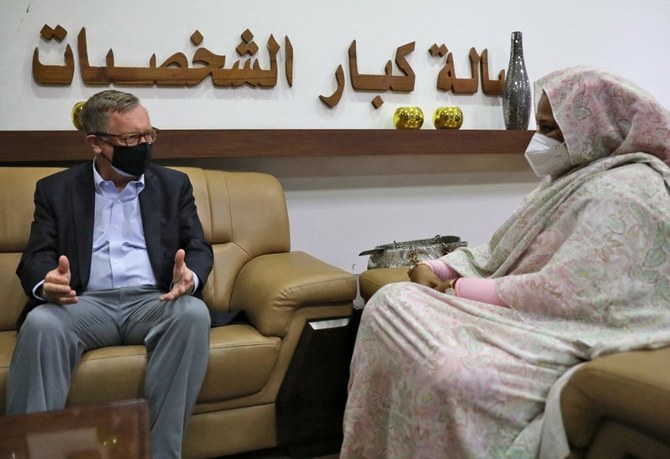
US special envoy for the Horn of Africa Jeffrey Feltman on Tuesday urged Sudan’s military to re-establish civilian rule, warning that “the world is watching.” (File/AFP)
Short Url
Updated 02 November 2021
Follow

‘The world is watching,’ US tells Sudan’s military

  • October coup was ‘grave setback,’ envoy tells briefing attended by Arab News
  • Jeffrey Feltman calls for ‘immediate restoration of democratic governance’

LONDON: The US special envoy for the Horn of Africa on Tuesday urged Sudan’s military to re-establish civilian rule, warning that “the world is watching.”

At a press briefing attended by Arab News, Jeffrey Feltman said: “The events of Oct. 25 in Sudan and the days since are a grave setback. The United States will continue to stand with the people of Sudan in their non-violent struggle to advance the goals of Sudan’s revolution.”

On Oct. 25, military leaders dissolved Sudan’s transitional government and detained its civilian leaders, who had been steering the country toward democratic rule.

Prime Minister Abdalla Hamdok, who had been calling for full civilian rule to replace the civil-military power-sharing that had been in place since the 2019 revolution, was confined to house arrest. 

“We remain extremely concerned about Sudan’s democratic trajectory after the military takeover,” Feltman said, adding that the military has “hijacked and betrayed the aspirations of the Sudanese people for a peaceful, democratic country, as evidenced by the 2019 peaceful revolution and enshrined in that year’s constitutional declaration.” 

The 2019 revolution saw the overthrow of dictator Omar Bashir after three decades in power. A large-scale civilian-led movement engaged in peaceful protest and civil disobedience for months until the military enacted a coup against him. 

The transitional government was then formed, comprising both civilian and military leaders and aimed at delivering long-term stability and democracy. 

Feltman said the international community is largely in agreement in its support for the civilian government. 

“The international community, from the African Union, to the Arab League, to the UN Security Council and to international financial institutions, have signaled loudly their deep concern about the military’s unconscionable actions,” he added. “We join them in calling for the immediate restoration of democratic governance in Sudan.” 

Since the October coup, protests have seen many Sudanese people killed and injured at the hands of security forces. 

“We urge the military to release all civilians detained in connection with the unacceptable events of Oct. 25, and to ensure that any who had been injured receive necessary medical care without interference,” Feltman said. 

The US has previously suspended huge amounts of funding it had been providing to the new Sudanese government, but Feltman said humanitarian aid is exempt from this. 

“I’ve admired the courage of the Sudanese people in demanding that their voices are heard, and in helping their country make strides toward a new democratic Sudan,” he added. 

“To those freedom-loving Sudanese, and to those that would seek to rob them of their democratic ambition, I say: The world is watching.”


Death toll rises to at least 10 in violence around Iran protests

Updated 58 min 48 sec ago
Follow

Death toll rises to at least 10 in violence around Iran protests

  • The weeklong protests, have become the biggest in Iran since 2022, when the death of 22-year-old Mahsa Amini in police custody triggered nationwide demonstrations

DUBAI: Violence surrounding protests in Iran sparked by the Islamic Republic’s ailing economy killed two other people, authorities said Saturday, raising the death toll in the demonstrations to at least 10 as they showed no signs of stopping.
The new deaths follow US President Donald Trump warning Iran on Friday that if Tehran “violently kills peaceful protesters,” the United States “will come to their rescue.” While it remains unclear how and if Trump will intervene, his comments sparked an immediate, angry response from officials within the theocracy threatening to target American troops in the Mideast.
The weeklong protests, have become the biggest in Iran since 2022, when the death of 22-year-old Mahsa Amini in police custody triggered nationwide demonstrations. However, the protests have yet to be as widespread and intense as those surrounding the death of Amini, who was detained over not wearing her hijab, or headscarf, to the liking of authorities.
The deaths overnight into Saturday involved a new level of violence. In Qom, home to the country’s major Shiite seminaries, a grenade exploded, killing a man there, the state-owned IRAN newspaper reported. It quoted security officials alleging the man carried the grenade to attack people in the city, some 130 kilometers (80 miles) south of the capital, Tehran.
Online videos from Qom purportedly showed fires in the street overnight.
The second death happened in the town of Harsin, some 370 kilometers (230 miles) southwest of Tehran. There, the newspaper said a member of the Basij, the all-volunteer arm of Iran’s paramilitary Revolutionary Guard, died in a gun and knife attack in the town in Kermanshah province.
Demonstrations have reached over 100 locations in 22 of Iran’s 31 provinces, the US-based Human Rights Activists News Agency reported.
Iran’s civilian government under reformist President Masoud Pezeshkian has been trying to signal it wants to negotiate with protesters. However, Pezeshkian has acknowledged there is not much he can do as Iran’s rial has rapidly depreciated, with $1 now costing some 1.4 million rials. That sparked the initial protests.