GLASGOW: Leaders at the COP26 global climate conference in Glasgow have pledged to stop deforestation by the end of the decade and slash emissions of the potent greenhouse gas methane to help slow climate change.
The inability of major powers so far to agree more broadly on rapid reductions in the use of fossil fuels, the main cause of manmade global warming, has upset the poorer, smaller countries likely to suffer its worst effects.
Surangel Whipps Jr, president of Palau, a Pacific state of 500 low-lying islands under threat from rising sea levels, told the leaders of the G20 industrial powers in a speech: “We are drowning and our only hope is the life-ring you are holding.”
Nearly 90 countries have joined a US- and EU-led effort to slash emissions of methane 30 percent by 2030 from 2020 levels, a senior Biden administration official said ahead of a formal announcement on Tuesday.
Methane is more short-lived in the atmosphere than carbon dioxide but 80 times more potent in warming the earth. Cutting emissions of the gas, which is estimated to have accounted for 30 percent of global warming since pre-industrial times, is one of the most effective ways of slowing climate change.
The Global Methane Pledge, first announced in September, now covers emissions from two-thirds of the global economy, according to the US official.
Among the signatories to be announced on Tuesday is Brazil — one of the five biggest emitters of methane, which is generated in cows’ digestive systems, in landfill waste and in oil and gas production. Three others — China, Russia and India — have not signed up, while Australia has said it will not back the pledge.
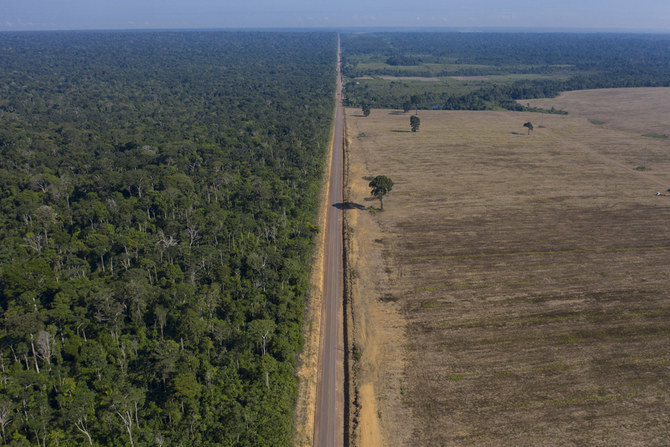
Humanity has also boosted the greenhouse gases in the atmosphere by hacking away at the forests that absorb roughly 30 percent of carbon dioxide emissions, according to the nonprofit World Resources Institute.
In 2020, the world lost 258,000 sq km (100,000 sq miles) of forest — an area larger than the United Kingdom, according to WRI’s Global Forest Watch. The conservation charity WWF estimates that 27 football fields of forest are lost every minute.
More than 100 national leaders pledged to halt and reverse deforestation and land degradation by the end of the decade, underpinned by $19 billion in public and private funds to invest in protecting and restoring forests.
The agreement vastly expands a commitment made by 40 countries as part of the 2014 New York Declaration of Forests, and promises more resources.
“Let’s end this great global chainsaw massacre by making conservation do what we know it can do and deliver long-term sustainable jobs and growth as well,” British Prime Minister Boris Johnson said.
COP26 aims to keep alive a receding target of capping global warming at 1.5 degrees Celsius (2.7 Fahrenheit) above pre-industrial levels to avert still greater damage from the intensified heatwaves, droughts, storms, floods and coastal damage that climate change is already causing.
Under the agreement, 12 countries pledged to provide $12 billion of public funding between 2021 and 2025 for developing countries to restore degraded land and tackle wildfires.
At least $7.2 billion will come from private sector investors representing $8.7 trillion in assets under management, who also pledged to stop investing in activities linked to deforestation such as cattle, palm oil and soybean farming and pulp production.
Brazil, which has cleared vast swathes of the Amazon rainforest, did make a new commitment on Monday to cut its greenhouse gas emissions by 50 percent by 2030, compared with a previous pledge of 43 percent.
And Prime Minister Narendra Modi for the first time set out a target date for India, heavily reliant on coal, to reduce its carbon emissions to a level it can absorb, albeit only in 2070 — 20 years beyond the UN’s global recommendation.
But there is scant sign so far of shared resolve by the world’s two biggest carbon polluters, China and the United States, which together account for more than 40 percent of global emissions but are at odds on numerous issues.
US President Joe Biden has singled out China and leading oil producer Russia for failing to step up their climate goals in Glasgow, while Beijing has rejected Washington’s efforts to separate climate issues from their wider disagreements.
The Communist Party-run Global Times said in an editorial on Monday that Washington’s attitude had made it “impossible for China to see any potential to have fair negotiation amid the tensions.”
China said on Tuesday that President Xi Jinping, who decided not to attend in person, had not been given an opportunity to deliver a video address, and had to send a written response instead — in which he offered no additional pledges.
The British government said it had wanted people to attend the conference in person, and had offered absentees the chance to provide recorded addresses or statements.
“If the world was a private company,” said Costa Rican President Carlos Alvarado Quesada, “imagine that for a minute, and the leaders of the world were to be different CEOs of the corporations — today we would all be fired.”


![]()
![]()

Leaders at global climate talks pledge to cut methane and save forests

Short Url
https://arab.news/rn4bq
Leaders at global climate talks pledge to cut methane and save forests
- Clamping down on methane flaring and leaks from oil wells and gas pipelines is considered one of the easiest ways to cut emissions
- Brazil, which has cleared vast swathes of the Amazon rainforest, did make a new commitment on Monday to cut its greenhouse gas emissions by 50 percent by 2030


Latest updates



© 2026 SAUDI RESEARCH & PUBLISHING COMPANY, All Rights Reserved And subject to Terms of Use Agreement.