

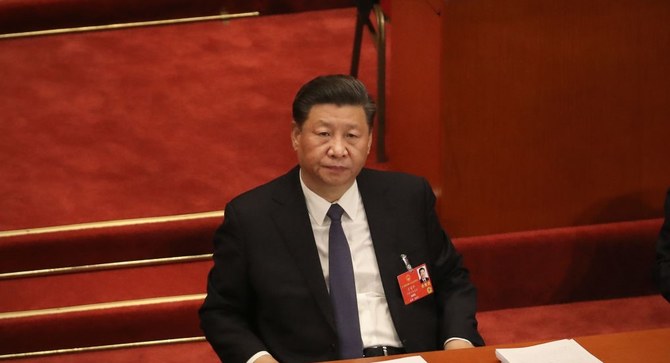
China says Xi was given no option for video address to COP26

Getty Images
Short Url
Updated 02 November 2021
Follow

China says Xi was given no option for video address to COP26

  • Beijing has rejected Washington's efforts to separate climate from wider conflicts between the two sides

China said on Tuesday that President Xi Jinping was not given an opportunity to deliver a video address to the COP26 climate talks in Scotland and had to send a written response instead.


Xi, who is not attending the United Nations meeting in person, delivered a written statement to the opening "high-level segment for heads of state and government" on Monday in which he offered no additional pledges, while urging countries to keep their promises and "strengthen mutual trust and cooperation".


"As I understand it, the conference organisers did not provide the video link method," Chinese foreign ministry spokesman Wang Wenbin told reporters at a regular briefing.


Britain has organised the COP26 meeting in Glasgow, Scotland which aims to secure net zero carbon emissions and keep the Paris Agreement target of a 1.5 degrees Celsius temperature rise within reach in order to curb the impact of global warming.


Climate watchers have expressed concern that Xi's physical absence from Glasgow means China is not prepared to offer any more concessions during this round of talks.


But Beijing has said it has already made a number of major pledges in the last year, promising to bring emissions to a peak by 2060, raise total solar and wind capacity to 1,200 gigawatts by 2030 and curb coal use starting in 2026.


The faltering diplomatic relationship between China and the United States - the two biggest emitters of climate-warming greenhouse gases - is emerging as one of the biggest stumbling blocks during the latest round of climate talks.


Beijing has rejected Washington's efforts to separate climate from wider conflicts between the two sides, with senior diplomat Wang Yi telling U.S. climate envoy John Kerry in September that there was still a "desert" threatening the "oasis" of climate cooperation.


One particular point of contention for China has been the U.S. imposition of sanctions on Chinese companies, including solar equipment suppliers, with links to the Xinjiang region.


China rejects western claims of human rights abuses in the northwestern region of the country.


"You can't ask China to cut coal production on the one hand, while at the same time imposing sanctions on Chinese photovoltaic enterprises," Wang said on Tuesday.


The Global Times, part of the Communist Party-run People's Daily stable of newspapers, said in a Monday editorial that the United States should not expect to be able to influence Beijing on climate, while attacking it on human rights and other issues.


Washington's attitude towards China has made it "impossible for China to see any potential to have fair negotiation amid the tensions", the paper said.


Jordan’s industry fuels 39% of Q2 GDP growth

Updated 31 December 2025
Follow

Jordan’s industry fuels 39% of Q2 GDP growth

JEDDAH: Jordan’s industrial sector emerged as a major contributor to economic performance in 2025, accounting for 39 percent of gross domestic product growth in the second quarter and 92 percent of national exports.

Manufactured exports increased 8.9 percent year on year during the first nine months of 2025, reaching 6.4 billion Jordanian dinars ($9 billion), driven by stronger external demand. The expansion aligns with the country’s Economic Modernization Vision, which aims to position the country as a regional hub for high-value industrial exports, the Jordan News Agency, known as Petra, quoted the Jordan Chamber of Industry President Fathi Jaghbir as saying.

Export growth was broad-based, with eight of 10 industrial subsectors posting gains. Food manufacturing, construction materials, packaging, and engineering industries led performance, supported by expanded market access across Europe, Arab countries, and Africa.

In 2025, Jordanian industrial products reached more than 144 export destinations, including emerging Asian and African markets such as Ethiopia, Djibouti, Thailand, the Philippines, and Pakistan. Arab countries accounted for 42 percent of industrial exports, with Saudi Arabia remaining the largest market at 955 million dinars.

Exports to Syria rose sharply to nearly 174 million dinars, while shipments to Iraq and Lebanon totaled approximately 745 million dinars. Demand from advanced markets also strengthened, with exports to India reaching 859 million dinars and Italy about 141 million dinars.

Industrial output also showed steady improvement. The industrial production index rose 1.47 percent during the first nine months of 2025, led by construction industries at 2.7 percent, packaging at 2.3 percent, and food and livestock-related industries at 1.7 percent.

Employment gains accompanied the sector’s expansion, with more than 6,000 net new manufacturing jobs created during the period, lifting total industrial employment to approximately 270,000 workers. Nearly half of the new jobs were generated in food manufacturing, reflecting export-driven growth.

Jaghbir said industrial exports remain among the economy’s highest value-added activities, noting that every dinar invested generates an estimated 2.17 dinars through employment, logistics, finance, and supply-chain linkages. The sector also plays a critical role in narrowing the trade deficit and supporting macroeconomic stability.

Investment activity accelerated across several subsectors in 2025, including food processing, chemicals, pharmaceuticals, mining, textiles, and leather, as manufacturers expanded capacity and upgraded production lines to meet rising demand.

Jaghbir attributed part of the sector’s momentum to government measures aimed at strengthening competitiveness and improving the business environment. Key steps included freezing reductions in customs duties for selected industries, maintaining exemptions for production inputs, reinstating tariffs on goods with local alternatives, and imposing a 16 percent customs duty on postal parcels to support domestic producers.

Additional incentives in industrial cities and broader structural reforms were also cited as improving the investment climate, reducing operational burdens, and balancing consumer needs with protection of local industries.