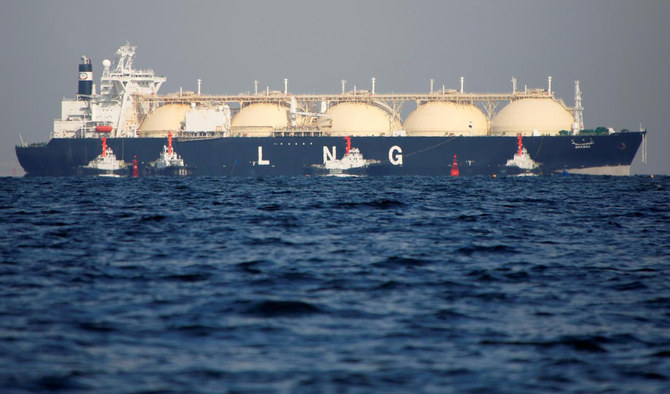
SINGAPORE: Pakistan LNG is seeking two liquefied natural gas (LNG) cargoes for delivery in November through an emergency tender after its term suppliers canceled delivery of cargoes, two industry sources said on Tuesday.
A sharp increase in gas prices has caused power shortages in many parts of the world, including China, amid a global energy crunch.
Pakistan LNG is seeking the cargoes for delivery into Port Qasim, Karachi, over Nov. 19 to 20 and Nov. 26 to 27 through a tender closing on Nov. 5, with same-day validity, according to a tender document posted on the company website.
This is due to the cancelation of two cargoes by the firm’s term suppliers for the month, one of the sources familiar with the matter said.
Commodities trader Gunvor could not supply the cargo because of force majeure at Equatorial Guinea’s LNG plant, the source said.
Italian energy group ENI could not deliver a cargo due to a default by its backend supplier, the source added.
Gunvor, ENI and Pakistan LNG did not immediately respond to Reuters’ requests for comment.
Pakistan has a five-year import deal with Gunvor and a 15-year agreement with ENI to buy LNG. Under the contracts, Pakistan LNG can impose a penalty of about 30 percent of the contractual price of a cargo on each company for cargo defaults.
Spot LNG prices rose to a record high of above $56 per million British thermal units (mmBtu) last month before pulling back to just above $30 per mmBtu, which is still over 400 percent higher than the same time last year.
That works out to three times the price of oil-linked term cargoes, which are priced at above 11 percent of Brent crude oil prices, or about $10 per mmBtu based on current oil prices.


Pakistan LNG issues emergency tender after term cargoes canceled
https://arab.news/p679s
Pakistan LNG issues emergency tender after term cargoes canceled

- Pakistan LNG is seeking the cargoes for delivery into Port Qasim, Karachi, in November
- Country needs this due to the cancelation of two cargoes by the firm’s term suppliers for the month

IMF mission begins talks in Islamabad as Pakistan seeks next program review
- Finance ministry confirms ‘kick-off meeting’ with visiting IMF delegation
- Review critical for next tranche under $7 billion bailout program
Karachi: Pakistan began formal talks with a visiting International Monetary Fund (IMF) delegation on Monday as the country prepares for the next review of its $7 billion bailout program.
The IMF team is in Pakistan to conduct a review under the Extended Fund Facility (EFF) approved in September 2024, a multi-year program aimed at stabilizing the economy after a balance-of-payments crisis, high inflation and dwindling foreign exchange reserves.
Pakistan has so far received roughly $3 billion of the EFF. Successful completion of the latest review could pave the way for the release of the next tranche of funds, subject to IMF board approval.
Separately in 2024, Pakistan also secured about $1.3 billion under the IMF’s Resilience and Sustainability Facility, a climate-focused funding window aimed at strengthening the country’s capacity to manage environmental and disaster-related risks.
“Kick-off meeting with IMF Mission held today,” the finance ministry said on Monday as it shared visuals of Finance Minister Muhammad Aurangzeb and senior officials meeting the delegation in Islamabad.
IMF country representative in Pakistan, Mahir Binici, told Arab News in an emailed statement;
“An IMF mission led by Ms. Iva Petrova has started discussions with the authorities in Karachi and Islamabad on the third review of Pakistan’s Extended Fund Facility (EFF) arrangement and the second review of the Resilience and Sustainability Facility (RSF).”
The discussions are expected to focus on Pakistan’s fiscal performance, revenue collection targets, structural reform implementation and broader macroeconomic stability measures agreed under the program.
The review comes at a sensitive time for Pakistan’s economy, with rising global oil prices and regional instability adding pressure to inflation and external accounts. Analysts say continued IMF engagement remains crucial for maintaining investor confidence and securing external financing.
Pakistan entered the IMF program to restore macroeconomic stability, strengthen public finances and rebuild foreign exchange reserves. Authorities have repeatedly described the reform agenda as necessary to ensure long-term economic resilience.
Further meetings between technical teams are expected over the coming days.