

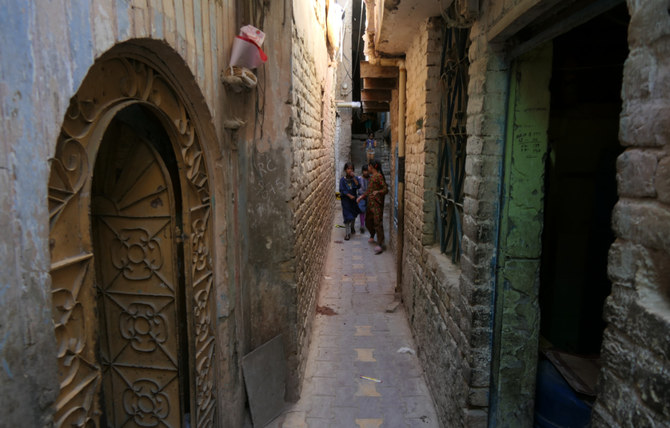

QUETTA: Surrounded by lavish apartment blocks and homes in downtown Quetta, lower-caste Hindus — who once helped the southern Pakistani city rise from its ruins after a deadly earthquake — have been living as if time stopped a century ago.
The Lachi Baradari Hindu community moved into the Shanti Nagar neighborhood of Quetta, the capital of Balochistan province, in the late 19th century.
While poverty is chronic in Balochistan — Pakistan’s largest province in terms of land area but its most underdeveloped in terms of almost all social indicators — the cycle of deprivation in Shanti Nagar seems unbreakable.
The neighborhood’s population has more than doubled in the past decade, but homes in the area expand only vertically, with new stories built atop tiny makeshift structures. Today, over 10,000 people live in the slum which spans only 20,000 sq. feet. Most families live in houses no larger than 300 sq. feet.
Ironically, when a deadly earthquake tore down Quetta in 1935, it was the men and women of the Lachi Baradari who worked as bricklayers to rebuild the city.
“We have rebuilt the city for residents of Quetta, but today we are unable to build homes for ourselves,” community leader Chaudery Kumar Chand told Arab News.
Chand himself has added three extra floors to his home in recent years to accommodate the families of his three married sons.
“We can’t buy additional land because the majority of our people are unemployed,” Chand said. “The provincial government has allotted land for Christians, upper-class Hindus and Sikhs, but we have never been offered any resettlement.”
Other community members shared the same stories of helplessness.
Allah Rakhi lives in a 250-sq-feet house with her five children and nine grandchildren.
“My elder son with his seven children lives in the basement while I am living with my younger son and daughters,” she said.
Chronic poverty has fueled social problems such as child marriage that only perpetuate the status quo. In families with limited resources, child marriage is often seen as a way to provide for their daughters’ future.
Sheela Devi was married off 35 years ago when she was barely 11. She and her husband are now living with one of their married sons and his family in a one-room home built two decades ago.
“We are unable to save our income because instead of spending money on a separate home, people here are compelled to save for their children’s timely marriages,” she said. “I have spent my entire life in search for a better life and now my children and grandson will suffer here without basic facilities of water, gas, and electricity as I did.”
Local priest, or pandit, Nadeem Chand said even the Shanti Nagar temple, the only one in the neighborhood, was too small to accommodate the community.
“People often stand outside during winter and rain season to take part in community rituals,” he told Arab News. “Barely 200 people of the Lachi Baradari take part inside the temple during our weekly prayer while the rest stand outside … We don’t know what sins we have committed.”
Chand, the community leader in the neighborhood, said it was not only the government, but also the richer and upper-caste members of the Hindu community in the province that refused support to its poorest members.
But Raj Kumar, president of the Quetta Hindu Panchayat, denied the accusations.
“We have been living as one whole Hindu community without keeping any division of lower and upper caste,” he told Arab News. “The population of Shanti Nagar has doubled in the last one decade, but they prefer to live as a community in a specific place like Shanti Nagar. Even some people of Lachi Baradari from Sindh province also migrated to Quetta.”
“The Lachi Baradari have been living in very appalling conditions, but we have been helping them within our capacity,” Kumar said. “We have allowed them to come to our temples during religious festivals.”
Dhanesh Kumar, a senator in Balochistan who served as the province’s minority minister until earlier this year, admitted that the Lachi Baradari had been neglected by the local and central governments for the past seven decades, but added that recent developments offered hope.
“The provincial government in Balochistan developed the streets and sewerage system in Shanti Nagar in 2020 with an allocated fund of Rs20 million ($117,000),” he said. “Now we have been constructing a large temple for the community inside the neighborhood.”
Kumar added: “We have been taking all possible steps to uplift this neglected Hindu community.”


