Glasgow students quids in as COP26 comes to town

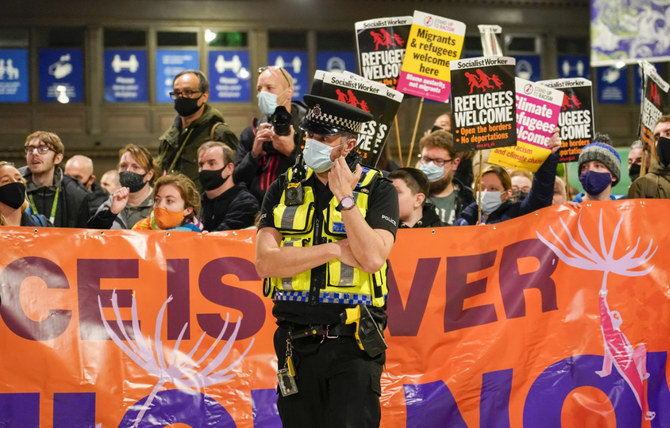
Climate activists hold banners at Glasgow Central station in Glasgow, Scotland ahead of the start of COP26, Saturday, Oct. 30, 2021. (AP)
Short Url
Updated 31 October 2021
Follow

Glasgow students quids in as COP26 comes to town

  • Most of our university classes are still online because of COVID-19 so we don’t need to be in Glasgow all the time

LONDON: University students in Glasgow are cashing in on this month’s UN environmental summit in Scotland by moving out of their rented apartments and sub-letting them for thousands of dollars to COP26 delegates.

Many of the city’s hotels are sold out ahead of the two-week summit which, along with world leaders, will bring an estimated 30,000 delegates from 197 countries to the city on the west coast of Scotland.

Glasgow is home to two large universities and several entrepreneurially minded students are moving back to Mom and Dad’s for the duration of the summit and charging delegates without accommodation up to $12,000 to rent their digs for six nights.

One student told Arab News: “It’s a no-brainer. Most of our university classes are still online because of COVID-19 so we don’t need to be in Glasgow all the time. The people we’re renting to are paying us almost four times our normal monthly rent to stay for just two weeks. They’re paying us so much we can employ proper cleaners to come in and tidy the place before they arrive.”

One homeowner reportedly offered their three-bedroom city center penthouse to rent for almost $62,000 on the website Booking.com.

Another student told Arab News that the money he and his four roommates were making by renting out their apartment would pay for them all to take a “lads holiday” in Spain and enable him to put a deposit down on a new car.

He said: “It’s great, I love climate change.”


Saudi stock market opens its doors to foreign investors

Updated 06 January 2026
Follow

Saudi stock market opens its doors to foreign investors

RIYADH: Foreigners will be able to invest directly in Saudi Arabia’s stock market from Feb. 1, the Kingdom’s Capital Market Authority has announced.

The CMA’s board has approved a regulatory change which will mean the capital market, across all its segments, will be accessible to investors from around the world for direct participation.

According to a statement, the approved amendments aim to expand and diversify the base of those permitted to invest in the Main Market, thereby supporting investment inflows and enhancing market liquidity.

International investors' ownership in the capital market exceeded SR590 billion ($157.32 billion) by the end of the third quarter of 2025, while international investments in the main market reached approximately SR519 billion during the same period — an annual rise of 4 percent.

“The approved amendments eliminated the concept of the Qualified Foreign Investor in the Main Market, thereby allowing all categories of foreign investors to access the market without the need to meet qualification requirements,” said the CMA, adding: “It also eliminated the regulatory framework governing swap agreements, which were used as an option to enable non-resident foreign investors to obtain economic benefits only from listed securities, and the allowance of direct investment in shares listed on the Main Market.”

In July, the CMA approved measures to simplify the procedures for opening and operating investment accounts for certain categories of investors. These included natural foreign investors residing in one of the Gulf Cooperation Council countries, as well as those who had previously resided in the Kingdom or in any GCC country. 

This step represented an interim phase leading up to the decision announced today, with the aim of increasing confidence among participants in the Main Market and supporting the local economy.

Saudi Arabia, which ‌is more than halfway ‍through an economic plan ‍to reduce its dependence on oil, ‍has been trying to attract foreign investors, including by establishing exchange-traded funds with Asian partners in Japan and Hong Kong.