Renovations offer new view of ancient West Bank mosaic

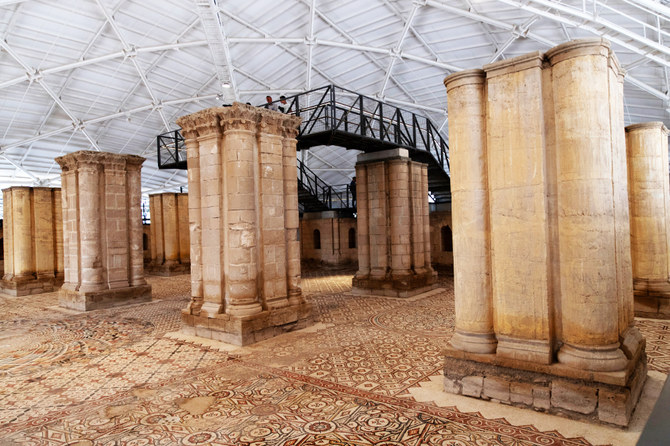
Visitors roam the site of a 7th century, 827 square meter mosaic. (AP)
Short Url
Updated 30 October 2021
Follow

Renovations offer new view of ancient West Bank mosaic

  • The palace was the winter resort of Caliph Hisham ibn Abd Al-Malik, who ruled from 724 to 743.

WEST BANK: Tourists are being offered a new glimpse at one of the largest ancient mosaics in the Middle East, after renovations undertaken by the Palestinian Authority were unveiled this week.
The 930-square-meter stone mosaic, with intricate geometric patterns, is part of what is known as Hisham’s Palace. It was built during the reign of the Umayyads, the first hereditary Muslim dynasty, which ruled from Damascus. The palace was the winter resort of Caliph Hisham ibn Abd Al-Malik, who ruled from 724 to 743.
It is situated near the desert oasis city of Jericho — one of the world’s oldest — in what is now the Israeli-occupied West Bank. Israel, which controls access to the territory, plans to welcome tourists from Nov. 1 as it lifts COVID-19 restrictions. The Palestinians hope the new project will attract both local and foreign travelers.
The $18 million project, which included the construction of a large dome to protect the mosaic from the elements, was partly funded by the Japanese government. Tourists can now view the mosaic from a new walkway suspended above it.
The project was originally supposed to be completed in 2018 but was delayed, in part because of the challenge of anchoring the dome without disturbing the archaeological remains.
Abdel Raheem Zahran, a local tourist who came with his children on Thursday, said he had been to the site seven years earlier, but it was “not as developed.”
“The dome that they made is great, you don’t have the sun beating down on you, ” he said.


Algeria inaugurates strategic railway to giant Sahara mine

President Tebboune attended an inauguration ceremony in Bechar. (AFP file photo)
Updated 02 February 2026
Follow

Algeria inaugurates strategic railway to giant Sahara mine

  • The mine is expected to produce 4 million tons per year during the initial phase, with production projected to triple to 12 million tons per year by 2030
  • The project is financed by the Algerian state and partly built by a Chinese consortium

ALGEIRS: Algerian President Abdelmadjid Tebboune on Sunday inaugurated a nearly 1,000-kilometer (621-mile) desert railway to transport iron ore from a giant mine, a project he called one of the biggest in the country’s history.
The line will bring iron ore from the Gara Djebilet deposit in the south to the city of Bechar located 950 kilometers north, to be taken to a steel production plant near Oran further north.
The project is financed by the Algerian state and partly built by a Chinese consortium.
During the inauguration, Tebboune described it as “one of the largest strategic projects in the history of independent Algeria.”
This project aims to increase Algeria’s iron ore extraction capacity, as the country aspires to become one of Africa’s leading steel producers.
The iron ore deposit is also seen as a key driver of Algeria’s economic diversification as it seeks to reduce its reliance on hydrocarbons, according to experts.
President Tebboune attended an inauguration ceremony in Bechar, welcoming the first passenger train from Tindouf in southern Algeria and sending toward the north a first charge of iron ore, according to footage broadcast on national television.
The mine is expected to produce 4 million tons per year during the initial phase, with production projected to triple to 12 million tons per year by 2030, according to estimates by the state-owned Feraal Group, which manages the site.
It is then expected to reach 50 million tons per year in the long term, it said.
The start of operations at the mine will allow Algeria to drastically reduce its iron ore imports and save $1.2 billion per year, according to Algerian media.