

At Expo Dubai, a spotlight on Balochistan at Pakistan Pavilion

This photo shows a seminar that was held at the Pakistan Pavilion in Dubai, United Arab Emirates, to promote investment and tourism opportunities in Balochistan on October 17, 2021. (Photo courtesy: Pakistan Pavilion Management)
Short Url
Updated 09 November 2021
Follow

At Expo Dubai, a spotlight on Balochistan at Pakistan Pavilion

  • Exhibition kicked off earlier this month and brought together representatives of more than 190 countries 
  • Pakistan to promote business potential, tourist attractions in other provinces in remaining five months 

DUBAI: The Pakistan Pavilion at Dubai Expo 2020 highlighted the investment opportunities, tourism potential and cultural magnificence of the country’s largest province of Balochistan throughout October, the organizers said on Wednesday. 

Described as “the event of the century,” the expo kicked off earlier this month and brought together representatives of more than 190 countries. 

The exhibition is the largest global gathering since the emergence of the coronavirus pandemic and will continue until April 2022. 

Speaking to Arab News, the organizers of the pavilion said they decided to use “Wonders of Balochistan” as the theme of the festival’s opening month to highlight the untapped potential of the country’s biggest province in terms of land area. 

“We arranged several events during October to promote the country’s largest federating unit of Balochistan,” said Afroz Abro, a senior official at the pavilion.  
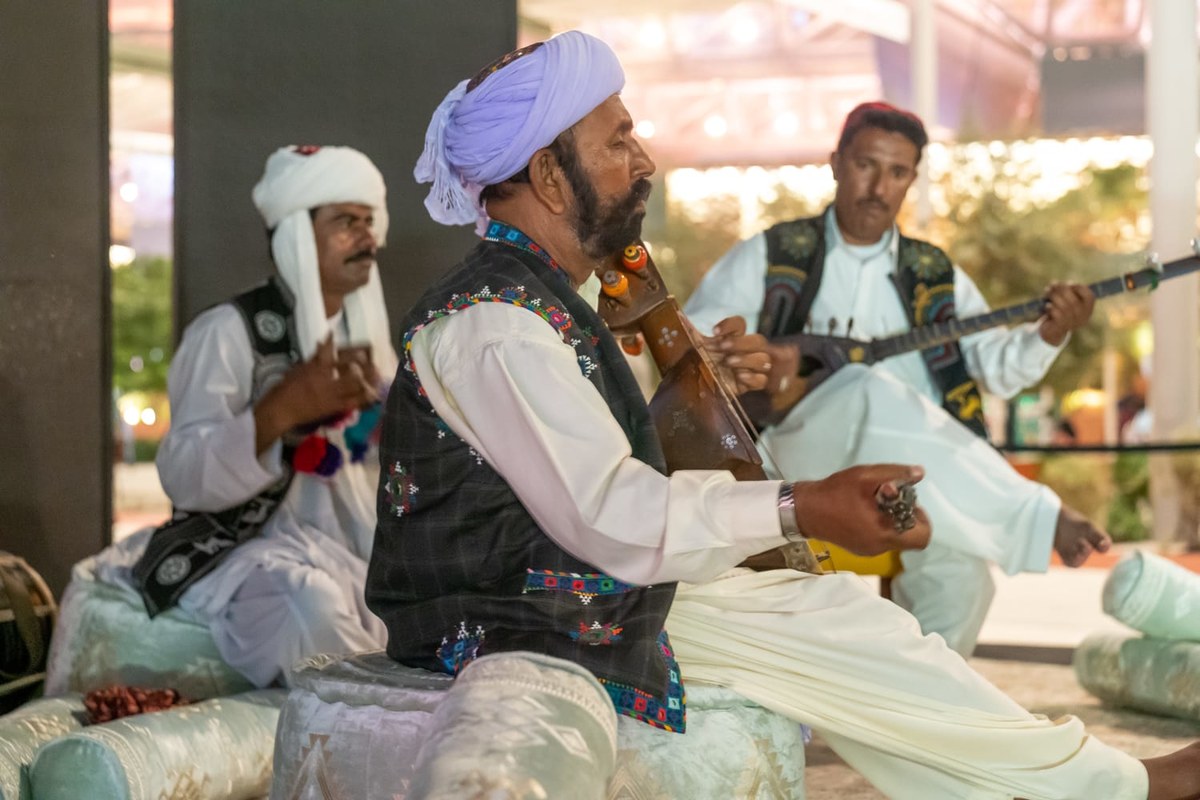


In this undated photo, a group of Baloch musicians can be seen performing a cultural show at the Pakistan Pavilion in Dubai, United Arab Emirates, during the month of October. (Photo courtesy: Pakistan Pavilion Management)

“The Wonders of Balochistan required us to focus on the country’s coastal belt, mines and mineral resources along with the possibility of generating renewable energy in the region. In other words, we tried to project all the strengths of the province during this month.” 

The management of the pavilion also arranged cultural shows, folk performances and a number of business seminars focusing on Balochistan. 

Abro said one such event centered on hi-tech business opportunities in the region, which was addressed by the provincial director of information technology who underscored the unlimited scope and potential for such businesses in Balochistan. 

He also mentioned the possibility of setting up Special Technology Zones and IT Parks in Quetta, Gwadar and Hub. 

The country’s Federal Board of Investment also held a two-day seminar on the Electric Vehicle Policy, while a session on carbon emissions was held by Malik Amin Aslam, Pakistan’s climate change minister, to promote the government’s Clean Green Pakistan initiative. 

The pavilion also ran the “Invest in Pakistan Campaign” during October by arranging multiple events for small and medium enterprises, government entities and entrepreneurs, Abro said. 

Artistes, such as the famous Baloch folk singer Akhtar Chanal Zahri, performed at the global arena and enthralled large numbers of people. 

“We arranged folk performances every evening in the courtyard of the pavilion,” Abro said, “which were attended by hundreds of visitors.” 

A British-Pakistani couple, living in Dubai for the last 10 years, described the Baloch cultural show as “exquisite.” 

“This is the second time we are visiting the pavilion and we are extremely impressed by the performance,” Naila Akhtar said. 

Her husband, Javed, nodded and said: “We did not understand what was being said, but we could still connect with the music.” 

The Pakistan Pavilion has dedicated the remaining five months of the expo to highlight the business potential and tourist attractions of other Pakistani provinces. 


Islamabad says surge in aircraft orders after India standoff could end IMF reliance

Updated 22 min 17 sec ago
Follow

Islamabad says surge in aircraft orders after India standoff could end IMF reliance

  • Pakistani jets came into the limelight after Islamabad claimed to have shot down six Indian aircraft during a standoff in May last year
  • Many countries have since stepped up engagement with Pakistan, while others have proposed learning from PAF’s multi-domain capabilities

ISLAMABAD: Defense Minister Khawaja Asif on Tuesday said Pakistan has witnessed a surge in aircraft orders after a four-day military standoff with India last year and, if materialized, they could end the country’s reliance on the International Monetary Fund (IMF).

The statement came hours after a high-level Bangladeshi defense delegation met Pakistan’s Air Chief Marshal Zaheer Ahmed Baber Sidhu to discuss a potential sale of JF-17 Thunder aircraft, a multi-role fighter jointly developed by China and Pakistan that has become the backbone of the Pakistan Air Force (PAF) over the past decade.

Fighter jets used by Pakistan came into the limelight after Islamabad claimed to have shot down six Indian aircraft, including French-made Rafale jets, during the military conflict with India in May last year. India acknowledged losses in the aerial combat but did not specify a number.

Many countries have since stepped up defense engagement with Pakistan, while delegations from multiple other nations have proposed learning from Pakistan Air Force’s multi-domain air warfare capabilities that successfully advanced Chinese military technology performs against Western hardware.

“Right now, the number of orders we are receiving after reaching this point is significant because our aircraft have been tested,” Defense Minister Asif told a Pakistan’s Geo News channel.

“We are receiving those orders, and it is possible that after six months we may not even need the IMF.”

Pakistan markets the Chinese co-developed JF-17 as a lower-cost multi-role fighter and has positioned itself as a supplier able to offer aircraft, training and maintenance outside Western supply chains.

“I am saying this to you with full confidence,” Asif continued. “If, after six months, all these orders materialize, we will not need the IMF.”

Pakistan has repeatedly turned to the IMF for financial assistance to stabilize its economy. These loans come with strict conditions including fiscal reforms, subsidy cuts and measures to increase revenue that Pakistan must implement to secure disbursements.

In Sept. 2024, the IMF approved a $7 billion bailout for Pakistan under its Extended Fund Facility (EFF) program and a separate $1.4 billion loan under its climate resilience fund in May 2025, aimed at strengthening the country’s economic and climate resilience.

Pakistan has long been striving to expand defense exports by leveraging its decades of counter-insurgency experience and a domestic industry that produces aircraft, armored vehicles, munitions and other equipment.

The South Asian country reached a deal worth over $4 billion to sell military equipment to the Libyan National Army, Reuters report last month, citing Pakistani officials. The deal, one of Pakistan’s largest-ever weapons sales, included the sale of 16 JF-17 fighter jets and 12 Super Mushak trainer aircraft for basic pilot training.