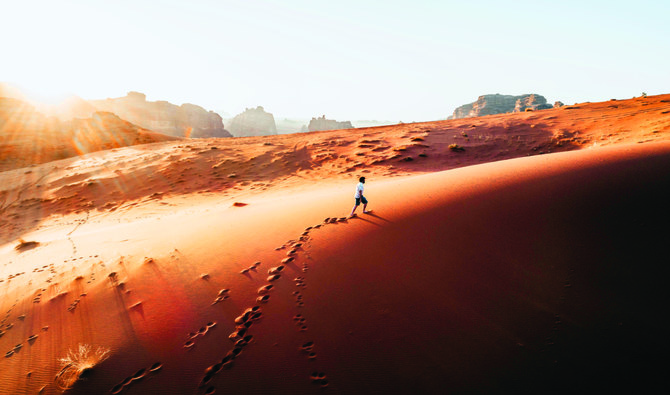

RIYADH: NEOM began as an idea conceived by Crown Prince Mohammed bin Salman during the first Future Investment Initiative Forum in 2017. The ambitious project is now a reality that serves as a vision for the future of a world that harnesses the power of smart technology, harmoniously linked with nature, to perfectly cater to the needs of humanity.
The developers of NEOM, a smart city located in Tabuk Province along the coast of the Red Sea, has announced that the first phase will be ready to welcome tourists and other visitors by 2024. But what is actually happening on the ground to help achieve that goal?
Arab News talked to three executives from NEOM to discuss the current status of investment, development and progress in the city of the future.
Cloud Park
“100 percent renewable energy, innovation, a friendly regulatory ecosystem,” Joseph Bradley, the CEO of NEOM Tech and Digital Holding Company, told Arab News as he described the project.
“NEOM is accelerating human progress. It’s not just for some humans but all humans, so we want to make sure that the connectivity creates an environment we like to call ‘digital air,’ meaning wherever you are you don’t have to worry about Wi-Fi or being connected to something.”
This means that ultimately every part of the city will be covered, whether it is permanently inhabited or not, and so digital connectivity will never be an issue.
“What you are seeing is the execution of this strategy,” Bradley said. “We are putting fiber to ground, we are putting 5G to ground, we bought sub-sea 30 terabits of capacity and we began to build our cloud park.”
Burying fiber for 5G services is expensive and so Bradley said that NEOM will instead rely on satellites to help serve high-operating applications.
He added that there is also a huge opportunity for revenue growth for hyperscalers, companies such as Google and Amazon who can provide cloud-based services for businesses.
“When you put cloud services in an environment it is almost a 1-to-1 ratio correlation between cloud penetration and economic growth,” the executive stated.
This will in turn boost gross domestic product and create further job growth in the Kingdom.
“We are building the physical world of NEOM and the digital world, and we are going to create some very unique experiences between the two that can only be accomplished if you are building,” Bradley said.
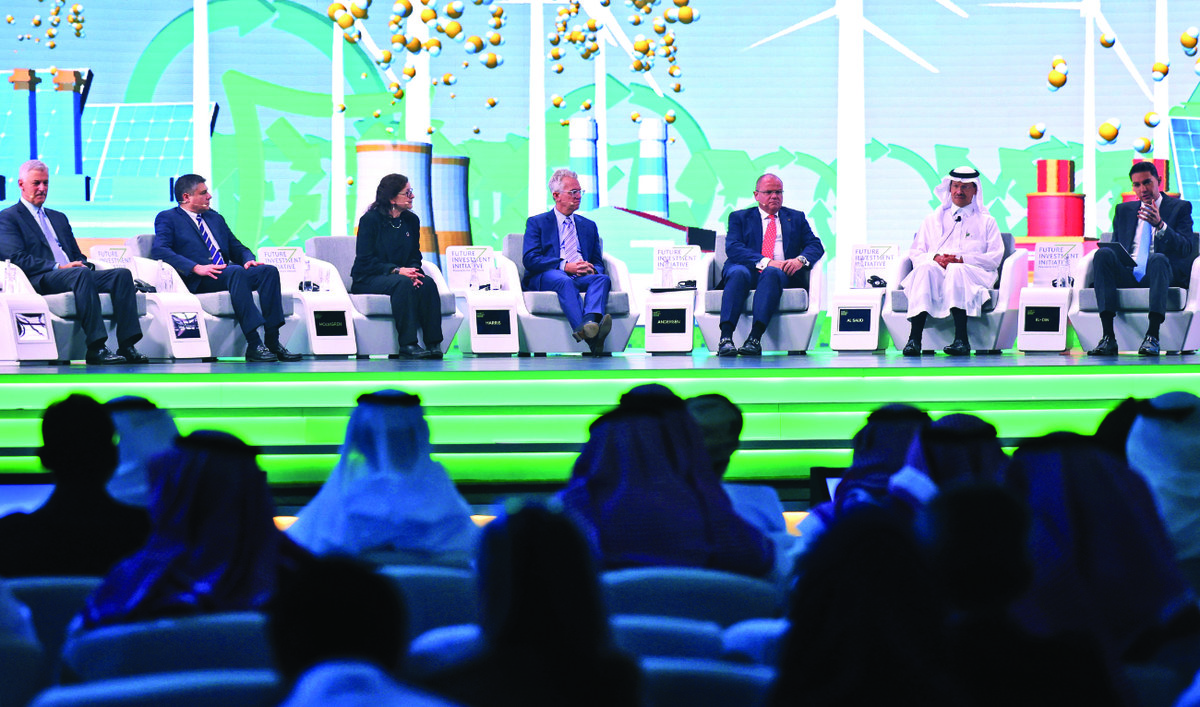
NEOM was first announced at the Future Investment Initiative Forum in 2017. Now it is becoming a reality. (AFP)
Green Hydrogen
The aim is for NEOM to be powered 100 percent by renewable energy, and one of the sources of that energy is green hydrogen. NEOM has already entered into a joint venture with ACWA Power and Air Products to develop its first green hydrogen production facility.
“One of our partners in the venture is ACWA power, which will provide electricity to NEOM by 2024,” Peter Terium, the managing director of energy, water and food at NEOM told Arab News.
The process of ensuring NEOM is powered completely by locally produced renewable energy will be carried out in increments over a coming years based on industry readiness, building preparation and other developments.
“I am proud to see that the first large-scale green hydrogen plant in the world is being built in NEOM, with 2,000 megawatts of electrolyzer capacity,” Terium said. “This is really a jump up from what is currently available.”
Most similar plants elsewhere operate at about 100-150 megawatts, he added.
“This is NEOM’S goal,” he said. “NEOM is a catalyst. NEOM is a front-runner. NEOM is setting the pace and giving direction, and a lot of companies in Saudi Arabia are happy to follow.”
NEOM’s First International Film
Another area in which NEOM is making big advances is its media strategy. The media and creative industry is one of 16 sectors the smart city will cater to, and NEOM aims to become a regional hub for content creation.
“Here in NEOM we see the media industry as a future industry; it acts as a glue for society through the ability to tell stories that project its identity locally and beyond,” said Wayne Borg, managing director of the project’s media, culture and entertainment sector.
 The diversity of NEOM’s landscape and natural resources provide endless possibilities for local and international film producers. Borg said that the technically driven philosophy of the project means that it can create a content-creation hub serving all aspects of the media, from film and television to animation and video games.
“At the heart of it will be telling stories and creating entertainment,” Borg said. “We want to focus on bringing that creative community together and helping to provide the opportunity to tell their stories.”
NEOM has the infrastructure and capability to support and facilitate such productions, he added.
“We have currently got a major feature film shooting at NEOM, an international feature film with a budget of some $100 million,” Borg revealed. “On any given day there are 400 or 500 people on set.”
The film, which is shooting in 10 locations and on multiple sets, is the largest movie production in the region to date, he said. NEOM has already hosted more than 21 productions, he added, and with studio infrastructure due to go online this year, deals are already in place to host another 10 in 2022.