JERUSALEM: Israel’s surprise “terrorist” designation of six Palestinian civil society groups has divided its ruling coalition and thrown a spotlight on Marxist group the Popular Front for the Liberation of Palestine.
The move announced last Friday by Defense Minister Benny Gantz caused shockwaves, including among European donors who support the targeted groups and from Amnesty International and Human Rights Watch.
Israeli non-government organizations, or NGOs, which partner with the implicated Palestinians also voiced astonishment.
So did some in the media, given the prominence of the groups involved — especially Al-Haq, a rights group founded in 1979 by writer Raja Shehadeh, a New Yorker magazine contributor.
Gantz has also taken fire from within Israel’s government, an unwieldy eight-party alliance that includes left-wing politicians.
Health Minister Nitzan Horowitz, leader of the dovish Meretz, warned that as an occupying military power Israel needed to be “very careful in imposing sanctions on Palestinian civil organizations because there are political, diplomatic and, more importantly, human rights consequences.”
Transport Minister and Labor leader Merav Michaeli said the way the announcement was made “caused Israel great damage with our greatest and most important friends.”
But Gantz’s office has not wavered, insisting that a joint security establishment investigation had proved the six groups operated “as an organized network under the leadership of the PFLP,” as the Marxist group is known.
The PFLP was founded in 1967 by George Habache — mixing Marxist-Leninism, Arab nationalism and virulent anti-Zionism — ultimately becoming the second most powerful Palestinian armed group after Yasser Arafat’s Fatah.
It currently does not have firepower matching the arsenal of rockets held by Gaza’s rulers Hamas or Islamic Jihad, but it is active in the international campaign to boycott Israel known as BDS, short for Boycott, Divestment, Sanctions.
The PFLP has been declared a terrorist organization by the United States and the European Union, and Israel says it is responsible for a 2019 bomb attack in the occupied West Bank that killed 17-year-old Israeli Rina Schnerb.
The PFLP leader in Israeli-blockaded Gaza told AFP the designated organizations have “no link” with his group beyond a shared ideology opposing the occupation.
“These NGOs work in complete independence,” Jamil Mazher said.
The PFLP has been a prime target of the Israeli organization NGO Monitor, which tracks funding and activities of non profit groups engaged in the Israeli-Palestinian conflict, with specific focus on European donors.
Its president Gerald Steinberg told AFP the designations last week “appears to reflect the impact of NGO Monitor’s ongoing research.”
NGO Monitor wrote to the European anti-fraud office OLAF in November 2020 to share what it said was evidence of EU funds being given to Palestinian NGOs with links to terrorist organizations.
OLAF replied in January that it had “dismissed the case on the grounds that there is no sufficient suspicion to open an investigation,” according to a letter seen by AFP.
Israel is not obligated to disclose the evidence it used to support the terrorism designation, with secrecy allowed under the 2016 counter-terrorism act.
The defense ministry has said the groups had hosted PFLP meetings, employed “convicted terrorists” and operated as a “lifeline” for the PFLP through “fundraising, money laundering and recruitment of activists.”
Tel Aviv University law professor Eliav Lieblich, writing on the Just Security website this week, argued that “it simply cannot be accepted that well-known and widely respected Palestinian human rights groups be designated as ‘terrorist organizations’ by executive fiat and on the basis of classified intelligence.”
An Israeli official told AFP that an envoy would soon head to Washington to share evidence after the US said it would be seeking “more information” about the designations.
Meanwhile, pushback persists against the decision.
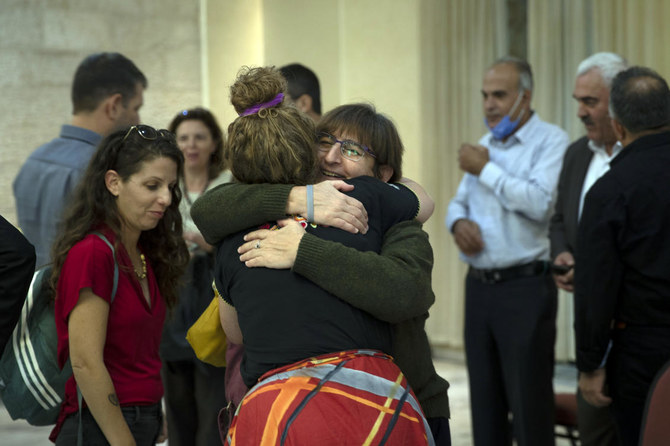
Representatives from 25 Israeli civil society groups traveled to Ramallah Wednesday to show solidarity with their Palestinian colleagues.
“This attack on Palestinian civil society, on Palestinian organizations, is not new,” Hagai El-Ad, the executive director of Israeli rights group B’Tselem, told AFP at the demonstration.
“What is new,” he added, is that “they’re targeting some of the most respected and oldest civil society organizations in Palestine, like Al-Haq,” and that growing international outrage means Israel may no longer be able to act with “impunity.”


![]()

Criticism over Israeli ‘terror’ label for Palestinian groups
Short Url
https://arab.news/wmep4
Criticism over Israeli ‘terror’ label for Palestinian groups
- Move by Defense Minister Benny Gantz has even drawn fire from within Israel’s government, an unwieldy eight-party alliance that includes left-wing politicians
- Representatives from 25 Israeli civil society groups traveled to Ramallah Wednesday to show solidarity with their Palestinian colleagues


Latest updates


© 2026 SAUDI RESEARCH & PUBLISHING COMPANY, All Rights Reserved And subject to Terms of Use Agreement.