



ISLAMABAD: Prime Minister Imran Khan has summoned a meeting of the National Security Committee on Friday to discuss the ongoing situation in the country as thousands of Tehreek-e-Labbaik Pakistan (TLP) religious party’s supporters continue their march on Islamabad.
The protesters reached Gujranwala, some 200 kilometers from Pakistan’s federal capital, on Thursday evening, saying they did not face much resistance from the law enforcement agencies.
TLP leaders said their followers would resume the march early Friday morning.
“In view of the situation arising because of the illegal activities of the proscribed outfit, Prime Minister Imran Khan has convened a meeting of the National Security Committee tomorrow [Friday],” the country’s information minister Chaudhry Fawad Hussain announced in a Twitter post on Thursday.
“Other issues related to national security will also be considered in this meeting,” he added.
The national security committee is a top consultative body that formulates policies regarding the country’s internal and external security matters.
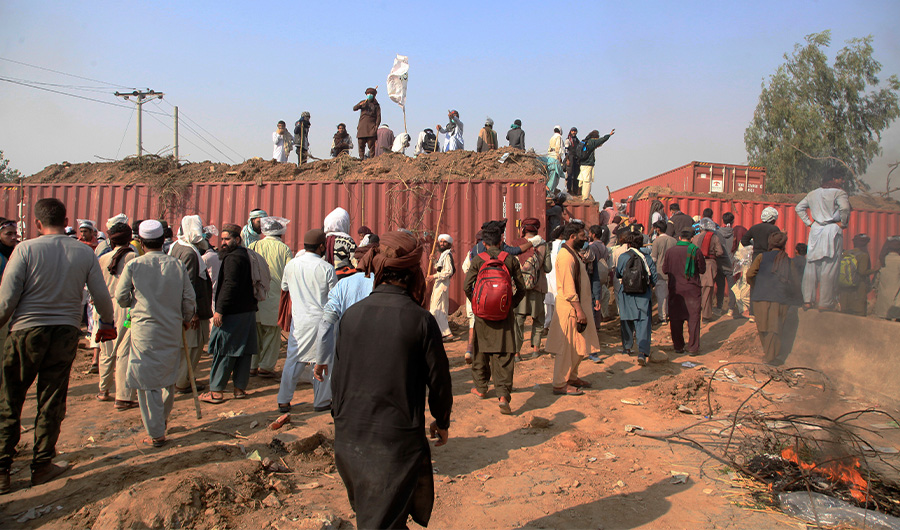
Supporters of Tehreek-e-Labiak Pakistan, a radical Islamist party, stand on shipping containers placed by police to block them during their protest march toward Islamabad, on a highway in the town of Sadhuke, in eastern Pakistan, Oct. 27, 2021. (AP)
TLP protesters have, meanwhile, continued their journey a day after violent clashes broke out between the group and the police personnel in Sadhoke, a small town some 50 kilometers away from Lahore which became the point of origin for the protest march.
The clashes left at least six people dead, including four policemen, and wounded 250 others, prompting the government to declare TLP a “militant group” on Wednesday.
“We will be staying in Gujranwala tonight and resume our march to Islamabad early in the morning,” senior TLP member Sajid Saifi told Arab News over the phone.
He said a TLP team was negotiating with the government, but “no breakthrough has been made so far.”
Punjab Chief Minister Usman Buzdar also held a high-level meeting in Lahore on Thursday to review the security situation.
“The chief minister has directed [officials] to take every possible step to establish peace in the province,” said a statement issued by his office after the meeting.
“I personally apologize to people for the inconvenience caused to them due to the closure of roads,” the chief minister was quoted as saying.
Buzdar also observed it was the “state’s foremost responsibility” to ensure protection of its people’s lives and properties.

Leaders of Tehreek-e-Labiak Pakistan, a radical Islamist party, rally a protest march toward Islamabad, on a highway in the town of Sadhuke, in eastern Pakistan, Wednesday, Oct. 27, 2021. (AP)
Earlier, Saifi told Arab News the law enforcement personnel did not stop TLP activists when they resumed their march toward Islamabad on Thursday morning.
“We are peaceful people, our protest is peaceful, and we also expect peace from the government,” he said.
The banned religious group announced its march on Islamabad on October 22. It seeks the release of its leader, Saad Rizvi, and the expulsion of the French envoy to Pakistan over publication of caricatures of Islam’s Prophet Muhammad (PBUH) in France last year.
The Punjab provincial administration had deployed heavy contingents of police in and around the eastern city of Lahore after the march’s announcement.
The TLP caravan had stayed in Muridke and given a three-day ultimatum to the government to meet their demands.
“We have already told the government that we won’t go back without getting our demands fulfilled,” Saifi said, adding that their caravan would continue to march toward Islamabad after a short stay in Gujranwala.
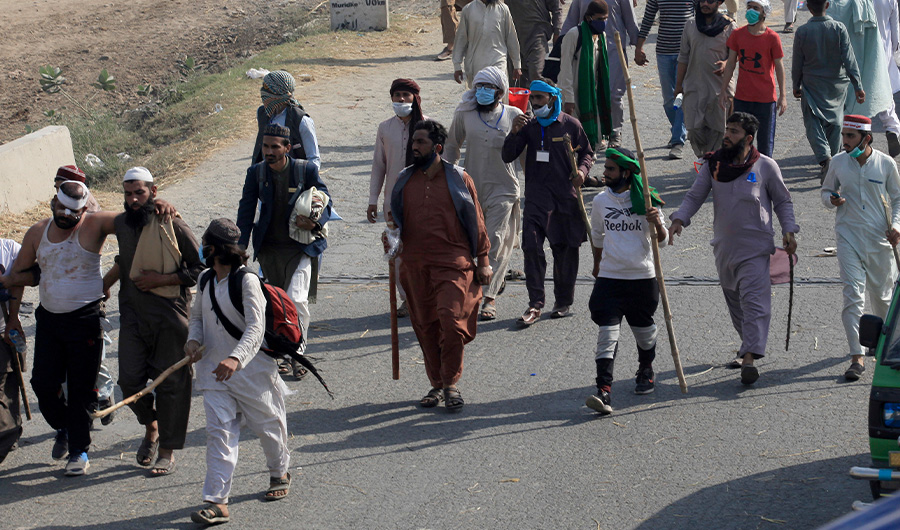
Supporters of Tehreek-e-Labbaik Pakistan help their colleague (L) who was injured in clashes with police during their protest march toward Islamabad, on a highway in the town of Sadhuke, in eastern Pakistan, Oct. 27, 2021. (AP)
“We believe in negotiations and dialogue, and hopefully the government will heed all our genuine demands,” the TLP leader said. “We don’t want any confrontation with law enforcers for they are also Muslims and Pakistanis.”
Hasaan Khawar, a spokesperson for the Punjab government, did not respond to requests for comment.
However, Pakistan’s National Security Adviser Moeed Yusuf issued a warning to the outlawed group.
“For all individuals and groups who think they can challenge the writ of the Pakistani state, do not test the proposition,” he said in a series of tweets. “As the basic principle of national security, the state will never shy away from protecting each and every citizen from any form of violence.”
Yusuf said TLP had crossed the red line and exhausted the state’s patience.
“They have martyred policemen, destroyed public property, and continue to cause massive public disruption. Law will take its course for each one of them and terrorists will be treated like terrorists with no leniency,” he said.
“There will be NO armed militias of any sort in our country.”


