LONDON: The US government is scheduled to ask Britain’s High Court on Wednesday to overturn a judge’s decision that WikiLeaks founder Julian Assange should not be sent to the United States to face espionage charges.
In January, a lower court judge refused an American request to extradite Assange on spying charges over WikiLeaks’ publication of secret military documents a decade ago.
District Judge Vanessa Baraitser denied extradition on health grounds, saying Assange was likely to kill himself if held under harsh US prison conditions. But she rejected defense arguments that Assange faces a politically motivated American prosecution that would override free-speech protections, and she said the US judicial system would give him a fair trial.
Lawyers for US authorities have been granted permission to appeal. At an earlier hearing they questioned the psychiatric evidence in the case and argued that Assange does not meet the threshold of being “so ill” that he cannot resist harming himself.
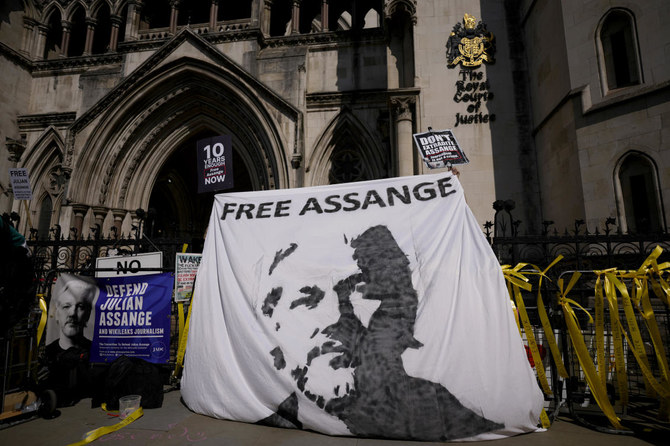
Several dozen pro-Assange protesters rallied outside London’s Royal Courts of Justice before the hearing, which is scheduled to last two days.
Assange, who is being held at London’s high-security Belmarsh Prison, had been expected to attend by video link, but he was not present as the hearing began. His lawyer, Edward Fitzgerald, said Assange “doesn’t feel able to attend the proceedings.”
Assange’s partner, Stella Moris, said outside court that she was “very concerned for Julian’s health. I saw him on Saturday. He’s very thin.”
“It is completely unthinkable that the UK courts could agree to this,” Moris said. “I hope the courts will end this nightmare, that Julian is able to come home soon and that wise heads prevail.”
The two justices hearing the appeal — who include England’s most senior judge, Lord Chief Justice Ian Burnett — are not expected to give their ruling for several weeks.
The High Court’s ruling will likely not end the epic legal saga, however, since the losing side can seek to appeal to the UK Supreme Court.
US prosecutors have indicted Assange on 17 espionage charges and one charge of computer misuse over WikiLeaks’ publication of thousands of leaked military and diplomatic documents. The charges carry a maximum sentence of 175 years in prison.
The prosecutors say Assange unlawfully helped US Army intelligence analyst Chelsea Manning steal classified diplomatic cables and military files that WikiLeaks later published. Lawyers for Assange argue that he was acting as a journalist and is entitled to First Amendment freedom of speech protections for publishing documents that exposed US military wrongdoing in Iraq and Afghanistan.
Assange, 50, has been in prison since he was arrested in April 2019 for skipping bail during a separate legal battle. Before that he spent seven years holed up inside Ecuador’s London embassy, where he fled in 2012 to avoid extradition to Sweden to face allegations of rape and sexual assault.
Sweden dropped the sex crimes investigations in November 2019 because so much time had elapsed, but Assange remains in prison. The judge who blocked extradition in January ordered that he must stay in custody during any US appeal, ruling that the Australian citizen “has an incentive to abscond” if he is freed.
WikiLeaks supporters say testimony from witnesses during the extradition hearing that Assange was spied on while in the embassy by a Spanish security firm at the behest of the CIA — and that there was even talk of abducting or killing him — undermines US claims he will be treated fairly.
Journalism organizations and human rights groups have urged President Joe Biden to drop the prosecution launched under his predecessor, Donald Trump.
Amnesty International Secretary-General Agnes Callamard said the charges were politically motivated and should be dropped.
“It is a damning indictment that nearly 20 years on, virtually no one responsible for alleged US war crimes committed in the course of the Afghanistan and Iraq wars has been held accountable, let alone prosecuted, and yet a publisher who exposed such crimes is potentially facing a lifetime in jail,” she said.


![]()

US set to appeal UK refusal to extradite WikiLeaks’ Assange
Short Url
https://arab.news/jnnzw
US set to appeal UK refusal to extradite WikiLeaks’ Assange
- In January, a lower court judge refused an American request to extradite Assange on spying charges
- US prosecutors have indicted Assange on 17 espionage charges and one charge of computer misuse


Latest updates




© 2026 SAUDI RESEARCH & PUBLISHING COMPANY, All Rights Reserved And subject to Terms of Use Agreement.