

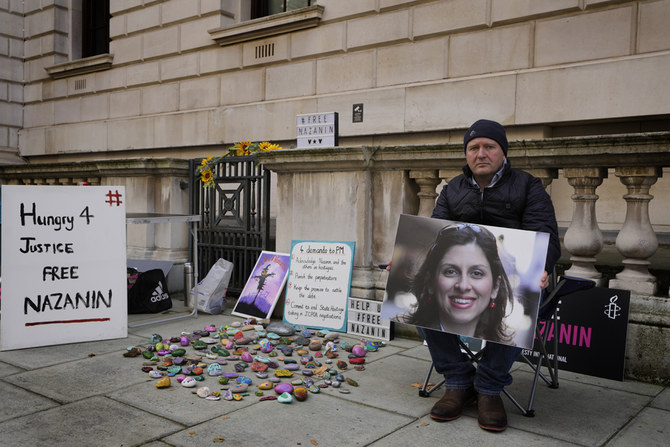
British police allegedly tried to remove protesting husband of Nazanin Zaghari-Ratcliffe

Richard Ratcliffe, husband of detained UK charity worker Nazanin Zaghari-Ratcliffe, holds a picture of his wife as he sits opposite the Foreign Office, Westminster, London, Oct. 25, 2021. (AP Photo)
Short Url
Updated 26 October 2021
Follow

British police allegedly tried to remove protesting husband of Nazanin Zaghari-Ratcliffe

  • Richard Ratcliffe was protesting outside UK Foreign Office over London’s alleged inaction regarding his wife’s detention in Iran
  • Zaghari-Ratcliffe has been detained by Tehran for over five years for allegedly plotting to overthrow the government

LONDON: Richard Ratcliffe, the husband of Nazanin Zaghari-Ratcliffe, has claimed that British police tried to remove him from his protest outside the UK Foreign, Commonwealth and Development Office and has pledged to stay until the government responds to his demands.

Nazanin Zaghari-Ratcliffe has been detained in Iran for over five years on national security charges that she strenuously denies. Her husband has argued repeatedly that the UK is not doing enough to secure her release.

Ratcliffe began a hunger strike over the weekend to pressure the government to do more to bring his wife home, and he alleges that police tried to remove him from his picket outside the FCDO at 3.45 a.m. on Monday morning.

He said that despite the attempted removal, he intends to stay until Whitehall takes action, according to the Evening Standard newspaper.

Ratcliffe was joined by his daughter Gabriella on Monday.

Zaghari-Ratcliffe, a British-Iranian dual national, has been in custody in Iran since 2016 after being accused of plotting to overthrow the government. She has spent four years in the notorious Evin prison and one under house arrest in her family’s home in Tehran.

Her family said Iranian authorities revealed she was being held as a bargaining chip over a historic debt between the UK and pre-revolutionary Iranian government worth £400 million ($552.168 million).

Ratcliffe told the Standard: “I’m staying until the government responds. I’m hoping that response is to engage with the demands and not to tell the police to move me on.”

He has demanded that Whitehall “acknowledge Nazanin and the others as hostages, punish the perpetrators, keep the promise to settle the debt and commit to end state hostage taking in Joint Comprehensive Plan of Action negotiations.”

The JCPOA, often referred to as the Iran nuclear deal, is currently being renegotiated by world powers including the US and European nations with Iran. Critics have said that the narrow deal focuses too heavily on Iran’s nuclear activity without addressing other malignant behavior, such as support for regional proxies and the use of kidnapping as a tool of diplomacy.

Ratcliffe has lamented the harm that the ordeal is doing to his daughter, who herself was previously not allowed to leave Iran. He has also criticized the British government for its treatment of his family.

“Two years ago we were allowed to camp in front of the Iranian Embassy for 15 days, much to their considerable anger. But it got Gabriella home. We are now giving the UK government the same treatment.

“In truth, I never expected to have to do a hunger strike twice. It is not a normal act,” he said. “It seems extraordinary, the need to adopt the same tactics to persuade the government here, to cut through the accountability gap.

“Of course Iran still remains the primary abuser in Nazanin’s case. But our family is caught in a dispute between two states.”

He added: “The UK is also letting us down.”

Sacha Deshmukh, interim CEO of Amnesty International UK, said: “It’s so incredibly upsetting that it’s come to this.

“Like Richard, we’ve grown tired of hearing ministers saying they’re ‘doing all they can’ for Nazanin and other arbitrarily-detained Britons in Iran — it doesn’t look like that to us, and it certainly hasn’t produced results.”

A spokesperson for the FCDO said: “Iran’s decision to proceed with these baseless charges against Nazanin Zaghari-Ratcliffe is an appalling continuation of the cruel ordeal she is going through.

“Instead of threatening to return Nazanin to prison, Iran must release her permanently so she can return home.

“We are doing all we can to help Nazanin get home to her young daughter and family and we will continue to press Iran on this point.”


Pakistan combing for perpetrators after deadly separatist attacks

Updated 9 sec ago
Follow

Pakistan combing for perpetrators after deadly separatist attacks

  • Around a dozen sites where the attacks took place — including the provincial capital Quetta — remained sealed off
  • The Baloch Liberation Army, the province’s most active militant separatist group, claimed responsibility for the attacks
QUETTA, Pakistan: Pakistan forces were hunting on Sunday for the separatists behind a string of coordinated attacks in restive Balochistan province, with the government vowing to retaliate after more than 120 people were killed.
Around a dozen sites where the attacks took place — including the provincial capital Quetta — remained sealed off, with troops combing the area a day after militants stormed banks, jails and military installations, killing at least 18 civilians and 15 security personnel, according to the military’s count.
At least 92 militants were also killed, the military added, while an official said that a deputy district commissioner had been abducted.
Mobile Internet service across the province has been jammed for more than 24 hours, while road traffic is disrupted and train services suspended.
After being rocked by explosions, typically bustling Quetta lay quiet on Sunday, with major roads and businesses deserted, and people staying indoors out of fear.
Shattered metal fragments and mangled vehicles litter some roads.
“Anyone who leaves home has no certainty of returning safe and sound. There is constant fear over whether they will come back unharmed,” Hamdullah, a 39-year-old shopkeeper who goes by one name, said in Quetta.
The Pakistan military said it was conducting “sanitization operations” in the areas that had been targeted in Saturday’s attacks.
“The instigators, perpetrators, facilitators and abettors of these heinous and cowardly act... will be brought to justice,” it said in a statement Saturday night.
The Baloch Liberation Army (BLA), the province’s most active militant separatist group, claimed responsibility for the attacks in a statement sent to AFP.
The group said it had targeted military installations as well as police and civil administration officials in gun attacks and suicide bombings.
Saturday’s attacks came a day after the military said it killed 41 insurgents in two separate operations in the province.
Pakistan has been battling a Baloch separatist insurgency for decades, with frequent armed attacks on security forces, foreign nationals and non-local Pakistanis in the mineral-rich province bordering Afghanistan and Iran.
Pakistan’s poorest province despite an abundance of untapped natural resources, Balochistan lags behind the rest of the country in almost every index, including education, employment and economic development.
Baloch separatists have intensified attacks on Pakistanis from other provinces working in the region in recent years, as well as foreign energy firms that they believe are exploiting its riches.
The separatists attacked a train with 450 passengers on board last year, sparking a two-day siege during which dozens of people were killed.