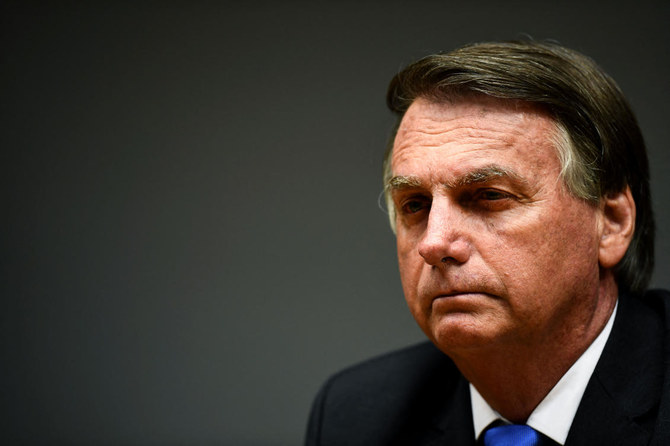
RIO DE JANEIRO: Facebook and YouTube have removed from their platforms a video by Brazilian President Jair Bolsonaro in which the far-right leader made a false claim that COVID-19 vaccines were linked with developing AIDS.
Both Facebook and Alphabet Inc’s YouTube said the video, which was recorded on Thursday, violated their policies.
“Our policies don’t allow claims that COVID-19 vaccines kill or seriously harm people,” a Facebook spokesperson said in a statement on Monday.
YouTube confirmed that it had taken the same step later in the day.
“We removed a video from Jair Bolsonaro’s channel for violating our medical disinformation policy regarding COVID-19 for alleging that vaccines don’t reduce the risk of contracting the disease and that they cause other infectious diseases,” YouTube said in a statement.
According to the Joint United Nations Programme on HIV and AIDS (UNAIDS), COVID-19 vaccines approved by health regulators are safe for most people, including those living with HIV, the virus that causes acquired immunodeficiency syndrome, known as AIDS.
Bolsonaro’s office did not respond immediately to a request for comment outside normal hours.
In July, YouTube removed videos from Bolsonaro’s official channel in which he recommended using hydroxychloroquine and ivermectin against COVID-19, despite scientific proof that these drugs are not effective in treating the disease.
Since then, Bolsonaro has avoided naming both drugs on his live broadcasts, saying the videos could be removed and advocating “early treatment” in general for COVID-19.
Bolsonaro, who tested positive for the coronavirus in July last year, had credited his taking hydroxychloroquine, an anti-malarial drug, for his mild symptoms. While Bolsonaro himself last January said that he wouldn’t take any COVID-19 vaccine, he did vow to quickly inoculate all Brazilians.
In addition to removing the video, YouTube has suspended Bolsonaro for seven days, national newspapers O Estado de S. Paulo and O Globo reported, citing a source familiar with the matter.
YouTube did not respond to a separate Reuters request for comment regarding the suspension on Monday night.


Facebook, YouTube take down Bolsonaro video over false vaccine claim
https://arab.news/2zbeu
Facebook, YouTube take down Bolsonaro video over false vaccine claim

- Both Facebook and Alphabet Inc’s YouTube said the video, which was recorded on Thursday, violated their policies


Saudi Arabia strengthens global ranking in 2026 Soft Power Index
- UAE maintains 10th place, Qatar climbs 2 spots
DUBAI: Saudi Arabia climbed three positions to 17th place in this year’s Soft Power Index, released on Tuesday by marketing consultancy Brand Finance.
Other Gulf nations also performed well, with the UAE maintaining its 10th-place ranking and Qatar and Bahrain each climbing two spots to No. 20 and No. 49, respectively, marking a rebound for the region after a softer showing in 2025.
The report indicates that the performance reflects sustained investment in proactive diplomacy, economic diversification and expanded initiatives across culture, tourism and sports.
It also comes at a time when several Western powers are recording declines in their rankings, highlighting the growing influence of Gulf states.
“The UAE remains a clear regional leader, while Saudi Arabia and Qatar have strengthened their global positions through focused economic diplomacy and international engagement,” said Savio D’Souza, managing director for the Middle East and Africa, Brand Finance.
Saudi Arabia and the UAE either maintained or improved their rankings across all key pillars, including familiarity, reputation and influence.
The Kingdom recorded notable gains, with increases of 25 points in the People & Values pillar and 12 points in the Culture & Heritage pillar.
“Although perceptions across some markets remain mixed, renewed upward movement in the rankings suggests that targeted, long-term soft power strategies are beginning to pay off,” D’Souza said.
Globally, the US retained its top position despite recording the steepest overall decline in its score, followed by China in second place. Japan rose to third place, overtaking the UK, which ranked fourth, while Germany placed fifth.
Brand Finance defines “soft power” as a “nation’s ability to influence the preferences and behaviors of various actors in the international arena (states, corporations, communities, publics, etc.) through attraction and persuasion rather than coercion.”
Each nation is assessed across 55 individual metrics, producing an overall score out of 100 and a ranking from first to 193rd.


