Japan requests boosting of UAE crude oil output: Minister

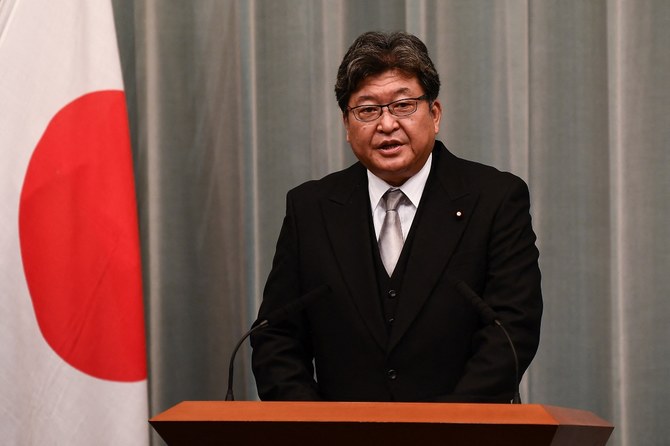
Hagiuda said he held a video conference with the UAE minister in charge on Monday and that he is arranging to make a similar request to Saudi Arabia. (File/AFP)
Short Url
Updated 26 October 2021
Follow

Japan requests boosting of UAE crude oil output: Minister

  • If the impact from surging crude oil prices spreads to small and midsize businesses, the ministry would create a consultation service and consider financing support Hagiuda said

TOKYO: Japan has asked the United Arab Emirates to increase its crude oil production in response to increased prices, industry minister Koichi Hagiuda said Tuesday.

“We will assess the impact on domestic industries by monitoring crude oil price trends and the domestic (price) situation for petroleum products,” Hagiuda told a press conference.

If the impact from surging crude oil prices spreads to small and midsize businesses, the ministry would create a consultation service and consider financing support, he said.

Hagiuda said he held a videoconference with the UAE minister in charge on Monday and that he is arranging to make a similar request to Saudi Arabia.

Also at the press conference, Hagiuda said he believes that it would not be appropriate to lift the suspension of a clause calling for a cut in gasoline taxes when gasoline prices continue to soar for a certain period.

Doing so would cause various problems, including confusing distribution systems and hurting central and local government finances, he said.

The clause, introduced by the administration of the now-defunct Democratic Party of Japan, has been suspended in order to secure funds for reconstruction programs in areas damaged in the March 2011 earthquake and tsunami.

In August, the UAE and Saudi Arabia supplied 76.7% of the total Japanese crude oil imports, a record for the two Arab countries feeding over three-quarters of Japan oil needs, data from the Ministry of Economy, Trade, and Industry showed.

Japan also struck its first fuel ammonia cooperation deal with the UAE’s Abu Dhabi National Oil Company (ADNOC) in January.

The two countries also agreed to further advance bilateral cooperation in areas including hydrogen and fuel ammonia.

*With JIJI Press

This story was originally published in Japanese on Arab News Japan


UAE uses AI to guide oil production decisions, transform factories, ports

Updated 22 January 2026
Follow

UAE uses AI to guide oil production decisions, transform factories, ports

  • Move marks major step, says minister for foreign trade

DUBAI: The UAE is now using artificial intelligence to guide production decisions in its oil and gas sector, replacing traditional simulation-based methods, a senior official said during the World Economic Forum in Davos on Thursday.

Speaking during the Factories That Think panel, the UAE’s Minister for Foreign Trade Thani Ahmed Al-Zeyoudi said the move marked a major step in the country’s adoption of AI, robotics and digital technologies across manufacturing, logistics, and energy sectors.

“Now we are applying AI. The AI tells us where to produce. We don’t need simulation engineers anymore to tell us where,” Al-Zeyoudi explained.

He said digitalization was also transforming the entire value chain, adding: “Digitalization and digital twinning are not only happening in factories, they are now across the entire value chain, from extraction and manufacturing to logistics, distribution and customs clearance.”

Al-Zeyoudi highlighted the UAE’s global logistics network, and said: “We have historically invested heavily in logistics, and today we are connected to around 250 ports around the world.

“The majority of consignments are now cleared before they arrive. What used to take a few days now takes just a matter of minutes.”

The minister also discussed the country’s shift away from labor-intensive models, and said: “This is no longer about wages; it’s about digitalization and improving efficiency in how we run operations.”

Robotics are being deployed at industrial sites to reduce downtime, and Al-Zeyoudi said: “Sites that used to shut down for three to six months can now be monitored by robotics during operation, reducing downtime to just a couple of days.”