



ISLAMABAD: Pakistani Prime Minister Imran Khan on Monday met with Saudi Crown Prince Mohammed bin Salman on the sidelines of the Middle East Green Initiative (MGI) summit in Riyadh and discussed with him a range of issues, including climate change, measures to tackle it and the Afghanistan situation.
At the launch of the summit in Riyadh, Crown Prince Mohammed announced two initiatives at a cost of $10.39 billion to combat climate change. The projects include an investment fund for carbon economy solutions in the region and a global initiative that will contribute to clean fuel solutions to feed more than 750 million people worldwide. Saudi Arabia will contribute around 15 percent of the entire cost.
PM Khan traveled to the kingdom on the invitation of the Saudi crown prince to attend the MGO summit and share his perspective on challenges faced by developing countries due to climate change.
During his meeting with the crown prince, PM Khan paid tribute to the leadership of the Custodian of the Two Holy Mosques, His Majesty King Salman bin Abdulaziz, in the progress and development of the kingdom. He lauded the crown prince for the Saudi Vision 2030, a strategic framework to reduce Saudi Arabia’s dependence on oil, diversify its economy, and develop public service sectors such as health, education, infrastructure, recreation, and tourism.
“The prime minister warmly congratulated the crown prince on successfully organizing the Middle East Green Initiative (MGI) Summit on Climate Change,” his office said in a statement.
“The summit clearly demonstrated the commitment of the Saudi leadership to take tangible steps for effectively tackling the challenge of Climate Change. The Prime Minister noted that the Saudi Green Initiative and the Middle East Green Initiative aligned closely with Pakistan’s Climate Change Initiatives – ‘Clean and Green Pakistan’ and the ‘Ten Billion Tree Tsunami’.”
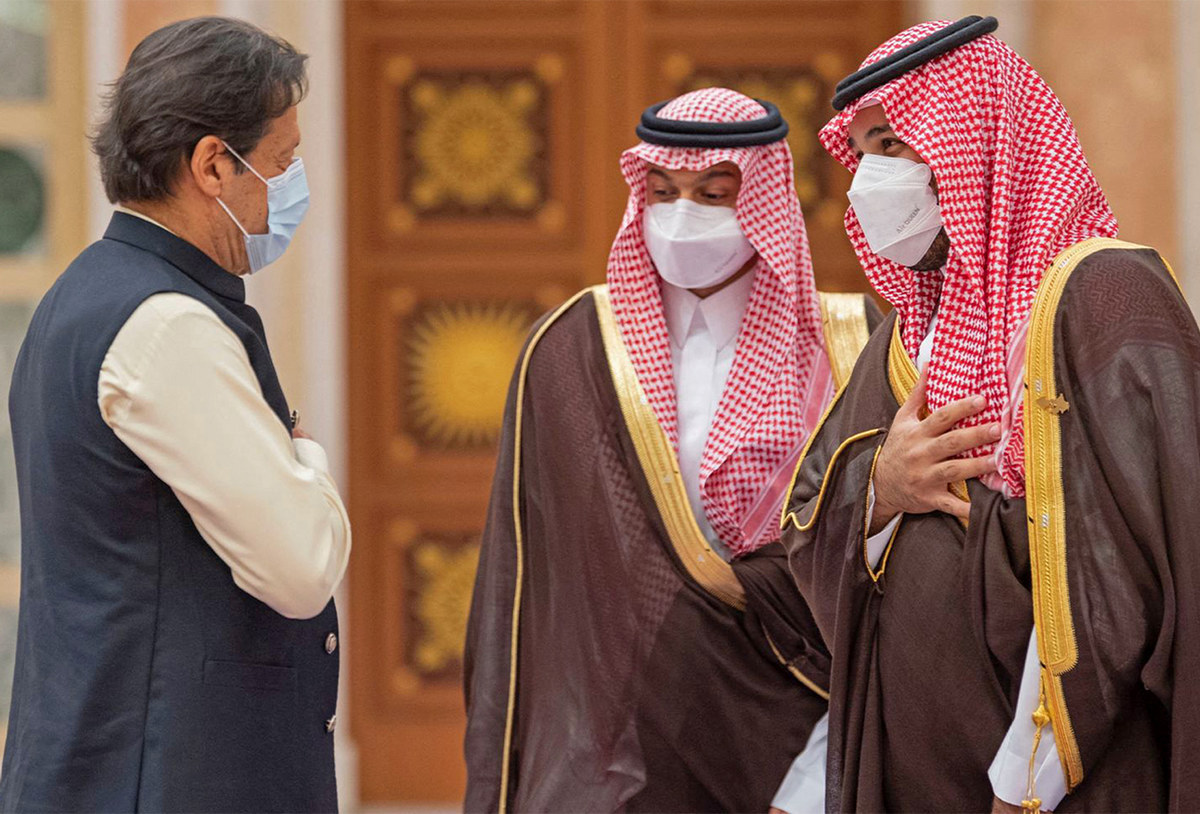
A handout picture provided by the Saudi Royal Palace on October 25, 2021 shows Saudi Crown Prince Mohammed bin Salman (R) welcoming Pakistani Prime Minister Imran Khan (L) during the Middle East Green Initiative Summit (MGI) in the Saudi capital Riyadh. (AFP)
He reiterated Pakistan’s support in the implementation of the initiatives and highlighted the significance Pakistan attached to its strategic ties with the kingdom.
The prime minister also expressed gratitude to Saudi Arabia for its steadfast support to Pakistan at every crucial juncture, according to PM Khan’s office. The two leaders agreed to further strengthen bilateral cooperation across all fields.
On the latest developments in Afghanistan, the Pakistan premier stressed the importance of active and constructive engagement of the international community to help alleviate the suffering of the Afghan people. He expressed concern about the deteriorating humanitarian situation in Afghanistan and hoped that the international community would take urgent steps to prevent a humanitarian crisis and economic collapse in Afghanistan.
In his address to the MGI summit earlier, PM Khan said, “All the experience that we have had in so far planting 2.5 billion trees in Pakistan and our target is 10 billion trees, so we will be sharing all our experience with you Highness [Crown Prince Mohammed bin Salman].”
He said climate change was probably one of the biggest crises facing humanity: “Unfortunately, this crisis was quite visible 20 years ago, but somehow we were all in self-denial. No one thought that this would actually happen, that the temperature was getting warmer. No one believed there would be effects of this.”
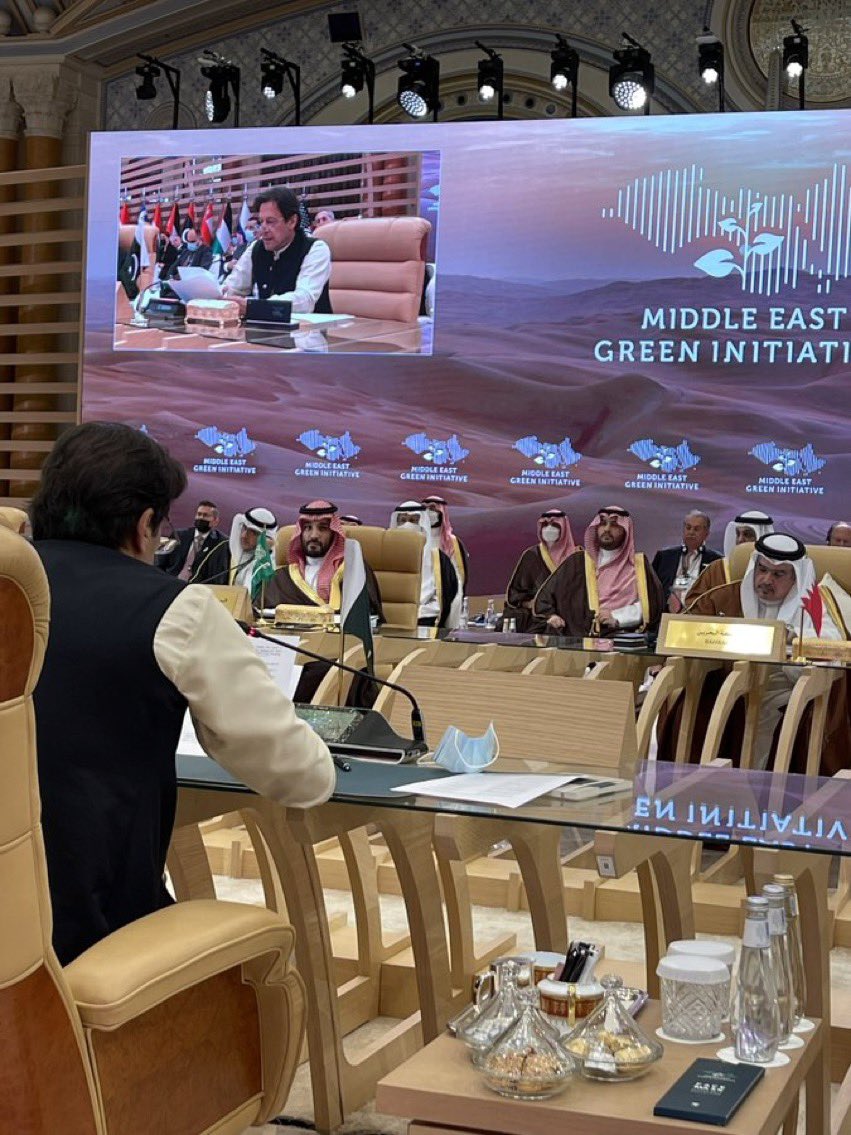
Pakistan's Prime Minister Imran Khan (left) addressses the Middle East Green Initiative Summit in Riyadh, Saudi Arabia, on October 25, 2021. (Photo courtesy: PTI/Twitter)
Khan highlighted the actions Pakistan was taking to combat climate change and emissions, including planting billions of trees and converting coal projects to hydroelectricity.
“We will shift 60 percent of all our energy into clean energy by 2030. Thirty percent of all transport will be shifted to electric vehicles by 2030. We already shelved 2400 megawatts of coal projects, and replaced them with 3700 megawatts of hydroelectricity, and then committed there would be no new coal projects in Pakistan,” he said. “The only energy through coal will be gasifications and that’s using local coal that is in Pakistan.”
Khan said Pakistan had focused on nature-based solutions. “Pakistan is the only country where mangrove carbon is growing. Mangroves absorb the highest amount of carbon emissions – we plan to plant 1 billion more of these trees by 2023.”
The MGI summit is the first of its kind event in the Middle East region. Riyadh, a signatory to the Paris climate pact, on Saturday set out details of its nationally determined contributions (NDCs) — goals for individual states under global efforts to prevent average global temperatures from rising beyond 1.5 degrees Celsius above pre-industrial levels.
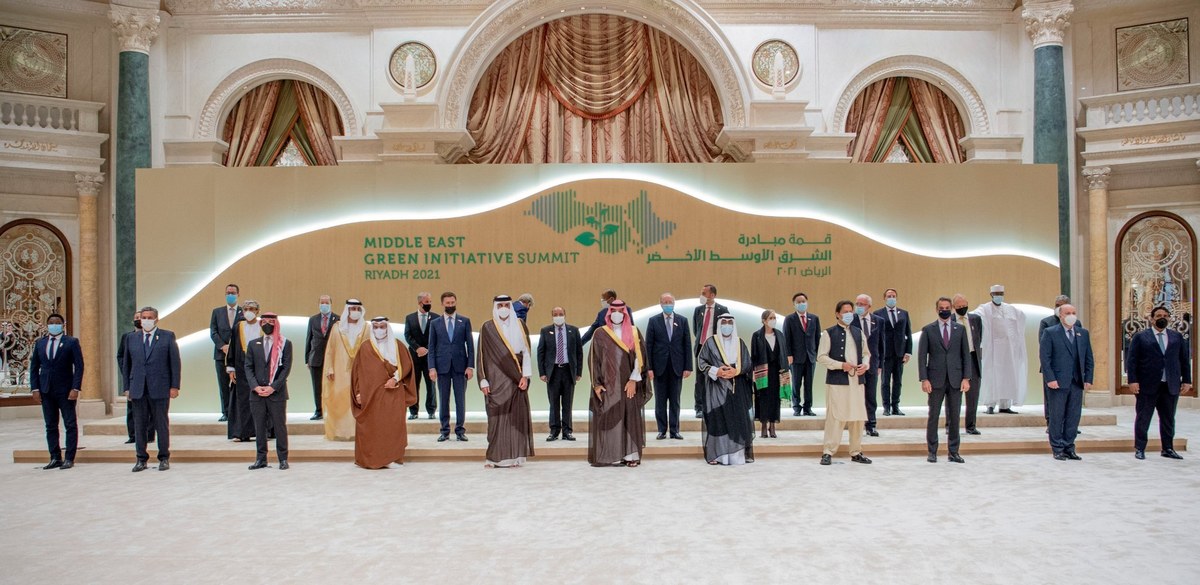
Top leaders and government officials from around the globe pose for a group photo as they gather in Riyadh on October 25, 2021, for the Middle East Green Initiative Summit mediated by Saudi Crown Prince Mohammed bin Salman (sixth from left). (Photo courtesy: Saudi Green Initiative)
The United States and the European Union want Saudi Arabia to join the global initiative on slashing methane emissions by 30 percent by 2030.
In his address to the summit, Crown Prince Mohammed said the kingdom would build a regional program to reduce carbon emissions within the framework of the Middle East Green Initiative and create a platform to implement the concept of a circular carbon economy.
“There are gaps in the regional climate action system. And through coordinating regional efforts and sharing experiences and technologies, we can accelerate achievements in our initiatives,” he said.
“We gather today at this summit to join forces and coordinate our efforts to protect the environment, confront climate change, and develop a roadmap toward reducing carbon emissions in the region by more than 10 percent of global contribution, and plant 50 billion trees in the region, through the largest tree-planting program globally,” the crown prince said.
“This will contribute to achieving 5 percent of the global target for afforestation,” he added.


