

In Riyadh meeting with envoy Kerry, PM Khan urges investment in climate change mitigation

U.S. special presidential envoy for climate John Kerry (L) calls on Pakistan Prime Minister Imran Khan, on the sidelines of the Middle East Green Initiative (MGI) summit, in Riyadh, Saudi Arabia, on October 25, 2021. (Photo courtesy: APP)
Short Url
Updated 25 October 2021
Follow

In Riyadh meeting with envoy Kerry, PM Khan urges investment in climate change mitigation

  • Prime Minister Imran Khan is in Saudi Arabia for the Middle East Green Initiative summit 
  • Last month, Pakistan, US held inaugural meeting of joint working group on climate, environment

ISLAMABAD: Pakistani Prime Minister Imran Khan on Monday urged a top United States official to explore the possibility of climate change mitigation investment in Pakistan and other developing nations, the prime minister’s office said, in a meeting held on the sidelines of the Middle East Green Initiative (MGI) summit in Riyadh. 
PM Khan was in Saudi Arabia on the invitation of Crown Prince Mohammed bin Salman to attend the MGI summit. He met US special presidential envoy for climate, John Kerry, on the sidelines of the moot on Monday. 
The development came weeks after Pakistan and the US held an inaugural meeting of a joint working group on climate and environment, and agreed to take “greater action” for climate change mitigation and adaptation. 
The US-Pakistan working group was formed in July this year at a meeting between Pakistani PM’s aide on climate change Malik Amin Aslam and US special envoy Kerry in London, where they both were attending a ministerial meeting on climate change on July 25-26. 
PM Khan “encouraged the Special Envoy to further explore the possibility of enhanced bilateral engagement through the US International Development Finance Corporation (DFC) to support investment in climate [change] mitigation, resilience, and adaptation in Pakistan and the developing world,” the PM’s office said in a statement. 
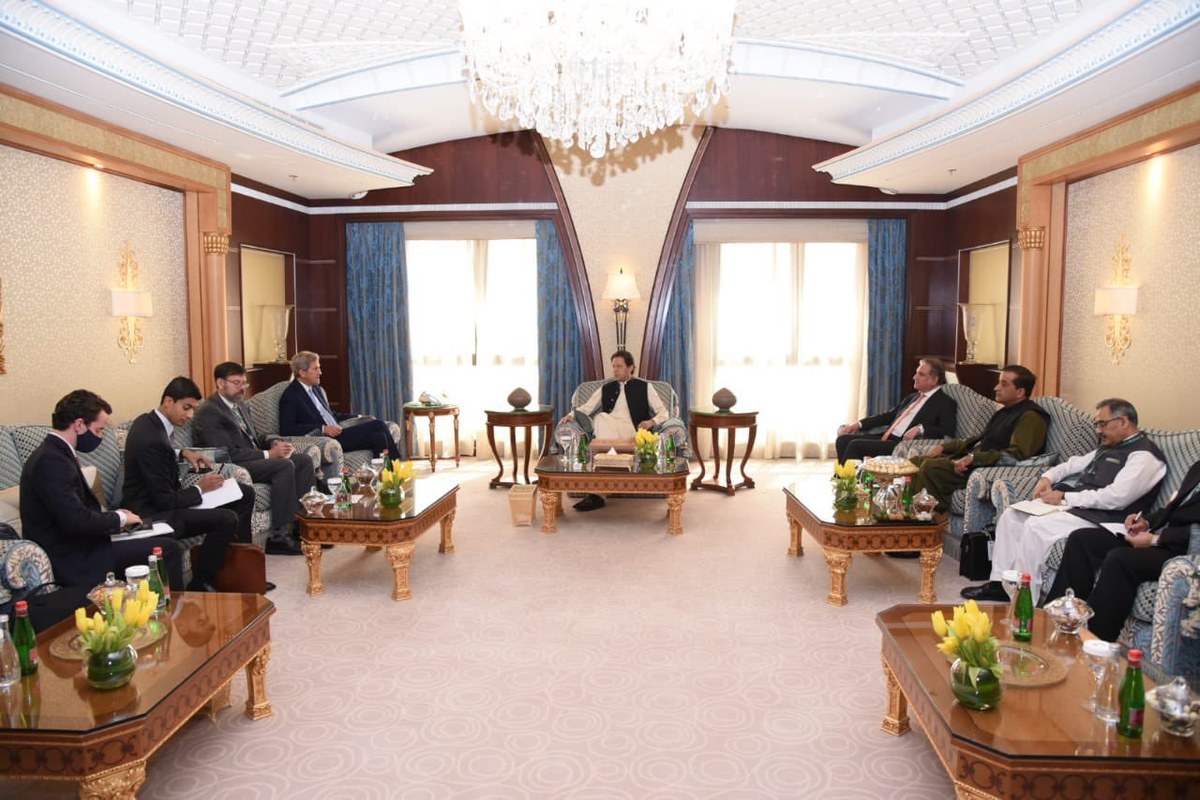


U.S. special presidential envoy for climate John Kerry (4L) mets Pakistan Prime Minister Imran Khan (C), on the sidelines of the Middle East Green Initiative (MGI) summit, in Riyadh, Saudi Arabia, on October 25, 2021. (Photo courtesy: APP)

The Pakistan premier underscored the need to reinforce national as well as global emphasis against this existential threat. 
Special Envoy Kerry agreed that “Pakistan and the US shared a longstanding relationship, which should be further reinforced in areas of mutual convergence, including climate and environment,” the statement read. 
The US official briefed PM Khan on various measures undertaken by President Joe Biden’s administration to develop a broad global consensus on climate action in the run-up to the United Nations Climate Change Conference of Parties later this month. 
The 2021 United Nations Climate Change Conference, also known as COP26, is the 26th United Nations Climate Change conference, scheduled to be held in the city of Glasgow from October 31 to November 12 under the presidency of the United Kingdom. 
PM Khan further said that Pakistan and the US should continue sharing ideas, expertise and technology to optimize mutually beneficial opportunities in the fight against climate change. 
The two sides agreed to work in “close coordination to determine next steps in building an effective framework of cooperation in this regard,” the statement said. 
PM Khan was in Saudi Arabia to share his perspective on the challenges faced by the developing countries due to climate change at the MGI Summit. 
In January 2021, Germanwatch, a Bonn-based think tank, described Pakistan as the eighth most vulnerable country to climate change, having witnessed 173 extreme weather events and suffered an estimated loss of $3.8 billion as a consequence from 2000 to 2019. 


Pakistan reviews austerity measures amid Middle East crisis, urges strict nationwide implementation

Updated 11 March 2026
Follow

Pakistan reviews austerity measures amid Middle East crisis, urges strict nationwide implementation

  • Deputy Prime Minister Ishaq Dar chairs review meeting of austerity steps
  • Officials briefed on salary cuts, school closures, four‑day week, petrol conservation

ISLAMABAD: Pakistan’s government on Wednesday assessed progress on a sweeping set of austerity measures introduced to mitigate the country’s economic strain from sharply rising global oil prices and supply disruptions linked to the ongoing war in the Middle East.

Prime Minister Shehbaz Sharif this week announced a series of austerity steps, including a four‑day work week for government offices, requiring 50  percent of staff to work from home, cutting fuel allowances for official vehicles by half, grounding up to 60  percent of the government fleet and closing all schools for two weeks to conserve fuel amid the global oil crisis.

The measures were unveiled in response to global oil market volatility triggered by the conflict involving the United States, Israel and Iran, which has disrupted supply routes such as the Strait of Hormuz and pushed crude prices sharply higher, straining Pakistan’s heavily import‑dependent energy sector.

“The meeting stressed the importance of strict and transparent adherence to the austerity measures, promoting fiscal responsibility and prudent use of public resources,” Deputy Prime Minister and Foreign Minister Senator Mohammad Ishaq Dar said in a statement.

He was chairing a meeting of the Committee for Monitoring and Implementation of Conservation and Additional Austerity Measures, constituted under the directions of the PM, bringing together federal and provincial officials to review execution of the broad cost‑cutting plan. 

Dar emphasized the government’s commitment to enforcing the PM’s austerity steps nationwide. The committee’s review also covered reductions in departmental expenditure, deductions from salaries of senior officials earning over Rs. 300,000 ($1,120), and coordination with provincial administrations to ensure uniform implementation of the plan.

Participants at the meeting reiterated that all ministries and divisions must continue strict monitoring and reporting, with transparent oversight mechanisms, as Pakistan navigates the economic pressures from the prolonged Middle East crisis and its fallout on global energy and trade markets.