

Trapped in ‘cruel’ forest, migrant regrets Belarus-EU crossing

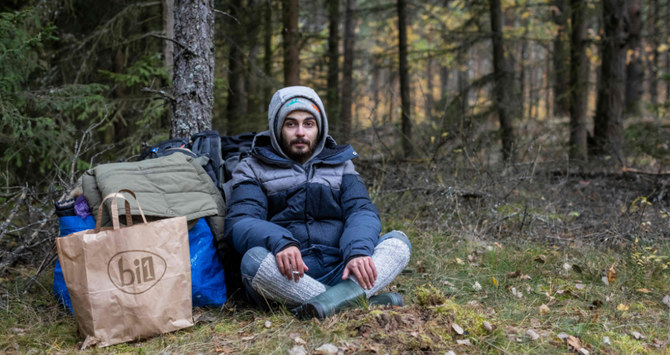
24-year-old Ali Abd Alwareth from Lebanon sits in the woods outside the Emergency State zone at the Polish-Belarusian border and waits for arrival of Border Guard patrol, October 22, 2021. (AFP)
Short Url
Updated 24 October 2021
Follow

Trapped in ‘cruel’ forest, migrant regrets Belarus-EU crossing

  • The EU suspects Belarus is masterminding the unprecedented influx of migrants into Poland as a form of retaliation against EU sanctions

KLESZCZELE, Belarus: Exhausted and trapped in a cold, “cruel” forest, Lebanese barber Ali Abd Alwareth said he regretted his week-long bid to enter the European Union via the Belarus-Poland border.

“It’s miserable. Something that you don’t wish for your worst enemy ... A nightmare,” the soft-spoken 24-year-old with Crohn’s disease told AFP.

Sitting cross-legged on a bed of pine needles and dead leaves near the border town of Kleszczele in eastern Poland, Abd Alwareth described being a ping-pong ball for the guards.

“I tried crossing like five, six times, and every time I got caught and deported back to the border” by Poland, he said in English.

The Belarusian side meanwhile refused to let him return to Minsk to fly home.

Abd Alwareth said security forces told him: “You have only two choices: either you die here or you die in Poland. That’s it.”

One of thousands of migrants — mostly from the Middle East — who have tried to penetrate the 400-km border since August, Abd Alwareth said he left the financial crisis in Lebanon in search of a better life.

The whole journey from his home region of Bekaa cost $4,000 and involved help from a Minsk-based company he found on social media.

The EU suspects Belarus is masterminding the unprecedented influx of migrants into Poland as a form of retaliation against EU sanctions, but the regime has put the blame on the West.

Poland has sent thousands of troops, built a razor-wire fence and implemented a three-month state of emergency that bans journalists and charity workers along the immediate border area.

During his grueling time in the woods, Abd Alwareth said he drank water off of leaves, was too cold to sleep, and was once hit on the head by either the Polish army or police.

Though “exhausted” and “devastated,” he said he understood that the border guards “are doing their job. They are protecting their country. We are illegal.”

On Friday, Abd Alwareth and his Syrian walking companions managed to get in touch with Polish activists, who met them in the forest with warm clothes and food as well as offering support when the guards arrived.

His fate up in the air, Abd Alwareth hopes to receive asylum in Poland — or at the very least, to return to Lebanon.

“Okay, you don’t want me here, you don’t want me in Belarus. Just deport me back home. That’s all I’m asking for,” he said.

“What is happening in the forest is cruel ... I feel like a puppet. It was my decision, I came this way -- but not to be treated like this,” he added.

“I refuse to die at the border. I just want to see my mum.”


What is Trump’s ‘Board of Peace’?

Updated 10 sec ago
Follow

What is Trump’s ‘Board of Peace’?

  • Countries asked to pay $1 billion for a permanent spot on the board
  • The board was originally conceived to oversee the rebuilding of Gaza

BRUSSELS: US President Donald Trump’s government has asked countries to pay $1 billion for a permanent spot on his “Board of Peace” aimed at resolving conflicts, according to its charter seen by AFP.

The board was originally conceived to oversee the rebuilding of Gaza, but the charter does not appear to limit its role to the occupied Palestinian territory.

WHAT WILL IT DO?

The Board of Peace will be chaired by Trump, according to its founding charter.

It is “an international organization that seeks to promote stability, restore dependable and lawful governance, and secure enduring peace in areas affected or threatened by conflict,” reads the preamble of the charter sent to countries invited to participate.

It will “undertake such peace-building functions in accordance with international law,” it adds.

WHO WILL RUN IT?

Trump will be chairman but also “separately serve as inaugural representative” of the US.

“The chairman shall have exclusive authority to create, modify, or dissolve subsidiary entities as necessary or appropriate to fulfil the Board of Peace’s mission,” the document states.

He will pick members of an executive board to be “leaders of global stature” to “serve two-year terms, subject to removal by the chairman.”

He may also, “acting on behalf of the Board of Peace,” “adopt resolutions or other directives.”

The chairman can be replaced only in case of “voluntary resignation or as a result of incapacity.”

WHO CAN BE A MEMBER?

Member states must be invited by the US president, and will be represented by their head of state or government.

Each member “shall serve a term of no more than three years,” the charter says.

But “the three-year membership term shall not apply to member states that contribute more than USD $1,000,000,000 in cash funds to the Board of Peace within the first year of the charter’s entry into force,” it adds.

The board will “convene voting meetings at least annually,” and “each member state shall have one vote.”

But while all decisions require “a majority of member states present and voting,” they will also be “subject to the approval of the chairman, who may also cast a vote in his capacity as chairman in the event of a tie.”

WHO’S ON THE EXECUTIVE BOARD?

The executive board will “operationalize” the organization’s mission, according to the White House, which said it would be chaired by Trump and include seven members:

US Secretary of State Marco Rubio

Steve Witkoff, Trump’s special negotiator

Jared Kushner, Trump’s son-in-law

Tony Blair, former UK prime minister

Marc Rowan, billionaire US financier

Ajay Banga, World Bank president

Robert Gabriel, loyal Trump aide on the National Security Council

WHICH COUNTRIES ARE INVITED?

Dozens of countries and leaders have said they have received an invitation.

They include China, India, Russia’s President Vladimir Putin, Ukraine’s Volodymyr Zelensky and Canada’s Prime Minister Mark Carney.

Egypt’s President Abdel Fattah El-Sisi and Argentina’s President Javier Milei have also confirmed an invite.

Other countries to confirm invites include Jordan, Brazil, Paraguay, Pakistan and a host of nations from Europe, Central Asia and the Middle East.

WHO WILL JOIN?

Countries from Albania to Vietnam have indicated a willingness to join the board.

Hungarian Prime Minister Viktor Orban, Trump’s most ardent supporter in the European Union, is also in.

Canada said it would take part, but explicitly ruled out paying the $1-billion fee for permanent membership.

It is unclear whether others who have responded positively — Armenia, Belarus, Kazakhstan, Morocco and Vietnam among them — would be willing to pay the $1 billion.

WHO WON’T BE INVOLVED?

Long-time US ally France has indicated it will not join. The response sparked an immediate threat from Trump to slap sky-high tariffs on French wine.

Zelensky said it would be “very hard” to be a member of a council alongside Russia, and diplomats were “working on it.”

WHEN DOES IT START?

The charter says it enters into force “upon expression of consent to be bound by three States.”