

Pakistani prime minister arrives in Saudi Arabia on three-day visit

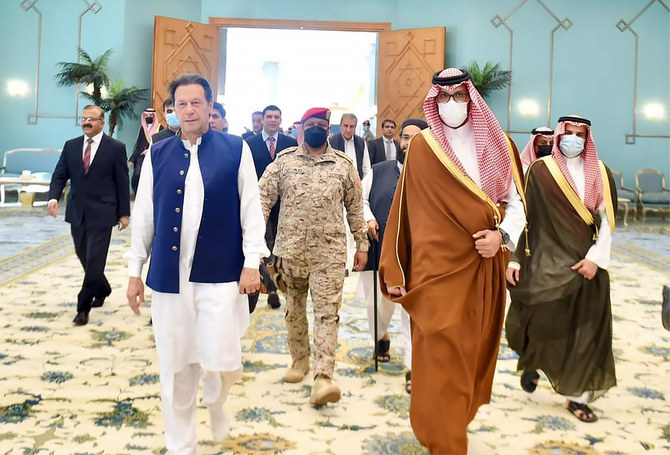
Deputy Governor of Madinah Prince Saud bin Khalid Al-Faisal (right in first row) receives Pakistan Prime Minister Imran Khan (left in first row) in Madinah, Saudi Arabia, on October 23, 2021. (Photo courtesy: SPA)
Short Url
Updated 24 October 2021
Follow

Pakistani prime minister arrives in Saudi Arabia on three-day visit

  • In second trip to the kingdom this year, Khan will attend Middle East green summit in Riyadh on Monday
  • Will attend event to promote investment in Pakistan, meet leading Saudi and Pakistani businessmen

ISLAMABAD: Pakistani Prime Minister Imran Khan on Saturday arrived in Saudi Arabia on a three-day visit at the invitation of Crown Prince Mohammed bin Salman and was received by Deputy Governor of Madinah Prince Saud bin Khalid Al-Faisal, announced the PM Office in a Twitter post.
This is Khan’s second visit to Saudi Arabia this year. He visited the kingdom last in May and signed several agreements.
“Prime Minister @ImranKhanPTI arrives in Madina on 3-day official visit to Saudi Arabia,” the Prime Minister’s Office said in a social media post with Khan’s pictures in the kingdom. “The PM was received by Deputy Govenor of Madinah Prince Saud bin Khalid Al-Faisal, and was given a warm reception.”


According to Pakistan’s state-run APP news agency, the prime minister will attend the “inaugural ceremony of the ‘Middle East Green Initiative (MGI) Summit’ being held in Riyadh” on Monday.
“The first of their kind in the Middle East Region, ‘Green Saudi Arabia’ and ‘Green Middle East’ initiatives were launched by the Crown Prince in March 2021 aimed at protecting the nature and planet,” it added.
Foreign Minister Shah Mahmood Qureshi, Energy Minister Hammad Azhar and the PM’s Special Assistant on Climate Change Malik Amin Aslam are accompanying the prime minister.
At the MGI summit, Khan will speak about challenges faced by developing countries due to climate change and highlight Pakistan’s experience of launching nature-based solutions to address environmental concerns, including the 10 Billion Tree Tsunami tree planation project, a flagship of his government.
“Besides meeting the Saudi leadership, the prime minister will also participate in an event on the promotion of investment in Pakistan and interact with leading investors and businessmen from Saudi Arabia and Pakistani diaspora,” APP said.
On Saturday, the crown prince of Saudi Arabia said the world’s top oil exporter aimed to reach zero-net emissions by 2060 and more than doubled its annual target to reduce carbon emissions to almost 280 million tons.
Crown Prince Mohammed bin Salman was speaking in recorded remarks at the Saudi Green Initiative, which comes ahead of the 26th UN Climate Change Conference of the Parties, or COP26, in Glasgow from Oct. 31 — Nov. 12, that hopes to agree on deeper emissions cuts to tackle global warming.
Riyadh, a signatory to the Paris climate pact, on Saturday set out details of its nationally determined contributions (NDCs) — goals for individual states under global efforts to prevent average global temperatures from rising beyond 1.5 degrees Celsius above pre-industrial levels.
The United States and the EU want Saudi Arabia to join a global initiative on slashing emissions of methane by 30 percent from 2020 levels by 2030.
US climate envoy John Kerry will also attend the wider Middle East green summit Riyadh is hosting on Monday.



Sindh assembly passes resolution rejecting move to separate Karachi

Updated 21 February 2026
Follow

Sindh assembly passes resolution rejecting move to separate Karachi

  • Chief Minister Shah cites constitutional safeguards against altering provincial boundaries
  • Calls to separate Karachi intensified amid governance concerns after a mall fire last month

ISLAMABAD: The provincial assembly of Pakistan’s southern Sindh province on Saturday passed a resolution rejecting any move to separate Karachi, declaring its territorial integrity “non-negotiable” amid political calls to carve the city out as a separate administrative unit.

The resolution comes after fresh demands by the Muttahida Qaumi Movement (MQM) and other voices to grant Karachi provincial or federal status following governance challenges highlighted by the deadly Gul Plaza fire earlier this year that killed 80 people.

Karachi, Pakistan’s largest and most densely populated city, is the country’s main commercial hub and contributes a significant share to the national economy.

Chief Minister Syed Murad Ali Shah tabled the resolution in the assembly, condemning what he described as “divisive statements” about breaking up Sindh or detaching Karachi.

“The province that played a foundational role in the creation of Pakistan cannot allow the fragmentation of its own historic homeland,” Shah told lawmakers, adding that any attempt to divide Sindh or separate Karachi was contrary to the constitution and democratic norms.

Citing Article 239 of Pakistan’s 1973 Constitution, which requires the consent of not less than two-thirds of a provincial assembly to alter provincial boundaries, Shah said any such move could not proceed without the assembly’s approval.

“If any such move is attempted, it is this Assembly — by a two-thirds majority — that will decide,” he said.

The resolution reaffirmed that Karachi would “forever remain” an integral part of Sindh and directed the provincial government to forward the motion to the president, prime minister and parliamentary leadership for record.

Shah said the resolution was not aimed at anyone but referred to the shifting stance of MQM in the debate while warning that opposing the resolution would amount to supporting the division of Sindh.

The party has been a major political force in Karachi with a significant vote bank in the city and has frequently criticized Shah’s provincial administration over its governance of Pakistan’s largest metropolis.

Taha Ahmed Khan, a senior MQM leader, acknowledged that his party had “presented its demand openly on television channels with clear and logical arguments” to separate Karachi from Sindh.

“It is a purely constitutional debate,” he told Arab News by phone. “We are aware that the Pakistan Peoples Party, which rules the province, holds a two-thirds majority and that a new province cannot be created at this stage. But that does not mean new provinces can never be formed.”

Calls to alter Karachi’s status have periodically surfaced amid longstanding complaints over governance, infrastructure and administrative control in the megacity, though no formal proposal to redraw provincial boundaries has been introduced at the federal level.