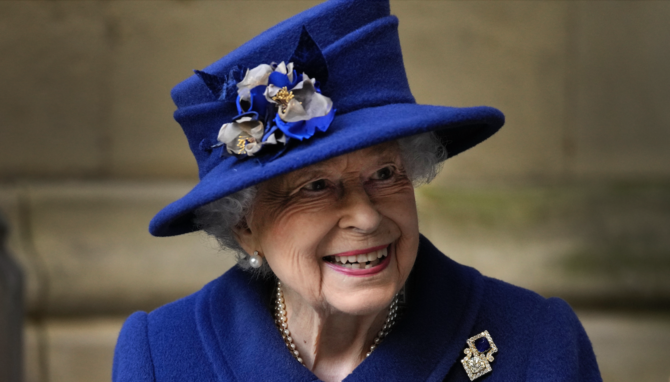
LONDON: Britain’s Queen Elizabeth II was back at Windsor Castle on Friday and in good spirits after revelations that she spent the night in a London hospital earlier this week.
Buckingham Palace said the 95-year-old British monarch went to the private King Edward VII’s Hospital in London on Wednesday for “preliminary investigations.” She returned to her Windsor Castle home at lunchtime on Thursday and was understood to be back at her desk by afternoon, undertaking light duties.
The queen underwent the tests after she canceled a scheduled trip to mark 100 years since the creation of Northern Ireland, and the palace said she had “reluctantly” accepted medical advice to rest for a few days. The matter was not related to COVID-19.
The palace does not normally offer a running account of the monarch’s health, citing her privacy. However, in this case it confirmed the queen’s hospital stay after The Sun newspaper reported the news.
On the whole, there is a rule of thumb is that if a senior member of the royal family undergoes a procedure or an operation, there is a medical bulletin, royal expert Robert Hardman told the BBC. But that doesn’t apply to tests.
The attention paid to the development merely reflects the great affection the global community has for the monarch, said Hardman, author of “Queen of the World,” which chronicles the monarch’s influence and stature around the globe.
“She hates people making a fuss of her in general but particularly to do with health,” he told the BBC. “And I think there’s a concern to sort of maintain the dignity of the office, and I know that one reason why nothing was said about yesterday’s trip to hospital was that they sort of didn’t suddenly want sort of huge banks of cameras and 24-hour news setting up outside the hospital.”
There has been some disquiet this week about Elizabeth’s health. Only days ago, she was seen using a walking stick at a Westminster Abbey service marking the centenary of the Royal British Legion, an armed forces charity. Though she had used a cane in 2003, it was after she underwent knee surgery.
Focus then turned to her hectic schedule, which has in recent days included audiences with diplomats, a reception at Windsor Castle for global business leaders, and attending the horse race at Ascot Racecourse.
In less than two weeks she is due to host world leaders at the United Nations climate summit in Glasgow, Scotland — a big engagement cited as one reason why she might want to rest up in advance.
Though Elizabeth has enjoyed robust health throughout her life, she is Britain’s longest-lived and longest-reigning monarch. She is due to celebrate her Platinum Jubilee — 70 years on the throne — next year.
Elizabeth has ruled since 1952 and was widowed this year when Prince Philip died at age 99 in April. She has cut back on her workload in recent years but still keeps a busy schedule of royal duties.
She recently declined the honor of being named “Oldie of the Year” by The Oldie magazine. Her office said that “Her Majesty believes you are as old as you feel, as such The Queen does not believe she meets the relevant criteria to be able to accept.”

Queen Elizabeth II back at castle following hospital visit
Short Url
https://arab.news/6e936
Queen Elizabeth II back at castle following hospital visit
- The queen underwent the tests after she canceled a scheduled trip to mark 100 years since the creation of Northern Ireland
- She is due to celebrate her Platinum Jubilee — 70 years on the throne — next year
Australia calls on Trump to respect NATO soldiers
- ‘Those 47 Australian families who will be hurting by these comments, they deserve our absolute respect, our admiration’
- US President Donald Trump lamented efforts of non-US troops in Afghanistan as ‘completely unacceptable’
SYDNEY: Australian Prime Minister Anthony Albanese said on Sunday that comments from US President Donald Trump lamenting the efforts of non-US troops in Afghanistan were “completely unacceptable.”
Trump said in a Fox News interview that NATO sent “some troops” but “stayed a little back, a little off the front lines.”
Trump appeared to be partially walking back his remarks on Saturday amid growing outrage from European and now Australian allies.
Speaking on the ABC’s Insiders program on Sunday morning, Albanese said Australian families of fallen soldiers would be “hurting” as a result of Trump’s comments.
“Those 47 Australian families who will be hurting by these comments, they deserve our absolute respect, our admiration,” Albanese said.
“The bravery that was shown by 40,000 Australians (who) served in Afghanistan, they were certainly on the frontlines in order to, along with our other allies, defend democracy and freedom and to defend our national interests,” he added.
“They deserve our respect.”
On Saturday, a day after British Prime Minister Keir Starmer condemned Trump’s remarks as “appalling,” Trump appeared to change his position — at least as far as British troops were concerned.
“The GREAT and very BRAVE soldiers of the United Kingdom will always be with the United States of America!” Trump said on his Truth Social platform.
“In Afghanistan, 457 died, many were badly injured, and they were among the greatest of all warriors. It’s a bond too strong to ever be broken.”
Albanese referenced Trump’s later comments, suggesting he also appreciated the Australian effort in Afghanistan.
“I think President Trump’s comments overnight indicate a very different position. He’s acknowledged the contribution,” Albanese told the ABC, but added that Trump’s previous comments were “entirely not appropriate. Completely unacceptable.”
‘I don’t like you either’
Albanese also announced Australia’s next Ambassador to the United States, recommending Greg Moriarty for the job.
Earlier this month, Australia announced its ambassador to the United States, Kevin Rudd, would leave after a three-year tenure overshadowed by Trump’s verdict on him: “I don’t like you either.”
Former Australian prime minister Rudd, who departs his post on March 31 to become president of the Asia Society think tank in New York, had sharply criticized Trump while he was out of office.
Trump expressed disdain for Rudd during a televised US-Australia meeting at the White House in October last year, prompting some Australian opposition calls for his posting to be ended.
Albanese said Moriarty was an “outstanding Australian public servant,” and he had consulted with the Trump administration on his selection.
Trump said in a Fox News interview that NATO sent “some troops” but “stayed a little back, a little off the front lines.”
Trump appeared to be partially walking back his remarks on Saturday amid growing outrage from European and now Australian allies.
Speaking on the ABC’s Insiders program on Sunday morning, Albanese said Australian families of fallen soldiers would be “hurting” as a result of Trump’s comments.
“Those 47 Australian families who will be hurting by these comments, they deserve our absolute respect, our admiration,” Albanese said.
“The bravery that was shown by 40,000 Australians (who) served in Afghanistan, they were certainly on the frontlines in order to, along with our other allies, defend democracy and freedom and to defend our national interests,” he added.
“They deserve our respect.”
On Saturday, a day after British Prime Minister Keir Starmer condemned Trump’s remarks as “appalling,” Trump appeared to change his position — at least as far as British troops were concerned.
“The GREAT and very BRAVE soldiers of the United Kingdom will always be with the United States of America!” Trump said on his Truth Social platform.
“In Afghanistan, 457 died, many were badly injured, and they were among the greatest of all warriors. It’s a bond too strong to ever be broken.”
Albanese referenced Trump’s later comments, suggesting he also appreciated the Australian effort in Afghanistan.
“I think President Trump’s comments overnight indicate a very different position. He’s acknowledged the contribution,” Albanese told the ABC, but added that Trump’s previous comments were “entirely not appropriate. Completely unacceptable.”
‘I don’t like you either’
Albanese also announced Australia’s next Ambassador to the United States, recommending Greg Moriarty for the job.
Earlier this month, Australia announced its ambassador to the United States, Kevin Rudd, would leave after a three-year tenure overshadowed by Trump’s verdict on him: “I don’t like you either.”
Former Australian prime minister Rudd, who departs his post on March 31 to become president of the Asia Society think tank in New York, had sharply criticized Trump while he was out of office.
Trump expressed disdain for Rudd during a televised US-Australia meeting at the White House in October last year, prompting some Australian opposition calls for his posting to be ended.
Albanese said Moriarty was an “outstanding Australian public servant,” and he had consulted with the Trump administration on his selection.
© 2026 SAUDI RESEARCH & PUBLISHING COMPANY, All Rights Reserved And subject to Terms of Use Agreement.