Pakistani information minister says draft law on ‘fake news’ sent to cabinet for approval 

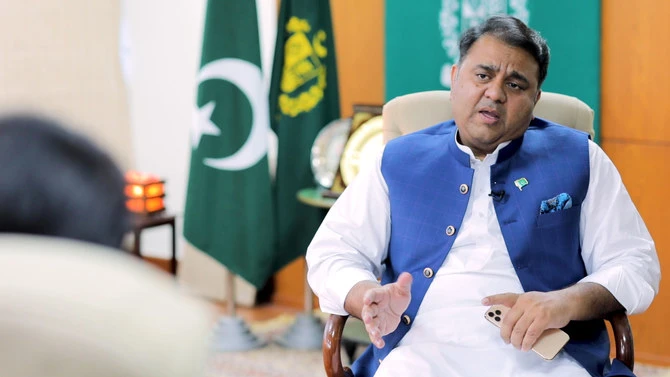
Pakistan's Science and Technology Minister Fawad Chaudhry speaks during an interview with Arab News in Islamabad on Sept. 10, 2020. (AN photo)
Short Url
Updated 22 October 2021
Follow

Pakistani information minister says draft law on ‘fake news’ sent to cabinet for approval 

  • Chaudhry Fawad Hussain says media and judicial reforms are necessary in Pakistan
  • His government aims to set up a media regulator to improve news industry standards 

ISLAMABAD: Pakistani Information Minister Chaudhry Fawad Hussain said on Friday that they had drafted a law on ‘fake news’ and it had been handed over to the federal cabinet for approval. 

The statement comes amid the government’s plans to set up a media regulatory authority to improve professional standards of the news industry by discouraging ‘fake news.’ 

The proposed Pakistan Media Development Authority, which would oversee films and monitor electronic, print and digital media, including Web TV, over-the-top content platforms and news websites, has rattled journalists and rights advocates, who fear it could be used to stifle dissent and free speech and institutionalize censorship. 

But Prime Minister Imran Khan’s government appears to be unfazed by the opposition to its plans. 

“[I] have been saying this since 2018 that the country cannot move forward without fundamental political reforms,” Hussain said in a Twitter post. 

“Media and judicial reforms are a must,” he added.

In August, Hussain had said the PMDA would be able to impose fines of up to Rs250 million, or roughly $1.5 million, on Pakistani media outlets that violate rules. But the government hadn’t included the provision of imprisonment in the new proposed law, he had said. 
Speaking at a discussion on ‘misinformation’ at the Arab News Pakistan Editors and Reporters conference in Islamabad last week, Hussain said it was important to combine freedom of expression with the idea of greater social responsibility. 

Quoting the former US president Barack Obama, he maintained that managing the flow of information had become the biggest challenge for modern governments around the world. 

He observed that ‘fake news’ was not only used by competing political factions, but also the rival countries engaging in information warfare.

World Bank president in Pakistan to discuss development projects, policy issues

Updated 01 February 2026
Follow

World Bank president in Pakistan to discuss development projects, policy issues

  • Pakistan, World Bank are currently gearing up to implement a 10-year partnership framework to grant $20 billion loans to the cash-strapped nation
  • World Bank President Ajay Banga will hold meetings with Pakistan Prime Minister Shehbaz Sharif and other senior officials during the high-level visit

ISLAMABAD: World Bank President Ajay Banga has arrived in Pakistan to hold talks with senior government officials on development projects and key policy issues, Pakistani state media reported on Sunday, as Islamabad seeks multilateral support to stabilize economy and accelerate growth.

The visit comes at a time when Pakistan and the World Bank are gearing up to implement a 10-year Country Partnership Framework (CPF) to grant $20 billion in loans to the cash-strapped nation.

The World Bank’s lending for Pakistan, due to start this year, will focus on education quality, child stunting, climate resilience, energy efficiency, inclusive development and private investment.

"World Bank President Ajay Banga arrives in Pakistan for a high-level visit," the state-run Pakistan TV Digital reported on Sunday. "During his stay, he will meet Prime Minister Shehbaz Sharif and other senior officials to discuss economic reforms, development projects, and key policy issues."

Pakistan, which nearly defaulted on its foreign debt obligations in 2023, is currently making efforts to stabilize its economy under a $7 billion International Monetary Fund (IMF) program.

Besides efforts to boost trade and foreign investment, Islamabad has been seeking support from multilateral financial institutions to ensure economic recovery.

“This partnership fosters a unified and focused vision for your county around six outcomes with clear, tangible and ambitious 10-year targets,” Martin Raiser, the World Bank vice president for South Asia, had said at the launch of the CPF in Jan. last year.

“We hope that the CPF will serve as an anchor for this engagement to keep us on the right track. Partnerships will equally be critical. More resources will be needed to have the impact at the scale that we wish to achieve and this will require close collaboration with all the development partners.”

In Dec., the World Bank said it had approved $700 million in ​financing for Pakistan under a multi-year initiative aimed at supporting the country's macroeconomic stability and service delivery.

It ‍followed a $47.9 ‍million World Bank grant ‍in August last year to improve primary education in Pakistan's most populous Punjab province.