

Lebanese design star Racil Chalhoub on how the pandemic changed her outlook on creativity, management

Racil Chalhoub was 10 years old when she told her mother she wanted to be a fashion designer. (Instagram)
Short Url
Updated 21 October 2021
Follow

Lebanese design star Racil Chalhoub on how the pandemic changed her outlook on creativity, management

  • ‘Beirut makes me want to dress up more than London does,’ says Racil Chalhoub

PARIS: Racil Chalhoub was 10 years old when she told her mother she wanted to be a fashion designer. They had gone to see a Marinelli fashion show at the Hotel Georges V in Paris when — blown away by what she had seen — the young Chalhoub turned to her mother and said: “That’s exactly what I want to do!”

In 2015, her dream came true when she launched her line of tuxedos for women — Racil — in London. The name is not an exercise in self-promotion, but a tribute to her mother, with whom she shares not only a first name, but also a keen and quirky fashion sense. She has since expanded her line to include dresses and tops.
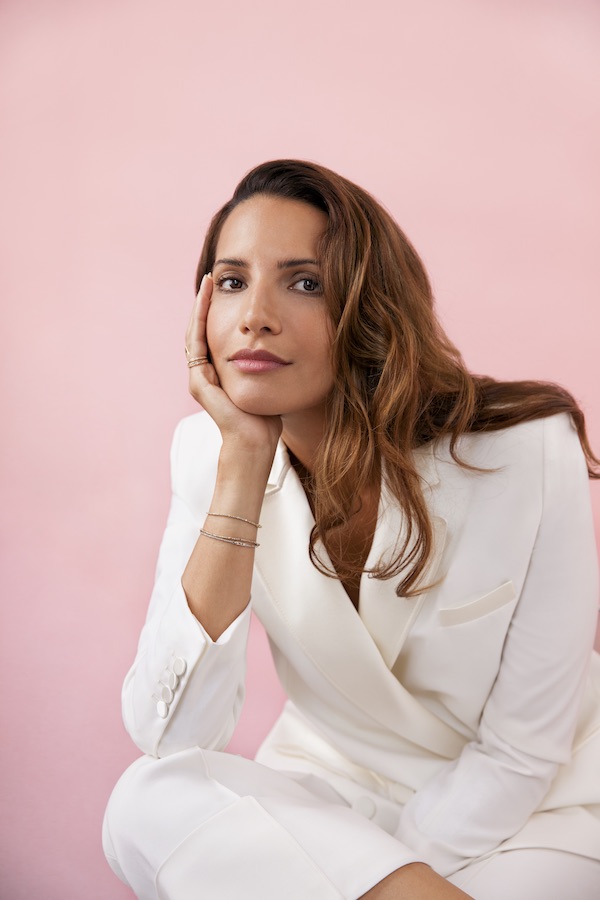


In 2015, her dream came true when she launched her line of tuxedos for women — Racil — in London. (Supplied)

When the COVID-19 pandemic hit, bringing the fashion industry and most of the world to a halt, Chalhoub — who was born in Lebanon, raised in Paris, and now lives in London, took the opportunity to pause, reflect and refocus her efforts.

Out of that time, a new collection was born earlier this year: an explosion of colors counterbalancing the black leggings and gray sweatshirts worn during lockdowns. For her Fall/Winter collection, black was replaced by brown and fresher colors, including coral, fuchsia, yellow and many more.

In her London apartment towards the end of summer, Chalhoub reflected on the past peculiar year, and discussed her inspirations and desires for her next collection with Arab News.


A post shared by RACIL (@racil)

How would you say the COVID-19 pandemic has affected your creative process and your daily work?

There are two complementary aspects in my field: creation and management — whether that’s regarding the brand, the business, the employees... The pandemic has really affected both of those aspects.

Creatively, it’s hard to stay inspired when you’re locked up at home, alone, for several months. Especially when you’re worrying about other things — the business, the employees, and family in Lebanon. So, honestly, I was facing a bit of a creative block. There are three elements that are always on my mood board: First, my mother, who is my muse and inspires me a lot, but whom I hadn’t seen for nearly a year. Second, (discos, clubs and) parties — and all of a sudden, we can’t go out. And third, the street. I walk a lot. I can find inspiration in a park or café, people-watching. During COVID, none of these three elements were present.


A post shared by RACIL (@racil)

It was only when I managed to escape from London in the summer to meet up with friends on vacation, to soak in the sun, roam the streets — when I was able to live a little again — that I found inspiration. Then I would sit in my corner and draw.

As for the management side, that was also difficult, because I came home one day and then never went back to the office. I have a team of 12 girls, whom I consider family. If I’m not doing well, the chances are they’re not doing well either.

So this period allowed me to think a lot about the structure of the company and the brand: what my identity is and where I’m heading. Coming out of all this, would I want the same thing as before? How could I adapt without losing my vision? I mean, with COVID we realized that the first thing we can live without is a suit or a tuxedo. A tuxedo is usually used to go to a gala or to a dinner, which we weren’t doing. We wear a suit to go to the office, where we weren’t going. But, at the same time, it’s what I love. It’s my brand’s DNA and I don’t want to lose that. So, why not translate it in a more relaxed way? I felt I couldn’t resume where I left off: I needed something different. So, in September, I decided to rebrand. I designed a new logo, launched new pieces, new categories and started new collaborations.


A post shared by RACIL (@racil)

I was feeling very restricted even before the pandemic. I had started this brand with this DNA and I really felt like it was the only thing I could do. So COVID was both an opportunity and a great excuse to say, “I’m going to try this, because it’s my brand. I’m going to allow myself to do it, and I’m going to see how my customers react.” And, so far, the reactions have been quite positive.

Would you say this new collection is more focused on the essentials?

For me, a jacket is essential. I’ve remained in that lane, but with different ‘essentials,’ adapted a little more to today's lifestyles. I have reduced the size of the collection, too. And I also worked a lot slower, which was quite stressful, but a lot more enjoyable as well. Before the pandemic, my days were always very stressful. It was a constant race. Then, all of a sudden, it was like we’d unplugged everything. So then we had to work out how to reconnect everything. But one thing I’m sure of: I cannot afford to run that fast anymore.


A post shared by RACIL (@racil)

We’re in a situation where we have to accept that some things are beyond our control. Before, if a delivery from a factory was late, I’d go crazy. Now I just do what I can. I can set a schedule and do everything I can to make everything work as it should, but you have to accept the slowdowns and setbacks. In the fashion business, where everything is so fast, this is refreshing.

Taking things day-by-day, not knowing what tomorrow holds, and realizing you can’t control everything… Would you say that resembles the Lebanese outlook?

That’s the Lebanese attitude, indeed. We still live day-by-day.

Do you still have a strong bond with Lebanon?


A post shared by RACIL (@racil)

I was born in Beirut, but I grew up in Paris and I didn’t live in Lebanon for long. But my family is there. I have lots of friends there. It’s a country I adore and which touches my heart infinitely. Before the pandemic and the various crises affecting Lebanon now, I would always take my dresses, my tuxedos, and my heels when I visited Beirut. I knew there would be great parties; that we were going to go out and see people. Beirut often makes me want to dress up more than London does.

I definitely think Lebanon influences me. I like the attitude of Lebanese women, who like to go out, to look beautiful, to dress well. They have this glamorous side.

So, you take inspiration from France, Lebanon and England?

Yes. I think every country has offered me something different. I have a very Parisian side to my everyday look, which is both a little nonchalant and quite chic at the same time. Fashion in London is very funky and colorful. You can really express yourself. There is a great contrast between French and English looks. All of that mixed together gives something quite unique, which I try to represent with Racil.


Riyadh takes shape at Tuwaiq Sculpture Symposium 2026

Updated 16 January 2026
Follow

Riyadh takes shape at Tuwaiq Sculpture Symposium 2026

RIYADH: This season, one of Riyadh’s busiest streets has taken on an unexpected role.

Under the theme “Traces of What Will Be,”sculptors are carving granite and shaping reclaimed metal at the seventh Tuwaiq Sculpture Symposium, running from Jan. 10 to Feb. 22.

The symposium is unfolding along Prince Mohammed bin Abdulaziz Road, known locally as Al‑Tahlia, a name that translates to desalination. The choice of location is deliberate.

The area is historically linked to Riyadh’s early desalination infrastructure, a turning point that helped to shift the city from water scarcity toward long‑term urban growth.

Twenty‑five artists from 18 countries are participating in this year’s event, producing large‑scale works in an open‑air setting embedded within the city.

The site serves as both workplace and eventual exhibition space, with sculptures remaining in progress throughout the symposium’s duration.

In her opening remarks, Sarah Al-Ruwayti, director of the Tuwaiq Sculpture Symposium, said that this year new materials had been introduced, including recycled iron, reflecting a focus on sustainability and renewal.

She added that the live-sculpting format allowed visitors to witness the transformation of raw stone and metal into finished artworks.

Working primarily with local stone and reclaimed metal, the participating artists are responding to both the material and the place.

For Saudi sculptor Wafaa Al‑Qunaibet, that relationship is central to her work, which draws on the physical and symbolic journey of water.

“My work … presents the connection from the salted water to sweet water,” Al‑Qunaibet told Arab News.

Using five pieces of granite and two bronze elements, she explained that the bronze components represented pipes, structures that carry saline water and allow it to be transformed into something usable.

The sculpture reflected movement through resistance, using stone to convey the difficulty of that transition, and water as a force that enables life to continue.

“I throw the stone through the difficult to show how life is easy with the water,” she said, pointing to water’s role in sustaining trees, environments and daily life.

Formally, the work relies on circular elements, a choice Al‑Qunaibet described as both technically demanding and socially resonant.

“The circle usually engages the people, engages the culture,” she said. Repeated circular forms extend through the work, linking together into a long, pipe‑like structure that reinforces the idea of connection.

Sculpting on site also shaped the scale of the piece. The space and materials provided during the symposium allowed Al‑Qunaibet to expand the work beyond her initial plans.

The openness of the site pushed the sculpture toward a six‑part configuration rather than a smaller arrangement.

Working across stone, steel, bronze and cement, American sculptor Carole Turner brings a public‑art perspective to the symposium, responding to the site’s historical and symbolic ties to desalination.

“My work is actually called New Future,” Turner told Arab News. “As the groundwater comes up, it meets at the top, where the desalination would take place, and fresh water comes down the other side.”

Her sculpture engages directly with the symposium’s theme by addressing systems that often go unseen. “Desalination does not leave a trace,” she said. “But it affects the future.”

Turner has been sculpting for more than two decades, though she describes making objects as something she has done since childhood. Over time, she transitioned into sculpture as a full‑time practice, drawn to its ability to communicate across age and background.

Public interaction remains central to her approach. “Curiosity is always something that makes you curious, and you want to explore it,” she said. Turner added that this sense of discovery is especially important for children encountering art in public spaces.

Saudi sculptor Mohammed Al‑Thagafi’s work for this year’s symposium reflects ideas of coexistence within Riyadh’s evolving urban landscape, focusing on the relationships between long‑standing traditions and a rapidly changing society.

The sculpture is composed of seven elements made from granite and stainless steel.

“Granite is a national material we are proud of. It represents authenticity, the foundation, and the roots of Saudi society,” Al‑Thagafi told Arab News.

“It talks about the openness happening in society, with other communities and other cultures.”

That dialogue between materials mirrors broader social shifts shaping the capital, particularly in how public space is shared and experienced.

Because the sculpture will be installed in parks and public squares, Al‑Thagafi emphasized the importance of creating multi‑part works that invite engagement.

Encountering art in everyday environments, he said, encouraged people to question meaning, placement, simplicity and abstraction, helping to build visual‑arts awareness across society.

For Al‑Thagafi, this year marked his fifth appearance at the symposium. “I have produced more than 2,600 sculptures, and here in Riyadh alone, I have more than 30 field works.”

Because the works are still underway, visitors can also view a small on‑site gallery displaying scaled models of the final sculptures.

These miniature models offer insight into each artist’s planning process, revealing how monumental forms are conceived before being executed at full scale.

As the symposium moves toward its conclusion, the completed sculptures will remain on site, allowing the public to encounter them in the environment that shaped their creation.