South Korea seeks space race entry with first homegrown rocket

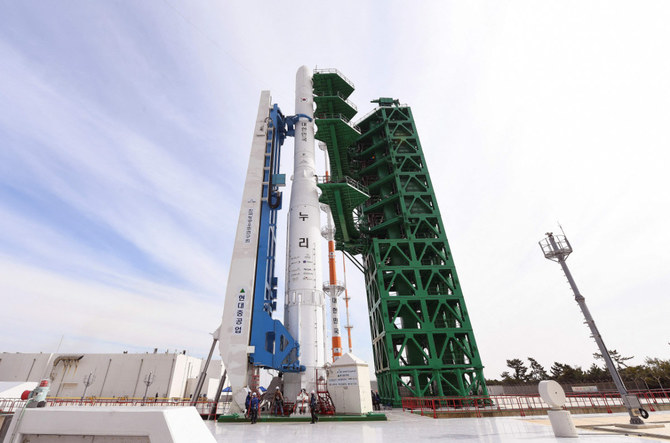
South Korea's first homegrown space rocket "Nuri" on the launch pad at the Naro Space Centre in Goheung in South Jeolla Province, a day before its expected launch. (Korea Aerospace Research Institute via AFP)
Short Url
Updated 21 October 2021
Follow

South Korea seeks space race entry with first homegrown rocket

  • South Korea's space program has a chequered record — its first two launches in 2009 and 2010, which in part used Russian technology, both ended in failure

SEOUL: South Korea is aiming to join the ranks of advanced spacefaring nations on Thursday when it attempts to put a one-ton payload into orbit using its first fully homegrown rocket.
The country has risen to become the world’s 12th-largest economy and a technologically advanced nation, home to the planet’s biggest smartphone and memory chip maker, Samsung Electronics.
But it has lagged in the headline-making world of spaceflight, where the Soviet Union led the way with the first satellite launch in 1957, closely followed by the United States.
In Asia, China, Japan and India all have advanced space programs, and the South’s nuclear-armed neighbor North Korea was the most recent entrant to the club of countries with their own satellite launch capability.
Ballistic missiles and space rockets use similar technology and Pyongyang put a 300-kilogramme (660-pound) satellite into orbit in 2012 in what Western countries condemned as a disguised missile test.
Even now, only six nations — not including North Korea — have successfully launched a one-ton payload on their own rockets.
The South will become the seventh if the Korean Satellite Launch Vehicle II, informally called Nuri, succeeds in putting its 1.5-ton dummy cargo into orbit from the launch site in Goheung, with an altitude of 600 to 800 kilometers being targeted.
The three-stage rocket has been a decade in development at a cost of 2 trillion won ($1.6 billion). It weighs 200 tons and is 47.2 meters (155 feet) long, fitted with a total of six liquid-fueled engines.

But the South Korean space program has a chequered record — its first two launches in 2009 and 2010, which in part used Russian technology, both ended in failure, the second one exploding two minutes into the flight and Seoul and Moscow blaming each other.
Eventually a 2013 launch succeeded, but still relied on a Russian-developed engine for its first stage.
The satellite launch business is increasingly the preserve of private companies, notably Elon Musk’s SpaceX, whose clients include the US space agency NASA and the South Korean military.
But one expert said a successful Nuri launch offered South Korea “infinite” potential.
“Rockets are the only means available to mankind to go out into space,” Lee Sang-ryul, the director of the Korea Aerospace Research Institute, told local paper Chosun Biz.
“Having such technology means we have fulfilled basic requirements to join this space exploration competition.”
Thursday’s launch is one step on an increasingly ambitious space program for South Korea, which President Moon Jae-in said would seek to launch a lunar orbiter next year, after he inspected a Nuri engine test in March.
“With achievements in South Korean rocket systems, the government will pursue an active space exploration project,” he said.
“We will realize the dream of landing our probe on the Moon by 2030.”


Bangladesh halts controversial relocation of Rohingya refugees to remote island

Updated 29 December 2025
Follow

Bangladesh halts controversial relocation of Rohingya refugees to remote island

  • Administration of ousted PM Sheikh Hasina spent about $350m on the project
  • Rohingya refuse to move to island and 10,000 have fled, top refugee official says

DHAKA: When Bangladesh launched a multi-million-dollar project to relocate Rohingya refugees to a remote island, it promised a better life. Five years on, the controversial plan has stalled, as authorities find it is unsustainable and refugees flee back to overcrowded mainland camps.

The Bhasan Char island emerged naturally from river sediments some 20 years ago. It lies in the Bay of Bengal, over 60 km from Bangladesh’s mainland.

Never inhabited, the 40 sq. km area was developed to accommodate 100,000 Rohingya refugees from the cramped camps of the coastal Cox’s Bazar district.

Relocation to the island started in early December 2020, despite protests from the UN and humanitarian organizations, which warned that it was vulnerable to cyclones and flooding, and that its isolation restricted access to emergency services.

Over 1,600 people were then moved to Bhasan Char by the Bangladesh Navy, followed by another 1,800 the same month. During 25 such transfers, more than 38,000 refugees were resettled on the island by October 2024.

The relocation project was spearheaded by the government of former Prime Minister Sheikh Hasina, who was ousted last year. The new administration has since suspended it indefinitely.

“The Bangladesh government will not conduct any further relocation of the Rohingya to Bhasan Char island. The main reason is that the country’s present government considers the project not viable,” Mizanur Rahman, refugee relief and repatriation commissioner in Cox’s Bazar, told Arab News on Sunday.

The government’s decision was prompted by data from UN agencies, which showed that operations on Bhasan Char involved 30 percent higher costs compared with the mainland camps in Cox’s Bazar, Rahman said.

“On the other hand, the Rohingya are not voluntarily coming forward for relocation to the island. Many of those previously relocated have fled ... Around 29,000 are currently living on the island, while about 10,000 have returned to Cox’s Bazar on their own.”

A mostly Muslim ethnic minority, the Rohingya have lived for centuries in Myanmar’s western Rakhine state but were stripped of their citizenship in the 1980s and have faced systemic persecution ever since.

In 2017 alone, some 750,000 of them crossed to neighboring Bangladesh, fleeing a deadly crackdown by Myanmar’s military. Today, about 1.3 million of them shelter in 33 camps in the coastal Cox’s Bazar district, making it the world’s largest refugee settlement.

Bhasan Char, where the Bangladeshi government spent an estimated $350 million to construct concrete residential buildings, cyclone shelters, roads, freshwater systems, and other infrastructure, offered better living conditions than the squalid camps.

But there was no regular transport service to the island, its inhabitants were not allowed to travel freely, and livelihood opportunities were few and dependent on aid coming from the mainland.

Rahman said: “Considering all aspects, we can say that Rohingya relocation to Bhasan Char is currently halted. Following the fall of Sheikh Hasina’s regime, only one batch of Rohingya was relocated to the island.

“The relocation was conducted with government funding, but the government is no longer allowing any funds for this purpose.”

“The Bangladeshi government has spent around $350 million on it from its own funds ... It seems the project has not turned out to be successful.”