

‘I am not at peace,’ Noor Mukadam’s mother says at protest demonstration in Islamabad

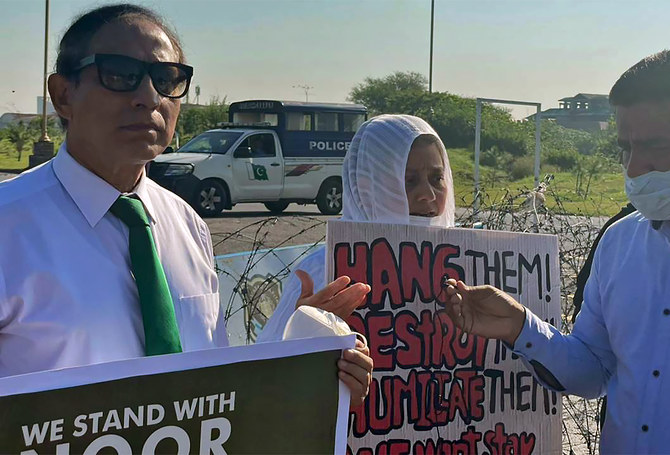
Noor Mukadam's mother is holding a placard during a protest demonstration in Islamabad, Pakistan, on October 20, 2021. Mukadam, daughter of a former Pakistani diplomat, was brutally murdered in the country's federal capital on July 20. (Photo courtesy: Justice for Noor)
Short Url
Updated 21 October 2021
Follow

‘I am not at peace,’ Noor Mukadam’s mother says at protest demonstration in Islamabad

  • ‘Noor was also a woman and I’m a mother and a woman too,’ says Kausar Mukadam while reacting to the bail of Asmat Adamjee in the murder case
  • A district court judge snubs the prime suspect, Zahir Jaffer, for violating the court’s decorum by trying to speak during the proceedings

ISLAMABAD: Family and friends of Noor Mukadam, a 27-year-old woman who was brutally murdered on July 20 in Islamabad, urged the judiciary to deliver swift justice in the case on Wednesday as they demanded the killer to be hanged as soon as possible.
About a dozen of these protesters gathered in front of the Parliament House as they sought early justice for Mukadam, the daughter of a former Pakistani diplomat Shaukat Mukadam, two days after the Supreme Court granted bail to Asmat Adamjee, the mother of the prime suspect, Zahir Jaffer, who, along with her husband, Zakir Jaffer, was arrested for allegedly abetting the crime.
Mukadam’s beheaded body was found at the Jaffer residence in Islamabad on July 20, after which their three household staff, namely Iftikhar, Jan Muhammad and Jameel, were also arrested.
“I am not at peace. I can’t sleep,” Kausar Mukadam, the victim’s mother, said while speaking to the media outside the Parliament House. “You don’t know, my daughter was a center of attraction in our home. I keep looking for her in my home. We won’t be at peace until we get justice.”
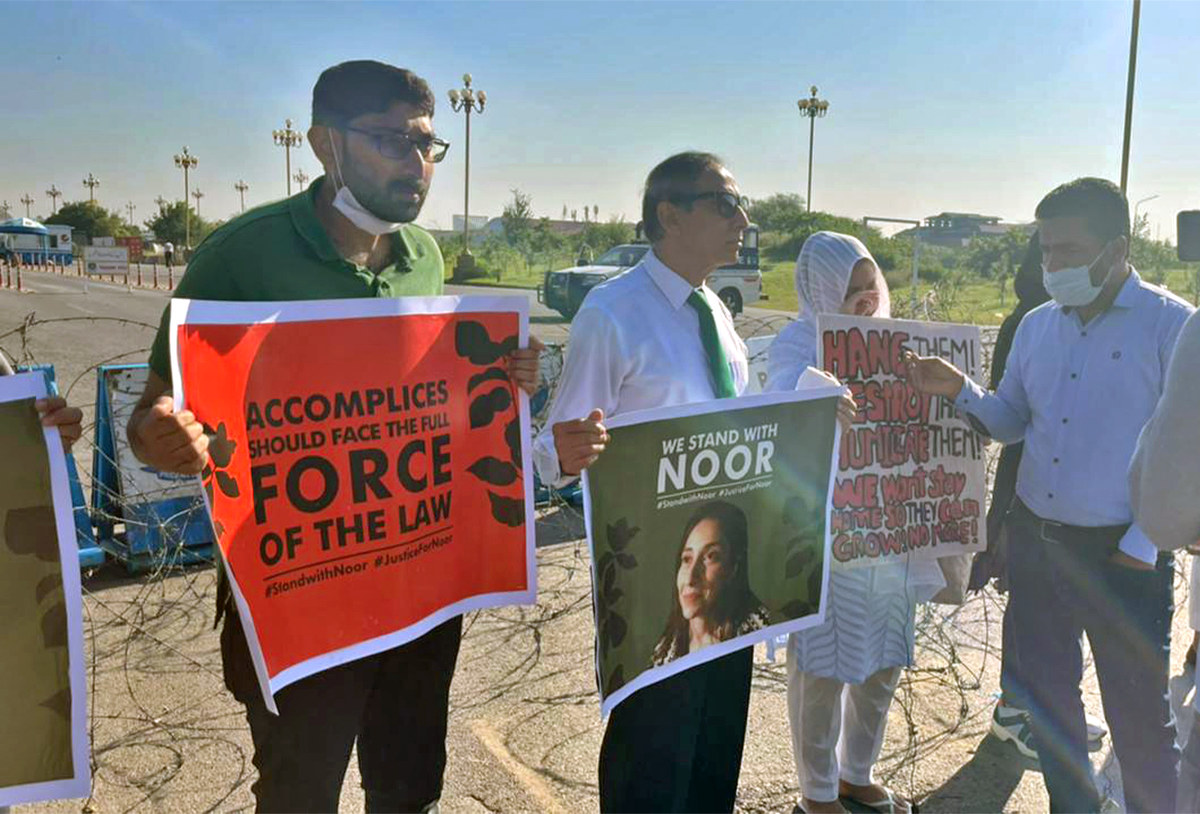


Noor Mukadam's family and friends hold a protest demonstration in Islamabad, Pakistan, on October 20, 2021. (Photo courtesy: Justice for Noor)

The participants of the gathering, including Mukadam’s parents, were carrying placards seeking swift justice in the case, though they also expressed confidence and trust in the judiciary.
“She [Noor Mukadam] was the youngest in our home, and we all used to treat her as a baby,” her mother said. “She was a soft spoken person who used to play with children.”
Discussing Asmat Adamjee’s bail which was granted to her for being a woman, she said: “Noor was also a woman, and I’m a mother and a woman too. I also deserve sympathy. I am hopeful the judiciary will give us justice.”
Kausar Mukadam maintained all suspects in the case were involved in the murder since none of them helped her daughter escape. “No one should get bail and they should be punished,” she said.
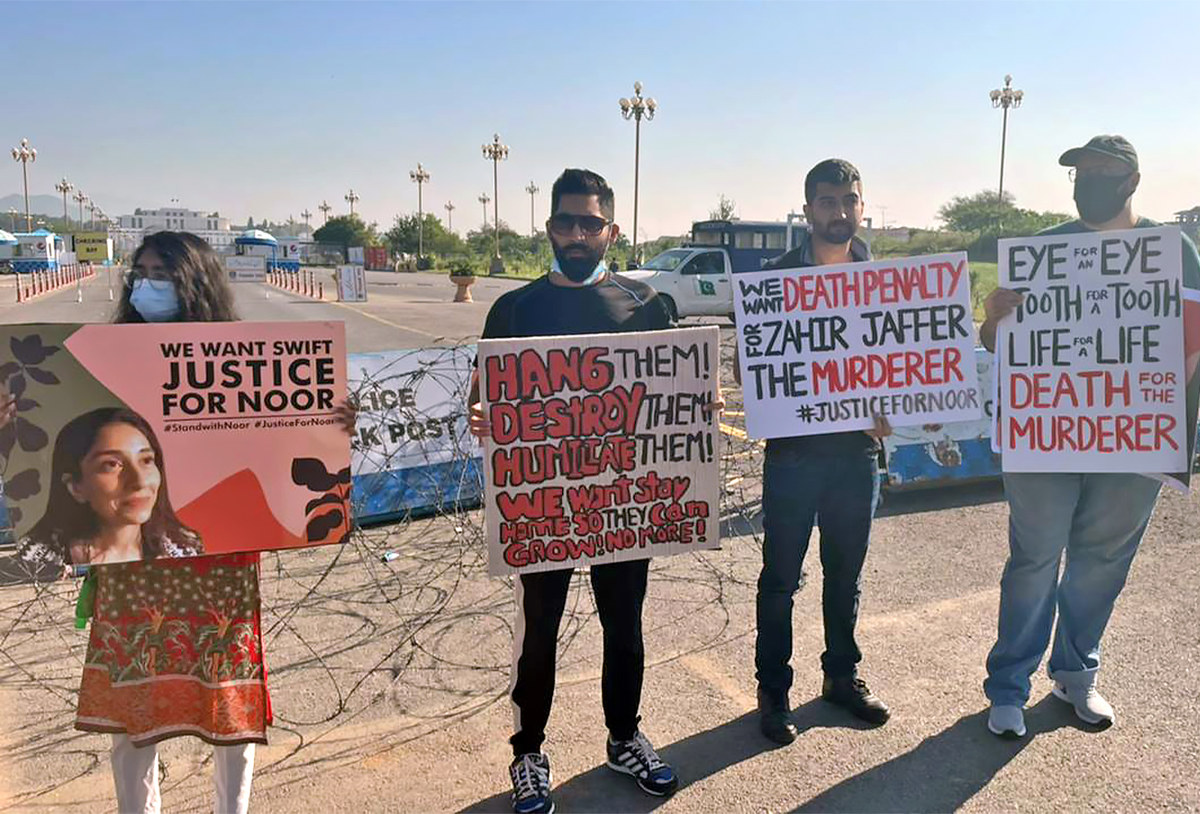


People seeking swift justice in the Noor Mukadam murder case hold placards during a protest demonstration in Islamabad, Pakistan, on October 20, 2021. (Photo courtesy: Justice for Noor)

Shaukat Mukadam, the victim’s father, said his family would accept the courts’ verdicts in the case, though he added that people were “disappointed with the [Supreme Court bail] decision.”
“The murderer should be hanged as soon as possible,” he said.
Separately, a district and sessions judge Atta Rabbani recorded the statement of a police witness in the case and adjourned the hearing until October 27.
As per the directions of the Islamabad High Court, the district court is required to complete the murder trial within a period of eight weeks.


The judge also snubbed Zahir Jaffer during the proceedings for violating the court’s decorum by trying to speak during the hearing.
“Don’t interrupt the proceedings,” the judge remarked while ordering the police to keep the suspect quiet in the courtroom.
His mother, Adamjee, requested the court during the proceedings to allow her to live in the F-7 residence where the gruesome murder had taken place since she had to stay in the federal capital to attend all the court hearings.
“This is your home, you can live there,” the judge said while Adamjee’s lawyer requested the court to put it on record to avoid any legal complications.


IMF warns against policy slippage amid weak recovery as it clears $1.2 billion for Pakistan

Updated 11 December 2025
Follow

IMF warns against policy slippage amid weak recovery as it clears $1.2 billion for Pakistan

  • Pakistan rebuilt reserves, cut its deficit and slowed inflation sharply over the past one year
  • Fund says climate shocks, energy debt, stalled reforms threaten stability despite recent gains

ISLAMABAD: Pakistan’s economic recovery remains fragile despite a year of painful stabilization measures that helped pull the country back from the brink of default, the International Monetary Fund (IMF) warned on Thursday, after it approved a fresh $1.2 billion disbursement under its ongoing loan program.

The approval covers the second review of Pakistan’s Extended Fund Facility (EFF) and the first review of its climate-focused Resilience and Sustainability Facility (RSF), bringing total disbursements since last year to about $3.3 billion.

Pakistan entered the IMF program in September 2024 after years of weak revenues, soaring fiscal deficits, import controls, currency depletion and repeated climate shocks left the economy close to external default. A smaller stopgap arrangement earlier that year helped avert immediate default, but the current 37-month program was designed to restore macroeconomic stability through strict monetary tightening, currency adjustments, subsidy rationalization and aggressive revenue measures.

The IMF’s new review shows that Pakistan has delivered significant gains since then. Growth recovered to 3 percent last year after shrinking the year before. Inflation fell from over 23 percent to low single digits before rising again after this year’s floods. The current account posted its first surplus in 14 years, helped by stronger remittances and a sharp reduction in imports. And the government delivered a primary budget surplus of 1.3 percent of GDP, a key program requirement. Foreign exchange reserves, which had dropped dangerously low in 2023, rose from US$9.4 billion to US$14.5 billion by June.

“Pakistan’s reform implementation under the EFF arrangement has helped preserve macroeconomic stability in the face of several recent shocks,” IMF Deputy Managing Director Nigel Clarke said in a statement after the Board meeting.

But he warned that Islamabad must “maintain prudent policies” and accelerate reforms needed for private-sector-led and sustainable growth.

The Fund noted that the 2025 monsoon floods, affecting nearly seven million people, damaging housing, livestock and key crops, and displacing more than four million, have set back the recovery. The IMF now expects GDP growth in FY26 to be slightly lower and forecasts inflation to rise to 8–10 percent in the coming months as food prices adjust.

The review warns Pakistan against relaxing monetary or fiscal discipline prematurely. It urges the State Bank to keep policy “appropriately tight,” allow exchange-rate flexibility and improve communication. Islamabad must also continue raising revenues, broadening the tax base and protecting social spending, the Fund said.

Despite the progress, Pakistan’s structural weaknesses remain severe.

Power-sector circular debt stands at about $5.7 billion, and gas-sector arrears have climbed to $11.3 billion despite tariff adjustments. Reform of state-owned enterprises has slowed, including delays in privatizing loss-making electricity distributors and Pakistan International Airlines. Key governance and anti-corruption reforms have also been pushed back.

The IMF welcomed Pakistan’s expansion of its flagship Benazir Income Support Program, which raises cash transfers for low-income families and expands coverage, saying social protection is essential as climate shocks intensify. But it warned that high public debt, about 72 percent of GDP, thin external buffers and climate exposure leave the country vulnerable if reform momentum weakens.

The Fund said Pakistan’s challenge now is to convert short-term stabilization into sustained recovery after years of economic volatility, with its ability to maintain discipline, rather than the size of external financing alone, determining the durability of its gains.