

Mideast economy recovering but social unrest on the rise: IMF

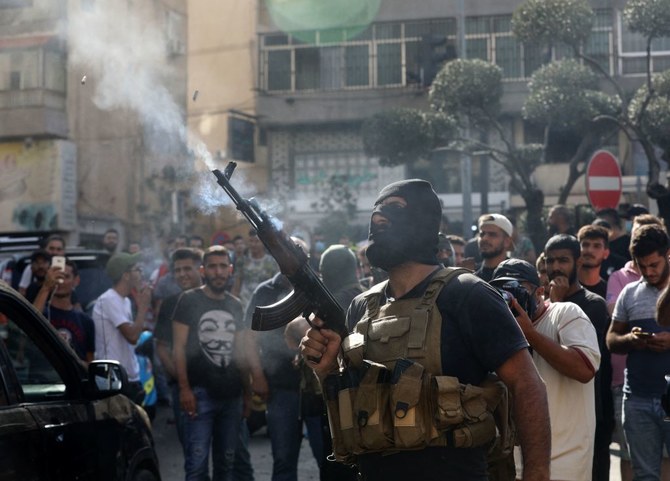
A member of Lebanon's Hezbollah movement fires his gun during the funeral of some of their members who were killed during clashes in the capital Beirut's southern suburbs, on October 15, 2021 (AFP via Getty Images)
Short Url
Updated 19 October 2021
Follow

Mideast economy recovering but social unrest on the rise: IMF

  • "The region is going through recovery in 2021. Since the beginning of the year, we see progress in the economic performance"

The Middle East and North Africa is on track to economic recovery, but rising social unrest and unemployment are threatening to hinder "progress", the International Monetary Fund said Tuesday.


The MENA region, which includes the Arab countries and Iran, saw its real GDP growth shrink by 3.1 percent in 2020 due to lower oil prices and sweeping lockdowns to prevent the spread of the coronavirus.


But with rapid vaccination campaigns, particularly in the Gulf nations, the IMF predicted that GDP growth would rise to 4.1 percent this year, a slight upgrade of 0.1 percent from the last projection in April.


"The region is going through recovery in 2021. Since the beginning of the year, we see progress in the economic performance," Jihad Azour, director of the Middle East and Central Asia Department at the IMF, told AFP in an interview.


But "this recovery is not the same in all countries. It is uncertain and uneven because of the divergence in vaccination... and geopolitical developments", Azour added.


The IMF said this month that while prospects for oil-exporting economies improved with higher oil prices, low-income and crisis-hit countries are witnessing "fragile" recoveries.


It warned of "a rise in social unrest" in 2021 that "could pick up further due to repeated infection waves, dire economic conditions, high unemployment and food prices".


Unemployment rates increased in MENA last year by 1.4 percent to reach 11.6 percent.


This rise exceeds that seen during the global financial crisis and the 2014-15 oil price shock, the IMF said.


The fund also warned of the longer-term risk of the uneven recovery, which could lead to a "permanent widening of existing wealth, income, and social gaps and, ultimately, weaker growth and less inclusive societies".


About seven million more people in the region are estimated to have entered extreme poverty during 2020-21 compared to pre-crisis projections, according to the IMF.


In Lebanon, the continuing drop in the value of the currency has dashed hopes that the government formed last month can stem an economic crisis, branded by the World Bank as one of the worst since the mid-19th century.


Nearly 80 percent of the Lebanese population lives below the poverty line.


"The Fund has already started technical discussions with the authorities... to develop what would be in fact that the framework within which the fund can help Lebanon," said Azour, a former Lebanese finance minister.


From barrels to bytes: How AI is powering Saudi Arabia’s industrial transformation

Updated 08 January 2026
Follow

From barrels to bytes: How AI is powering Saudi Arabia’s industrial transformation

  • Inside the Kingdom’s drive to merge energy expertise with digital intelligence

RIYADH: Artificial intelligence is moving beyond concept to become a cornerstone of Saudi Arabia’s energy sector, reshaping how oil, gas, and power systems are managed and optimized.

Industry giants like Saudi Aramco are embedding smart systems into their operations to boost efficiency, reliability, and sustainability—key pillars in the Kingdom’s efforts to modernize its industrial base and diversify its economy.

According to the International Energy Agency, oil and gas companies were among the first to adopt digital technologies. The agency estimates that applying AI to power plant operations and maintenance could save up to $110 billion annually by 2035 through reduced fuel consumption and maintenance costs.

For Saudi Arabia, this technological momentum offers both a blueprint and an opportunity. Under Vision 2030, integrating data and intelligent automation is transforming how energy is explored, refined, and delivered.

At the heart of Saudi Aramco’s operations is a digital transformation strategy centered on artificial intelligence, big data, and the industrial Internet of Things. These technologies are applied at every stage of production—from mapping reservoirs and optimizing drilling to improving efficiency and safety.

AI also underpins Aramco’s Digital Transformation Program, which develops in-house smart tools and data-driven platforms designed to cut emissions, reduce costs, and enhance performance while ensuring a reliable energy supply.

A prime example is the Upstream Innovation Center, where engineers have implemented AI solutions that reduce fuel gas use in boilers, improve efficiency, and detect potential leaks through fiber-optic monitoring. At the Khurais oil field, more than 40,000 sensors monitor approximately 500 wells via an Advanced Process Control system—the first of its kind for a conventional oil field at Aramco. Digitization at Khurais has increased production by around 15 percent, doubled troubleshooting speed, and lowered both costs and environmental impact.

These advances illustrate how Aramco’s network is evolving into a connected, adaptive model, blending traditional engineering expertise with digital intelligence.

DID YOU KNOW?

• AI could save up to $110 billion a year in global power plant fuel and maintenance costs by 2035.

• Advanced Process Control enables real-time monitoring of hundreds of oil wells in the Kingdom.

• AI-powered simulations now replace weeks of manual analysis, enabling faster operational decisions.

As Saudi Arabia develops an AI-driven energy economy, the King Abdullah University of Science and Technology is bridging the gap between digital innovation and industrial application. 

Bernard Ghanem, chair of the Center of Excellence for Generative AI, said the university is working with Saudi Aramco to develop AI systems that predict the chemical properties of materials and accelerate research into direct air capture technologies for carbon dioxide removal.

He told Arab News that KAUST is partnering with SABIC and ACWA Power to apply AI in process optimization and materials discovery, turning lab-scale research into practical solutions for the energy sector.

Ghanem said KAUST’s generative AI materials program combines a robotic chemistry lab with its AI Chemist foundation model, a system that accelerates the development of catalysts, battery materials, and membranes for clean energy applications.

“This is our lab of the future, automating experimentation and speeding up energy innovation,” he said.

Opinion

This section contains relevant reference points, placed in (Opinion field)

Mani Sarathy, professor of chemical engineering at KAUST, noted that AI-based reinforcement learning tools are already improving efficiency in hydrocarbon refineries by enhancing simulations and shortening analysis cycles.

“AI is helping energy companies run complex simulations that once took weeks, enabling faster and more precise operational decisions,” he told Arab News.

Sarathy added that the next phase will combine automation with expert oversight. Hybrid human-AI control systems, he explained, are likely to become standard in critical operations, balancing digital autonomy with safety and reliability as Saudi industries expand AI deployment.

These efforts highlight KAUST’s growing role in transforming AI from an academic discipline into a driver of industrial innovation in Saudi Arabia’s energy sector under Vision 2030.

Meanwhile, Skeleton Technologies is bringing AI-driven energy storage solutions to Saudi partners, solutions that are already reshaping industrial systems across Europe and beyond. In Europe, the company combines artificial intelligence and advanced materials to reduce energy use and improve efficiency in data centers, electricity grids, and defense systems.

“Our solutions allow AI infrastructure to consume less electricity and reduce grid connection needs, making AI operations more energy efficient,” Arnaud Castaignet, vice president of government affairs and strategic partnerships at Skeleton, told Arab News.

Inside its factories, Skeleton uses AI-driven digital twin models, created with Siemens Digital Industries, to simulate production, optimize operations, and enable predictive maintenance, Castaignet said. At the core of its technology is curved graphene, a proprietary carbon material that gives Skeleton’s supercapacitors exceptional conductivity.

“It allows our supercapacitors to charge and discharge within microseconds, around 12 microseconds, something batteries cannot do,” Castaignet said.

The company’s flagship Graphene GPU system, built on these supercapacitors, cuts energy use in AI data centers by up to 40 percent and reduces grid requirements by 45 percent while boosting computing performance. The devices are free of lithium, nickel, and cobalt, relying instead on graphene derived from silicon carbide—essentially sand—processed entirely in Germany.

“To build sustainable AI infrastructure, you need energy-saving hardware as well as renewable power,” Castaignet added. “Our Graphene GPU shows both can work together.”

As Saudi Arabia continues linking engineering expertise with digital intelligence, its industrial progress is measured not only in barrels of oil but also in bytes, data, and the smart systems shaping its energy future.