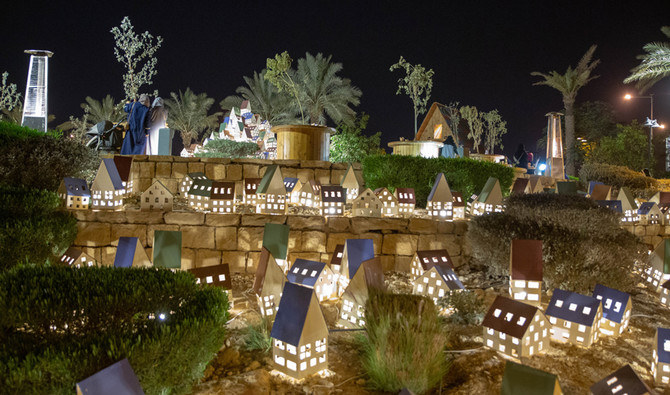
RIYADH: Riyadh’s “Winter Wonderland” returns on Oct. 26 with a 40 percent wider space than its first edition in 2019.
Due to high demand, the GEA announced that it has increased the venue to 376,025 sq km. More than 103 games spread across six sections will be available for visitors of all age groups. The area will hold several entertainment shows, competitions, performances, and art displays.
Visitors can visit the Dream Land Carnival, the Snow Forest with an ice-skating rink right in the heart of the desert, Disney on Ice, the Magic Box area, Horror Adventures, and a circus with acrobatic music shows.
There will be 51 adult games that include the Haunted House, Sky Loop, and several international games held for the first time in the Kingdom.

Riyadh’s Winter Wonderland returns on Oct. 26
https://arab.news/grd6r
Riyadh’s Winter Wonderland returns on Oct. 26
Madinah’s culinary identity lends itself to shared cross-cultural connection
- Madinah earned the title of UNESCO Creative City of Gastronomy in November 2025
RIYADH: In every part of the Arab world, people have long argued about to whom certain traditional dishes belong, each wanting to claim the “correct” recipe and origin as their own, a contention that stands true across the Kingdom’s cities as well — and that might not be such a bad thing.
One of its most historically and religiously significant cities, Madinah, is a perfect example of how culinary diversity actually lends itself to culinary connection between different homes and cultures.
Chef Heba Ramadan, raised in Riyadh but originally from Madinah, spoke to Arab News about the city’s unique culinary character, which earned it the title of UNESCO Creative City of Gastronomy in November 2025.
To Ramadan, Madinah embodies nostalgic childhood memories, family gatherings and joyful moments — especially those centered around food.
As long as you get to the right flavor, it does not matter how you got there.
“Each house has their own way. That’s why I can’t say this way is right or that way is wrong,” she said.
Ramadan added that recipes are not fixed texts or religious doctrines, but are dynamic pieces of social and geographic history that represent changing people, changing times, and the melding of various customs and influences.
If you visit homes across Madinah today, you will find slight variations in the way that families prepare certain dishes.
“For example, Madini rice — everyone knows this dish, but each family makes it differently. Some families don’t put saffron because the grandfather didn’t like saffron, so they grew up cooking it that way.”
Another popular dish is wheat soup: Ramadan said that some people, like her mother, make it using whole milk, others with goat milk, some with no milk at all, and even some who make it with tomato.
“When I searched, I found that people from Makkah make it with tomato, so you see how the dish changes from family to family.”
A recipe is a living organism; it is affected by factors of its surrounding environment. Personal preference is one example, while others are more complex and drawn out.
Over generations, recipes naturally evolve due to convenience and changing lifestyles.
Busier lives, more demanding careers and increasingly expensive economies mean that people lack the time to recreate recipes from scratch in the exact way they were once done traditionally.
Instead, puff pastries (i.e. convenience) often win against making handmade dough (i.e. time-consuming manual labor).
On the other hand, sometimes adjustments are added on.
Ramadan said that jareesh, a beloved dish across the Kingdom, was originally made without any protein, just buttermilk.
Over time, chicken or other meats were included in the dish to add nutritional value.
“Mothers added protein so the kids would eat better, and that’s how the recipe changed.”
A vital factor to keep in mind is Madinah’s unique position as a historical religious passageway and gathering point for pilgrims.
Historically, pilgrims did not stay for just a few days, but instead for weeks or even months.
“They didn’t just visit — they lived, they stayed and they exchanged experiences,” Ramadan said.
These long stays led to deep cultural exchange as pilgrims arriving from around the world brought their spices, recipes, ingredients and techniques with them.
Madinah’s food absorbed these influences over time and foreign dishes were adapted into local versions, and vice versa; a process that Ramadan said does not erase authenticity, but defines it.
Kabuli rice, made with orange zest and citrus juice, is believed to have adapted from these exchanges.
At the end of the day, most of us enjoy dishes the way they were made growing up because those flavors were tied to emotional memory.
Perhaps these reasons explain why Ramadan is a little skeptical of UNESCO’s method of defining “official” recipes.
She believes that culinary heritage cannot be standardized without losing its essence, and trying to standardize it by finding the most common factors between recipes or asking the city’s historical families for the correct methods does not paint a true picture of its culinary character.
And considering the close-knit socialization of residents in a small city like Madinah, “everyone knows the families in Madinah and how each family cooks their dishes,” she added.
Ramadan believes the city was chosen because its food is flavor-driven, historically layered and maintained through households rather than institutions.
She suggests UNESCO may have been fascinated by the number of variation within a single culinary identity, yet, all the flavor profiles feel recognizably “Madini.”
For example, “we have different types of rice. Even if it’s white rice, each one has a different flavor.”
Madinah’s traditional dishes were developed based on the local agriculture, seasonal availability of ingredients and circumstantial factors like electricity availability.
Before refrigeration, daily cooking depended on fresh, same-day ingredients, so every dish was directly tied to the land.
Ramadan, who transitioned into cooking to pursue her passion after spending more than a decade in an accounting and finance career, believes that food is meant to be shared, remembered and respected.
She started out in gastronomy by opening her own business before putting it on hold during COVID-19, after which she returned to work as a baker and in hot kitchens.
As her cooking career took off, Ramadan was selected by Diriyah to create traditional dishes for a few of their major events.
Ramadan began representing the Kingdom internationally as a traditional Saudi chef, working with the Saudi Tourism Authority and continuing her work with Diriyah.
Much of Ramadan’s career was defined by the realization that much of Madinah’s food heritage was undocumented and misunderstood.
And although she sees food as dynamic and flexible, Ramadan also strongly believes that it is her job to represent Saudi food globally in a traditional framework, sans any modern fusions or fireworks.
While she respects chefs who experiment with fusion recipes and welcomes any tourists visiting the Kingdom to try both the modern and the traditional, her role adamantly favors cultural representation, not reinterpretation.
Abroad, authenticity is required in both preparation and plating.
Ramadan is admittedly worried about safekeeping these recipes through future generations; as reliance on convenience increases and families spend less time together in the kitchen, she fears that youth are becoming less interested in cooking or trying new foods.
In her opinion, this had led to losing important skills such as smelling food to identify what spices or ingredients are missing.
“This is something you train. It doesn’t come from reading a recipe … you learn by standing next to your mother, your grandmother, and smelling,” she said.
“It’s not written. It’s sensory.”


