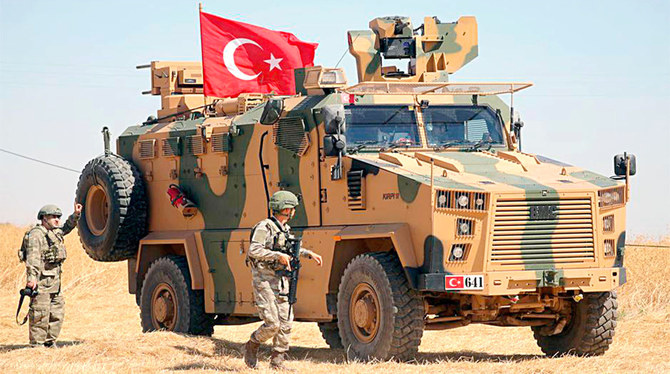
Turkey shifting Syria strategy after Kurdish militia’s attacks

Turkey is ‘already in a tense relationship with Russia over Syria’s opposition-held Idlib province and would not like to add a new layer to these tensions.’ (Reuters/File)
Short Url
Updated 19 October 2021
Follow

Turkey shifting Syria strategy after Kurdish militia’s attacks

  • The militia has engaged in a cross-border shelling campaign against nearby Turkish villages

ANKARA: Turkey is shifting to a proxy force strategy and diplomacy with the US and Russia to counter the Kurdish People’s Defense Units in Syria instead of deploying its own troops, analysts have said.
It comes after senior Turkish officials hinted at a strategy change regarding the war-torn country following deadly attacks by the militia in the Kurdish-dominated Tal Rifaat region, which targeted Turkish police officers.
The militia has also engaged in a cross-border shelling campaign against nearby Turkish villages.
President Recep Tayyip Erdogan said that Ankara was “determined to remove all threats in northern Syria,” while Foreign Minister Mevlut Cavusoglu pledged that Turkey “would do what is necessary for its security,” adding that neither the US or Russia had kept their promises to ensure the withdrawal of the militia from the Syrian border.
But the Turkish government has said that the military will pursue a “much more different campaign” in northern Syria, sparking debate over whether Ankara will engage in diplomatic talks with the US and Russia before launching possible military action.
The militia is the chief local partner of the US in its fight against Daesh in the region, while Turkey considers the Kurdish group and its political wing, the Democratic Union Party, as Syrian extensions of the outlawed Kurdistan Workers’ Party, which has fought a civil war against the Turkish state for more than three decades.
In the meantime, the Syrian Liberation Front branch of the Syrian National Army said that it is “determined to clear our regions from all terror groups,” including the Kurdistan Workers’s Party, Democratic Union Party and Daesh.
Soner Cagaptay, director of the Turkish program at the Washington Institute, said that every time Russian President Vladimir Putin has allowed Turkey to enter Syria and seize territory from the Kurdish militia, he has demanded that Turkey end its support for rebel groups.
“This involved a land exchange with either Turkey taking territories from the YPG (Kurdish People’s Defense Units in Syria) or the Bashar Assad regime taking territories from the hands of the rebels. But this new model that we are talking right now is a bit different from this one. Now, Turkish-backed troops in Syria, instead of Turkish troops, might move in to take an area from the YPG with a tacit agreement from Putin,” he told Arab News.
According to Cagaptay, Ankara’s broader strategy is to divide the militia-controlled zones and prevent the formation of any future political entity in the group’s territory.
“The recent Erdogan-Putin deal in Sochi aimed at implementing this new model,” he said.
Amid particularly sensitive times for US-Turkey relations, a growing emphasis on diplomatic channels outweighs military action, he added. Erdogan is expected to discuss the issue with US President Joe Biden on the sidelines of the G20 summit in Rome at the end of October.
After their recent meeting in Sochi, Erdogan will also talk to Putin following his meeting with Biden.
According to Ozgur Unluhisarcikli, Ankara office director of the German Marshall Fund of the US, the threat that Turkey sees in the Kurdish militia is the possibility of a Kurdish state being formed close to its borders.
“Ankara is therefore taking whatever measures it can to prevent this from happening,” he told Arab News.
Unluhisarcikli said that current conditions mean that it is unsuitable for Turkey to conduct military operations against YPG-held territories in northwest or northeast Syria.
Therefore, Ankara will push diplomatic channels to proceed efficiently, he added.
“Turkey is already in a tense relationship with Russia over Syria’s rebel-held Idlib province and would not like to add a new layer to these tensions. At a time when Turkey is trying to improve relations with US, it would not like to introduce a new headache,” he said.
Meanwhile, during a press conference last week, US Secretary of State Antony Blinken said that the Biden administration does not support efforts to normalize relations with the Assad regime.
Experts also note that the fate of Idlib province, hosting about 4 million civilians under the control of Turkish-backed rebels, will be critical in the coming days in shaping the calculus of Turkey’s relationship with Syria, with a potential migrant influx causing domestic political worries for Ankara.
On Saturday, shelling by regime forces of the opposition-held town of Sarmada on the northern outskirts of Idlib near the Turkish border killed four people and wounded more than a dozen, according to the UK-based Syrian Observatory for Human Rights.


Aoun hails disarmament progress: ‘Lebanon achieved in 1 year what it had not seen in 4 decades’

Updated 20 January 2026
Follow

Aoun hails disarmament progress: ‘Lebanon achieved in 1 year what it had not seen in 4 decades’

  • President Joseph Aoun highlights achievements during first year in office despite many challenges
  • Army announced this month it had successfully disarmed Hezbollah in the south of the country

BEIRUT: Lebanese President Joseph Aoun confirmed on Tuesday that the country’s armed forces “are now the sole operational authority south of the Litani River, despite doubts, accusations of treason, insults and slander.”

Speaking at the Presidential Palace in Baabda during a traditional New Year meeting with members of the diplomatic corps and the heads of international missions, he highlighted what he viewed as Lebanon’s achievements since he took office on Jan. 9, 2025.

The government’s approval in August and September last year of plans to bring all weapons in the country under state control, and ensure the authority of the state across all Lebanese territory using its own forces, was “no minor detail,” he said.

“Lebanon achieved in one year what it had not seen in four decades,” he added, as he recalled taking office in a “deeply wounded state” that has suffered decades of institutional paralysis and economic crises.

Despite campaigns of distortion, intimidation and misinformation, and Israel’s failure to abide by the November 2024 ceasefire agreement, the changed reality on the ground over the past 12 months speaks for itself, he said.

“The truth is what you see, not what you hear,” Aoun said, pointing out that “not a single bullet was fired from Lebanon during my first year in office, except for two specific incidents recorded last March, the perpetrators of which were swiftly arrested by official authorities.”

The army carried out “extensive operations” to clear large areas of the country of illegal weapons regardless of who controlled them, the president continued, in line with the terms of the Nov. 27 ceasefire agreement with Israel, which he described as “an accord Lebanon respects and that was unanimously endorsed by the country’s political forces.”

These efforts reflected a determination to spare the country a return to the “suicidal conflicts that have come at a heavy cost in the past,” he added.

Aoun stressed his commitment during the second year of his presidency to restoring control of all Lebanese territory to the exclusive authority of the state, securing the release of prisoners, and the reconstruction of war-ravaged areas.

He said that southern Lebanon, like all of the country’s international borders, would fall under the sole control of the Lebanese Armed Forces, putting a definitive end to any attempts “to draw us into the conflicts of others, even as those same parties pursue dialogue, negotiations and compromises in pursuit of their own national interests.”

The Lebanese Army Command announced early this month the completion of the first phase of its plans to disarm nonstate groups south of the Litani River. The government is now awaiting an army report next month detailing its next steps.

Gen. Rodolphe Haykal, the army’s commander, has said that the plan “does not have a specific time frame for completing this phase, which encompasses all Lebanese regions.”

A Lebanese official confirmed to Arab News that the army now has exclusive control of territory south of the Litani River, and no other armed forces or military factions have a presence there.

Aoun’s affirmation of his determination to “stay on course” came two days after Hezbollah leader Naim Qassem gave a sharply worded speech that delivered both implicit and explicit rebukes aimed at the president and Foreign Minister Youssef Raji.

His criticisms focused on their efforts to take control of weapons north of the Litani River, following a declaration by Aoun that “the time for arms is over,” a position that Hezbollah vehemently rejects in what appears to be an attempt to derail the gradual, phased disarmament strategy embraced by the Lebanese government and the international community.

Progress in the efforts of the military to take control of all weapons in the country hinges on securing vital logistical support for the country’s armed forces, a condition tied to the International Conference for Supporting the Lebanese Army and Internal Security Forces, which is due to take place on March 5 in Paris.

Aoun told the diplomats that the conference is the result of efforts led by the international Quintet Committee supporting Lebanon: the US, Saudi Arabia, France, Qatar and Egypt.

Archbishop Paolo Borgia, the papal ambassador to Lebanon, speaking in his role as dean of the diplomatic corps, said that the current crisis in the country serves “as a harsh test” that must remind political leaders of their duty to prevent history from repeating itself.

He called for respect for all electoral processes as a vital part of any nation’s democratic life, and for “genuine peace without weapons, one that can disarm enemies through the convincing power of goodness and the strength of meeting and dialogue.”

He added: “Those holding the highest public offices must give special attention to rebuilding political relationships peacefully, both nationally and globally, a process grounded in mutual trust, honest negotiations and faithful adherence to commitments made.”