EU says we are at a critical point in time for the Iran nuclear deal

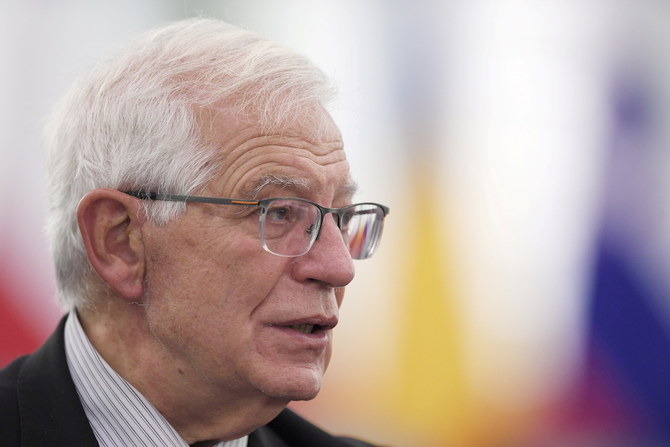
EU foreign policy chief Josep Borrell delivers a speech at the European Parliament in Strasbourg, France, on Oct. 5, 2021. (Reuters)
Short Url
Updated 19 October 2021
Follow

EU says we are at a critical point in time for the Iran nuclear deal

  • US says ‘intermediate step’ of meeting in Brussels not necessary for Iran talks

LUXEMBOURG/WASHINGTON: The EU will not hold talks in Brussels on Thursday with Iran on restarting negotiations over the country’s nuclear deal, the bloc’s foreign policy chief said, contradicting a declaration by Tehran.
“I heard that someone was convinced that next Thursday was going to be a meeting — no,” Josep Borrell said Monday after a meeting of EU foreign ministers.
“But we made clear to the Iranians that time is not on their side, and it is better to go back to the negotiation table quickly.”
His remarks came after Iran’s foreign ministry spokesman said the country’s lead nuclear negotiator, Ali Bagheri, would go to Brussels for discussions Thursday.
The 2015 pact with world powers limited Tehran’s nuclear ambitions in exchange for sanctions relief, but was hit by the withdrawal of the US under former president Donald Trump in 2018.
The EU, which acts as coordinator for the deal, has been seeking to restart talks aimed at reviving it.
Negotiations got under way in Vienna in April after Trump’s successor President Joe Biden signaled a willingness to come back on board and lift sanctions imposed by Trump.
But the talks have been suspended since June, when ultraconservative Ebrahim Raisi was elected president of Iran.
In Washington, US State Department spokesman Ned Price called on Iran to resume the talks on reviving the accord “as soon as possible.”
He said the US does not think talks in Brussels are necessary before the resumption of indirect negotiations with Iran.
“To be clear, we do not think it is necessary,” Price said when asked about the possibility of a meeting in Brussels.
“The destination we seek is in Vienna, not an intermediate step in Brussels,” Price told reporters, adding the US, its allies and partners involved in the Iran deal agreed that the indirect talks in Vienna “should resume as soon as possible.”
“There is no daylight with our partners. There is no disagreement that a mutual return to compliance remains in our interests.”
Tehran has repeatedly said in recent weeks that it is seeking to return to the negotiations soon in Vienna, but has set no date for doing so amid growing impatience from the other parties.
Borrell insisted he remains willing to meet with Iran’s representative bilaterally “if they need some clarifications” before restarting talks in Vienna.
“I will do because it is my duty, and my will is to do my best in order to restore negotiations as soon as possible. But there is nothing concrete about it,” he said.
The US has participated only indirectly in the Vienna talks, and Washington insists Iran must return to its nuclear commitments that it has been rolling back.
(With AFP and Reuters)


Trump claims Iran working on missiles that could hit US

Updated 31 min 14 sec ago
Follow

Trump claims Iran working on missiles that could hit US

  • Trump says his preference is diplomacy, but would never allow Tehran to have a nuclear weapon

WASHINGTON: US President Donald Trump on Tuesday claimed Iran is seeking to develop missiles that can strike the United States and accused Tehran of working to rebuild a nuclear program that was targeted by American strikes last year.

The United States and Iran are engaged in high-stakes negotiations over Iran’s atomic program and other issues including missiles, with Trump saying he prefers diplomacy but is willing to use force if talks fail.

“They’ve already developed missiles that can threaten Europe and our bases overseas, and they’re working to build missiles that will soon reach the United States of America,” Trump said during his State of the Union address.

In 2025, the US Defense Intelligence Agency said Iran could potentially develop a militarily viable intercontinental ballistic missile by 2035 “should Tehran decide to pursue the capability,” but did not say if it had made such a decision.

Tehran currently possesses short- and medium-range ballistic missiles with ranges that top out at about 1,850 miles (3,000 kilometers), according to the US Congressional Research Service.

The continental United States is more than 6,000 miles from Iran’s western tip.

Washington and Tehran have concluded two rounds of talks aimed at reaching a deal on Iran’s nuclear program to replace the agreement that Trump tore up during his first term in office.

 ‘Preference’ is diplomacy

The United States has repeatedly called for zero uranium enrichment by Iran but has also sought to address its ballistic missile program and support for armed groups in the region — demands Iran has rejected.

Iran has also repeatedly rejected that it is pursuing nuclear weapons.

Trump ordered strikes on three Iranian nuclear sites last year, claiming afterward that Tehran’s atomic program was obliterated.

On Tuesday, he said Iran wants “to start all over again,” and that it is “at this moment again pursuing their sinister nuclear ambitions.”

Trump has sent a massive US military force to the Middle East, deploying two aircraft carriers as well as more than a dozen other ships, a large number of warplanes and other assets to the region.

He has repeatedly threatened to strike Iran if negotiations fail to reach a new agreement. Talks with Tehran are currently set to continue on Thursday.

“My preference is to solve this problem through diplomacy but one thing is certain: I will never allow the world’s number one sponsor of terror, which they are by far, to have a nuclear weapon,” Trump said.

The US president’s speech primarily focused on domestic issues, making no mention at all of China — Washington’s primary military and economic rival — and only briefly referring to Russia.

Trump said he was working to end the bloody conflict between Russia and Ukraine, and repeated his inaccurate claim that he had brought eight other wars to an end since returning to office in January 2025.

He also hailed NATO’s decision to spend five percent of gross domestic product on defense — a move made under heavy pressure from Trump and his administration.