

Egypt poverty rate falls 3% despite pandemic

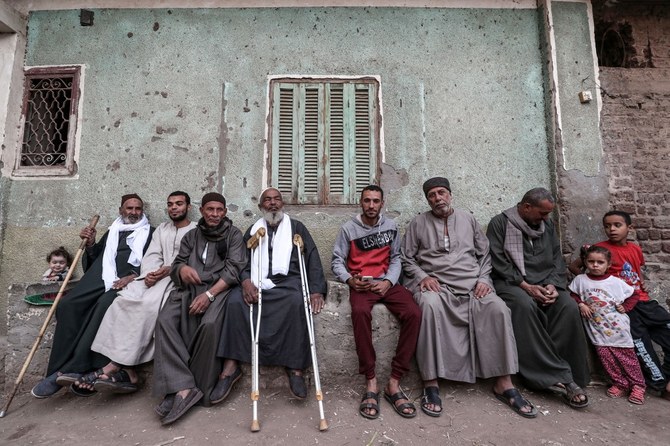
Egyptian men in the village of Al-Nehaya, one of the poorest in the country, in the province of Assiut, central Egypt. (AFP)
Short Url
Updated 18 October 2021
Follow

Egypt poverty rate falls 3% despite pandemic

  • Extreme poverty in Egypt (the percentage of people who cannot secure their food needs) decreased nationwide
  • CAPMAS said that 80.6 percent of individuals who live in families with 10 or more members are poor

CAIRO: Egypt’s poverty rate has fallen to the lowest level in 20 years, according to data from the Central Agency for Public Mobilization and Statistics.

CAPMAS defines poverty based on material wealth measurements, and classifies Egyptians as impoverished if they are unable to provide “minimum basic needs for themselves or a family.”

Needs include food, housing, clothing, education, and health and transportation services, according to the agency.

CAPMAS said that poverty rates in Egypt fell to 29.7 percent during the 2019-2020 fiscal year — a decline of 2.8 percent from the 32.5 percent recorded in 2017-2018. It added that this reflects the success of the country in striving for social justice in conjunction with economic reforms implemented by the state.

The agency said that extreme poverty in Egypt (the percentage of people who cannot secure their food needs) decreased nationwide to 4.5 percent in 2019-2020, down from 6.2 percent in 2017-2018.

The agency noted a correlation between growing family sizes and financial insecurity, saying: “The increase in the size of the family is a cause and a consequence of poverty. At the same time, it is a result of poor families not having sufficient social protection and therefore resorting to having more children for social protection when old or ill as a source of income.”

CAPMAS said that 80.6 percent of individuals who live in families with 10 or more members are poor, and that 48.1 percent of individuals who live in families with 6-7 members are also poor, compared to 7.5 percent of families with fewer than four members.

The agency indicated that education levels are the most relevant indicator of poverty, as poverty rates decrease as the level of education rises among parts of the population.

The percentage of poor among Egyptians with no formal education reached 35.6 percent in 2019-2020, compared to 9.4 percent for university graduates.

CAPMAS said that the Egyptian state is “making a lot of efforts” to protect the poor with the aim of improving the quality of life of citizens.

Social programs launched by the Egyptian government form the cornerstone Egypt’s Vision for Sustainable Development 2030.

The agency said that one of the most important programs is the national project for the development of Egyptian rural villages, which aims to improve living standards, build infrastructure, support people with disabilities and boost urban services.

The CAPMAS results came as the International Monetary Fund raised its forecast for the growth of the Egyptian economy during 2021, despite lowering estimates for the global economy.


Syria Kurds impose curfew in Qamishli ahead of govt forces entry

Updated 2 sec ago
Follow

Syria Kurds impose curfew in Qamishli ahead of govt forces entry

QAMISHLI: Kurdish forces imposed a curfew on Kurdish-majority Qamishli in northeastern Syria on Tuesday, ahead of the deployment of government troops to the city, an AFP team reported.
The curfew came after Syrian security personnel entered the mixed Kurdish-Arab city of Hasakah and the countryside around the Kurdish town of Kobani on Monday, as part of a comprehensive agreement to gradually integrate the Kurds’ military and civilian institutions into the state.
The Kurds had ceded territory to advancing government forces in recent weeks.
An AFP correspondent saw Kurdish security forces deployed in Qamishli and found the streets empty of civilians and shops closed after the curfew came into effect early on Tuesday.
It will remain in force until 6:00 am (0300 GMT) on Wednesday.
The government convoy is expected to enter the city later on Tuesday and will include a limited number of forces and vehicles, according to Marwan Al-Ali, the Damascus-appointed head of internal security in Hasakah province.
The integration of Kurdish security forces into the interior ministry’s ranks will follow, he added.
Friday’s deal “seeks to unify Syrian territory,” including Kurdish areas, while also maintaining an ongoing ceasefire and introducing the “gradual integration” of Kurdish forces and administrative institutions, according to the text of the agreement.
It was a blow to the Kurds, who had sought to preserve the de facto autonomy they exercised after seizing vast areas of north and northeast Syria in battles against Daesh during the civil war, backed by a US-led coalition.
Mazloum Abdi, head of the Kurdish-led Syrian Democratic Forces (SDF), had previously said the deal would be implemented on the ground from Monday, with both sides to pull forces back from frontline positions in parts of the northeast, and from Kobani in the north.
He added that a “limited internal security force” would enter parts of Hasakah and Qamishli, but that “no military forces will enter any Kurdish city or town.”