

Shooting in Syria could mark new phase in Israeli campaign

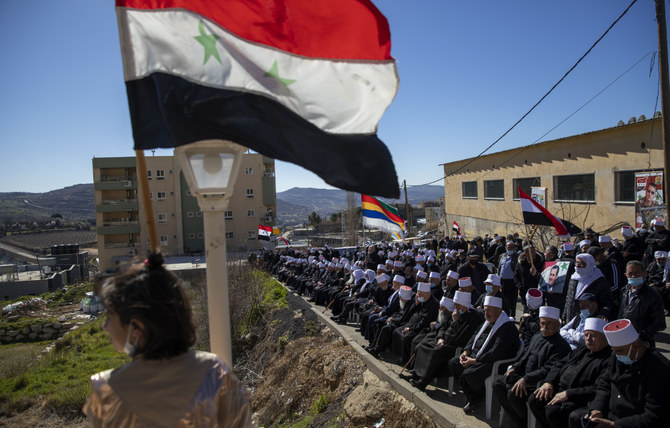
Druse supporters of Syrian President Bashar Assad wave Syrian flags during a rally close to the Syrian border demanding the return of the Golan Heights, captured by Israel in 1967, in Majdal Shams, Golan Heights. (AP/File)
Short Url
Updated 18 October 2021
Follow

Shooting in Syria could mark new phase in Israeli campaign

  • Israel captured the Golan Heights from Syria in the 1967 Mideast war and later annexed the strategic territory

JERUSALEM: The death of a former Syrian Druze lawmaker, allegedly by Israeli sniper fire, could mark a new phase in what Israel calls its war against Iranian entrenchment in neighboring Syria.

Syria’s state-run news agency said that Midhat Saleh was fatally shot Saturday in Ein el-Tinneh, a village along the Israeli frontier in the Golan Heights where he ran a Syrian government office. Israeli media said Saleh had been assisting the Iranian military against Israel.

The Israeli military declined to comment, but if Saleh was indeed killed by Israel, it would mark the first time that Israeli snipers are known to have killed someone identified as an Iranian-linked target across the border. Israel has said it will not tolerate a permanent Iranian military presence in Syria and has acknowledged carrying out scores of airstrikes on alleged Iranian arms shipments and military targets in Syria in recent years.

Israel captured the Golan Heights from Syria in the 1967 Mideast war and later annexed the strategic territory, which overlooks northern Israel. Most of the world does not recognize the annexation, though the Trump administration declared the territory to be part of Israel.

Saleh was born in Majdal Shams, in the Israeli-controlled side of the Golan, and was jailed several times by Israel, most recently for 12 years until 1997. He later moved to Syria, was elected to parliament in 1998 and served as an adviser to the government on the Golan issue.

The small Druze community living in the Israeli-controlled side of the Golan generally has good relations with Israel. But many members still profess loyalty to Syria, in part because they have relatives on the other side of the border.

Samih Ayoub, a resident on the Israeli side of the Golan, told Israel’s Army Radio station Saleh had “no connection” to Iran or to any militia. “He’s just a quiet man who works in an office. They killed him next to his house,” he said.

Saleh’s brother, Yasser Saleh, a doctor in Damascus, said his brother also lived in the Syrian capital but visited the border area periodically, slept there and sometimes spoke with relatives across the frontier. He said his younger brother had survived an earlier assassination attempt in early 2011 and remained committed to ending Israel’s control over the Golan Heights until the end. He said his brother was survived by a wife and two children, including a son named Golan.

While there was no official comment, Israeli military commentators — who are given high-level background briefings with top army brass — said Saleh was intimately involved in assisting the Iranians build up their capabilities along the Israeli front. Iran has sent thousands of forces to Syria to back the army of President Bashar Assad during the country’s decade-long civil war.

“He answered directly to the Iranians,” wrote Yossi Yehoshua, a military correspondent for Yediot Ahronot, Israel’s largest paid daily newspaper.

Giora Eiland, a former Israeli national security adviser, told Army Radio that if Israel killed Saleh, it was meant to send a message to the Iranians and not connected to the past. “I assume this was not an act of revenge,” he said. “We’re not talking about a mass murderer.”

Yoel Guzansky, a senior fellow and expert on Iran at the Institute for National Security Studies, a Tel Aviv think tank, said it was not a sure thing that Israel had even been involved. He said that Saleh was not an especially valuable target and also had tense relations with Iranian proxy Hezbollah and objected to the group’s activities in the Golan.

But he said that if Israel did indeed kill Saleh through an unprecedented sniper attack, it sent a powerful message to Iran and Syria about their activities near the Israeli border.

“It says that we have many ways and many techniques,” he said. “We’re watching you.”


UN nuclear watchdog says it’s unable to verify whether Iran has suspended all uranium enrichment

Updated 3 sec ago
Follow

UN nuclear watchdog says it’s unable to verify whether Iran has suspended all uranium enrichment

VIENNA: Iran has not allowed the United Nations nuclear watchdog to access nuclear facilities affected by the 12-day war in June, according to a confidential report by the watchdog circulated to member states and seen Friday by The Associated Press.
The report from the International Atomic Energy Agency stressed that therefore it “cannot verify whether Iran has suspended all enrichment-related activities,” or the “size of Iran’s uranium stockpile at the affected nuclear facilities.”
The IAEA report on Friday warned that due to the continued lack of access to any of Iran’s four declared enrichment facilities, the agency “cannot provide any information on the current size, composition or whereabouts of the stockpile of enriched uranium in Iran.”
The report stressed that the “loss of continuity of knowledge over all previously declared nuclear material at affected facilities in Iran needs to be addressed with the utmost urgency.”
Iran long has insisted its program is peaceful, but the IAEA and Western nations say Tehran had an organized nuclear weapons program up until 2003.
Highly enriched material should be verified regularly
According to the IAEA, Iran maintains a stockpile of 440.9 kilograms (972 pounds) of uranium enriched up to 60 percent purity — a short, technical step away from weapons-grade levels of 90 percent.
That stockpile could allow Iran to build as many as 10 nuclear bombs, should it decide to weaponize its program, IAEA director general Rafael Grossi warned in a recent interview with the AP. He added that it doesn’t mean that Iran has such a weapon.
Such highly enriched nuclear material should normally be verified every month, according to the IAEA’s guidelines.
The IAEA also reported that it had observed, through the analysis of commercially available satellite imagery, “regular vehicular activity around the entrance to the tunnel complex at Isfahan.”
The facility in Isfahan, some 350 kilometers (215 miles) southeast of Tehran, was mainly known for producing the uranium gas that is fed into centrifuges to be spun and purified.
Israel has struck buildings at the Isfahan nuclear site, among them a uranium conversion facility. The US also struck Isfahan with missiles during the war last June.
The IAEA also reported that through the analysis of commercially available satellite imagery, it has observed “activities being conducted at some of the affected nuclear facilities, including the enrichment facilities at Natanz and Fordow,” but it added that “without access to these facilities it is not possible for the Agency to confirm the nature and the purpose of the activities.”
The confidential IAEA report also said Friday that Iran did provide access to IAEA inspectors “to each of the unaffected nuclear facilities at least once since the military attacks of June 2025, with the exception of Karun Nuclear Power Plan, which is in the early stages of construction and does not contain nuclear material.”
IAEA joined Geneva talks between Iran and US
The IAEA reported on Friday that Grossi attended negotiations between the US and Iran on Feb. 17 and Feb. 26 in Geneva at which he “provided advice on issues relevant to the verification of Iran’s nuclear program.” The report said that those negotiations are “ongoing.”
The Trump administration has held three rounds of nuclear talks this year with Iran under Omani mediation. Thursday’s round of talks in Geneva ended without a deal, leaving the danger of another Mideast war on the table as the US has gathered a massive fleet of aircraft and warships in the region.
Oman’s Foreign Minister Badr Al-Busaidi said technical talks involving lower-level representatives would continue next week in Vienna, the home of the IAEA. The agency is likely to be critical in any deal.
The US is seeking a deal to limit Iran’s nuclear program and ensure it does not develop nuclear weapons.
Iran says it is not pursuing weapons and has so far resisted demands that it halt uranium enrichment on its soil or hand over its stockpile of highly enriched uranium.
Similar talks last year between the US and Iran about Iran’s nuclear program broke down after Israel launched what became a 12-day war on Iran, that included the US bombing Iranian nuclear sites.
Before the June war, Iran had been enriching uranium up to 60 percent purity.