BEIRUT: Syria’s government and opposition in the war-torn country have agreed to start drafting constitutional reforms, the UN Syria envoy announced Sunday, a major step after a nine-month hiatus of talks and several fruitless rounds.
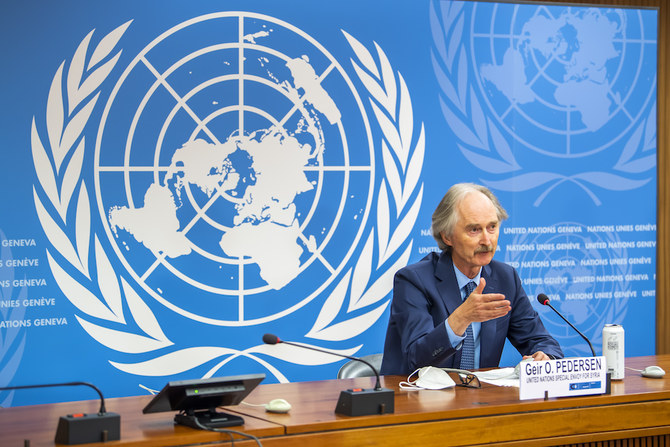
UN special envoy for Syria Geir Pedersen didn’t say what was behind the agreement or offer details of what comes next. The drafting sessions formally begin Monday.
Pedersen met Sunday with the co-chairs of a committee which includes figures from fourth-term President Bashar Assad’s government, as well as exiles and civil society representatives. The two sat together for the first time to discuss how to proceed, and plans for the week ahead, Pedersen said.
Thirty representatives divided between the two sides, along with 15 members of civil society, will be meeting with Pedersen in Geneva until Friday.
“I have been negotiating between the parties to establish a consensus on how we are going to move forward. I am very pleased to say we have reached such consensus,” Pedersen told reporters, appealing to all parties to maintain the spirit.
“My appeal for the 45 (members) is that we work as we have agreed to, and that we now start the drafting process of the constitutional committee,” he said.
The last round of talks ended in January without progress. Pedersen announced late September an agreement on “methodology” for a sixth round. It’s based on three pillars: respect for rules of procedure, the submission of texts of “basic constitutional principles” ahead of the meeting, and regular meetings of the co-chairs with him before and during the meeting.
Syria’s 10-year conflict has killed over 350,000 people and displaced half the country’s pre-war 23 million population, including more than 5 million refugees mostly in neighboring countries.
At a Russia-hosted Syrian peace conference in January 2018, an agreement was reached to form a 150-member committee to draft a new constitution.
The 2012 United Nations’ road map to peace in Syria calls for the drafting of a new constitution and ends with UN-supervised elections with all Syrians, including members of the diaspora, eligible to participate.
After the fifth round of negotiations failed in late January, Pedersen hinted the Syrian government delegation was to blame for the lack of progress.
The United States and several Western allies accused Assad of deliberately stalling and delaying the drafting of a new constitution until after presidential elections to avoid a UN-supervised vote, as called for by the Security Council.
In late May, Assad was re-elected in what the government called a landslide for a fourth seven-year term. The West and his opposition described the election as illegitimate and a sham.
Pedersen said the need for “a genuine intra-Syrian dialogue” was reportedly discussed by Assad and Russian President Vladimir Putin recently in Moscow, “and through this, a genuine process of Syrian political reform.”


![]()

Syrian constitutional committee agrees to start drafting constitutional reform: UN envoy
Short Url
https://arab.news/6ct6g
Syrian constitutional committee agrees to start drafting constitutional reform: UN envoy
- Syrian government and opposition co-chair meeting for first time, agree to launch process for drafting constitutional reform
- Pedersen says the Syrian Constitutional Committee is an important contribution to the political process but will not be able to solve the political crisis itself


Latest updates


© 2026 SAUDI RESEARCH & PUBLISHING COMPANY, All Rights Reserved And subject to Terms of Use Agreement.