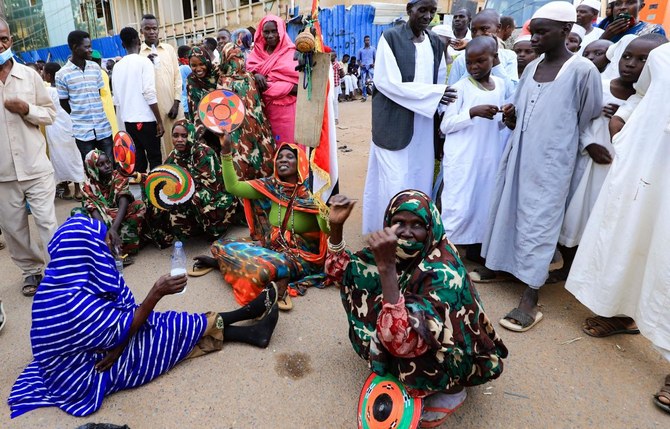
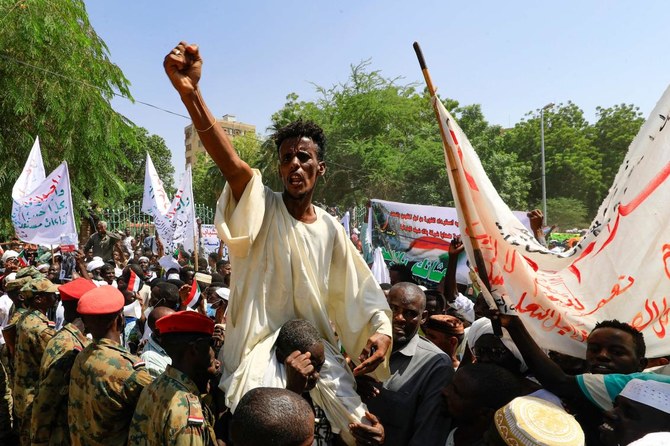
KHARTOUM: Thousands of pro-military Sudanese protesters took to the streets Saturday demanding the dissolution of the transitional government, saying it had “failed” them politically and economically.
The protests came as Sudanese politics reels from divisions among the factions steering the rocky transition from two decades of iron-fisted rule by Omar Al-Bashir, who was ousted by the army in April 2019 in the face of mass protests.
Saturday’s demonstrations were organized by a splinter faction of the Forces for Freedom and Change (FFC), a civilian alliance which spearheaded the anti-Bashir protests and became a key plank of the transition.
“We need a military government, the current government has failed to bring us justice and equality,” said Abboud Ahmed, a 50-year-old protester near the presidential palace in central Khartoum.
The official SUNA news agency reported that protesters had traveled in by truck from Khartoum’s outskirts and from neighboring states.
Critics alleged that the protests involved sympathizers of the Bashir regime, which was dominated by Islamists and the military.
Banners called for the “dissolution of the government.” Protesters chanted “one army, one people” and “the army will bring us bread.”
“We are marching in a peaceful protest and we want a military government,” said housewife Enaam Mohamed.
On Friday, Prime Minister Abdalla Hamdok warned that the transition is facing its “worst and most dangerous” crisis.
The mainstream faction of the FFC said: “The current crisis is not related to dissolution of the government of not.
“It is engineered by some parties to overthrow the revolutionary forces... paving the way for the return of remnants of the previous regime.”
Support for the transitional government has waned in recent months in the face of a tough package of IMF-backed economic reforms, including the slashing of fuel subsidies and a managed float of the Sudanese pound.
Protests have rocked eastern Sudan where demonstrators have blocked trade through the key hub of Port Sudan since September.
On September 21, the government said it thwarted a coup attempt which it blamed on both military officers and civilians linked to Bashir’s regime.


![]()
![]()
![]()

Thousands of pro-military protesters rally against Sudan government

Short Url
https://arab.news/686p5
Thousands of pro-military protesters rally against Sudan government
- Saturday’s demonstrations were organized by a splinter faction of the Forces for Freedom and Change (FFC)
- FFC is a civilian alliance which spearheaded the anti-Bashir protests and became a key plank of the transition


Latest updates


© 2026 SAUDI RESEARCH & PUBLISHING COMPANY, All Rights Reserved And subject to Terms of Use Agreement.