PARIS: French President Emmanuel Macron on Saturday condemned as “inexcusable” a deadly crackdown by Paris police on a 1961 protest by Algerians whose scale was a taboo covered up for decades by French authorities.
Macron told relatives and activists on the 60th anniversary of the bloodshed that “crimes” were committed on the night of October 17, 1961 under the command of the notorious Paris police chief Maurice Papon.
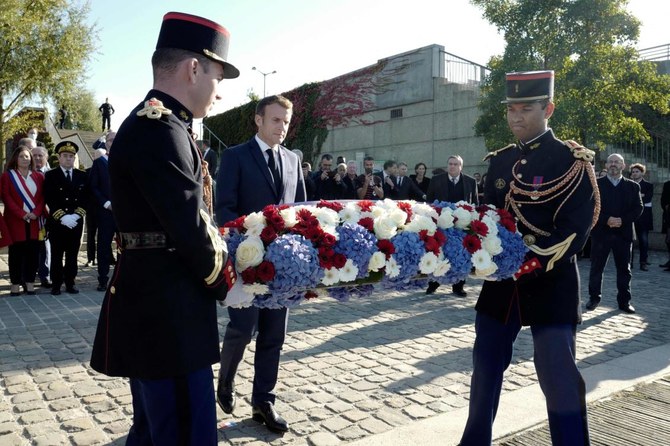
He acknowledged that several dozen protesters had been killed, “their bodies thrown into the River Seine” and paid tribute to the memory of the victims.
The precise number of victims has never been made clear and some activists fear several hundred could have been killed.
Macron “recognized the facts: that the crimes committed that night under Maurice Papon are inexcusable for the Republic,” the Elysee said.
“This tragedy was long hushed-up, denied or concealed,” it added.
Macron, the first French president to attend a memorial ceremony for those killed, observed a minute of silence in their memory at the Bezons bridge over the Seine on the outskirts of Paris where the protest started.
His comments that crimes were committed went further than predecessor Francois Hollande, who acknowledged in 2012 that the protesting Algerians had been “killed during a bloody repression.”
However, as expected, he did not issue a formal apology. He also did not give a public speech, with the Elysee issuing only the written statement.
Papon was in the 1980s revealed to have been a collaborator with the occupying Nazis in World War II and complicit in the deportation of Jews. He was convicted of crimes against humanity but later released.

Macron condemns ‘inexcusable’ crackdown on 1961 Paris protest of Algerians
Short Url
https://arab.news/8jv2a
Macron condemns ‘inexcusable’ crackdown on 1961 Paris protest of Algerians
- Macron told relatives and activists on the 60th anniversary of the bloodshed that ‘crimes’ were committed on the night of October 17, 1961
- Macron acknowledged that several dozen protesters had been killed, ‘their bodies thrown into the River Seine’ and paid tribute to the memory of the victims
Russian pensioners turn to soup kitchen as war economy stutters
SAINT PETERSBURG: Dishes clatter, steam bursts from large cooking pots and music is seeping through the bustling chatter of Russian pensioners, hunched over bowls of free meals in a Saint Petersburg soup kitchen.
The general mood is upbeat but the place, at full capacity, is a testament to financial hardships plaguing an ever-increasing number of Russia’s elderly people, struggling to make ends meet as the country’s war economy stutters.
Nina, a 77-year-old retired engineer, said she could no longer go to the supermarket, getting her lunch and dinner from the soup kitchen instead, as she was not able to afford her own groceries.
“I haven’t been to a shop for three years because I don’t have the money. There’s simply no point in going,” she told AFP, her voice resolute but eyes glistening.
“Should I just go, look around and leave?,” she asked.
The cost of living in Russia — particularly in large cities — has skyrocketed in the four years since Moscow launched its full-scale offensive in Ukraine.
Huge spending on the military helped Russia buck predictions of economic collapse, but has pushed up inflation — a headache for the Kremlin which has aimed to shield citizens from the fallout of its war.
Prices have surged by a combined 45 percent since Russia launched its offensive, according to official data.
And though President Vladimir Putin recently hailed a cooling of inflation amid high interest rates, pensioners in the Saint Petersburg soup kitchen say their situation is still dire.
- ‘Poor boys’ -
On a bright winter day, AFP met former accountants, doctors and engineers turning to the free bowls of soup and pasta on offer.
Zinaida, a 77-year-old former paediatrician, told AFP her pension was 26,400 rubles ($345) a month.
“Over the last two to three years, we have seen food prices rise,” Zinaida said, attributing the surge to raising taxes.
In order to plug holes in Russia’s stretched public finances, the Kremlin has tapped the pockets of its citizens, raising the nationwide sales tax from 20 to 22 percent, starting this year.
For many pensioners like Zinaida, juggling monthly expenses has become increasingly tricky.
“By our age, everyone has a whole load of illnesses,” she said, and the medications were “very expensive.”
“You work just to pay for the utilities and the pharmacy. There is almost nothing left for anything else.”
That sentiment is shared by Anna, 66, who, despite a career as a surgeon, said she struggled to pay her bills in retirement.
“When you go to the pharmacy, you start to wonder if you’ll be able to buy anything for lunch.”
The Central Bank, which has hiked borrowing costs in a bid to tame price rises, expects annual inflation to ease to Moscow’s four-percent target only in 2027.
That is just one of the Russian economy’s worsening indicators as the war in Ukraine drags into its fifth year.
Growth slowed dramatically to one percent in 2025, Putin said earlier this week — down from 4.3 a year prior.
But for Tatyana, a former accountant, “it’s only fair that things should get more expensive.”
“We have this war going, with our poor boys there. May God grant them all good health.”
The general mood is upbeat but the place, at full capacity, is a testament to financial hardships plaguing an ever-increasing number of Russia’s elderly people, struggling to make ends meet as the country’s war economy stutters.
Nina, a 77-year-old retired engineer, said she could no longer go to the supermarket, getting her lunch and dinner from the soup kitchen instead, as she was not able to afford her own groceries.
“I haven’t been to a shop for three years because I don’t have the money. There’s simply no point in going,” she told AFP, her voice resolute but eyes glistening.
“Should I just go, look around and leave?,” she asked.
The cost of living in Russia — particularly in large cities — has skyrocketed in the four years since Moscow launched its full-scale offensive in Ukraine.
Huge spending on the military helped Russia buck predictions of economic collapse, but has pushed up inflation — a headache for the Kremlin which has aimed to shield citizens from the fallout of its war.
Prices have surged by a combined 45 percent since Russia launched its offensive, according to official data.
And though President Vladimir Putin recently hailed a cooling of inflation amid high interest rates, pensioners in the Saint Petersburg soup kitchen say their situation is still dire.
- ‘Poor boys’ -
On a bright winter day, AFP met former accountants, doctors and engineers turning to the free bowls of soup and pasta on offer.
Zinaida, a 77-year-old former paediatrician, told AFP her pension was 26,400 rubles ($345) a month.
“Over the last two to three years, we have seen food prices rise,” Zinaida said, attributing the surge to raising taxes.
In order to plug holes in Russia’s stretched public finances, the Kremlin has tapped the pockets of its citizens, raising the nationwide sales tax from 20 to 22 percent, starting this year.
For many pensioners like Zinaida, juggling monthly expenses has become increasingly tricky.
“By our age, everyone has a whole load of illnesses,” she said, and the medications were “very expensive.”
“You work just to pay for the utilities and the pharmacy. There is almost nothing left for anything else.”
That sentiment is shared by Anna, 66, who, despite a career as a surgeon, said she struggled to pay her bills in retirement.
“When you go to the pharmacy, you start to wonder if you’ll be able to buy anything for lunch.”
The Central Bank, which has hiked borrowing costs in a bid to tame price rises, expects annual inflation to ease to Moscow’s four-percent target only in 2027.
That is just one of the Russian economy’s worsening indicators as the war in Ukraine drags into its fifth year.
Growth slowed dramatically to one percent in 2025, Putin said earlier this week — down from 4.3 a year prior.
But for Tatyana, a former accountant, “it’s only fair that things should get more expensive.”
“We have this war going, with our poor boys there. May God grant them all good health.”
© 2026 SAUDI RESEARCH & PUBLISHING COMPANY, All Rights Reserved And subject to Terms of Use Agreement.