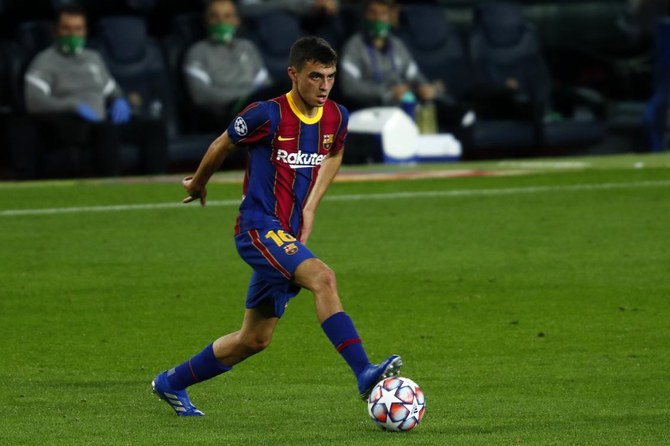
Pedri signs new deal with ‘greatest club’ Barcelona

Barcelona has re-signed Pedri Gonzalez to a new contract through the 2025-26 season. The 18-year-old midfielder is one of the few bright spots in an otherwise tumultuous period for the Spanish club. (AP)
Short Url
Updated 15 October 2021
Follow

Pedri signs new deal with ‘greatest club’ Barcelona

  • Pedri has been one of the very few bright spots for Barcelona over the past year
  • “My desire was to remain here for many years,” the 18-year-old Pedri said after signing

BARCELONA: Barcelona midfielder Pedri González signed a new contract through 2026 on Friday, with the club hoping the teenager can help it recover from the traumatic departure of Lionel Messi.
Pedri has been one of the very few bright spots for Barcelona over the past year, during which a president has resigned and its debt has skyrocketed. Barcelona had to let Messi walk away when it could not pay his wages. Painful losses on the field have followed.
“My desire was to remain here for many years,” the 18-year-old Pedri said after signing. “It is true that we are going through a difficult moment, but we are the greatest club in the world and we are going to work this out.”
Pedri is coming off a breakout season, his first with Barcelona after joining from Las Palmas. The playmaker led Barcelona with 53 appearances, helping it win the Copa del Rey.
Pedri also became a key player for Spain, helping the national team reach the semifinals of the European Championship and winning a silver medal at the Tokyo Olympics.
His salary was not made public but Barcelona president Joan Laporta thanked Pedri for making “an effort” to reach an agreement that the cash-strapped club could afford. An exultant Laporta, who at one point in their joint news conference accidently called Pedri “Messi,” said re-signing the teenager was “of those days when it pays to be Barça’s president.”
In a sign of the expectations Barcelona has placed on Pedri, his contract includes a release clause of 1 billion euros ($1.1 billion), the highest in club history. Barcelona director of football Mateu Alemany said Pedri’s release clause “means he will be off the market for several years.”
Pedri signed for Barcelona in 2019 from Las Palmas, a second-division club on his native Canary Islands. The transfer fee of 5 million euros ($5.8 million) proved a steal. At Barcelona, Pedri quickly convinced coach Ronald Koeman that he should be his central playmaker in a similar role to former great Andrés Iniesta.
Spain coach Luis Enrique took note and gave Pedri a starting spot in the European Championship, where his precision passing and ball control earned him the award for the tournament’s best young player.
With Messi gone and no money to make big signings, Pedri forms part of a youth movement at Barcelona along with forward Ansu Fati and Gavi Páez, who recently became the youngest player to debut for Spain at age 17.
Pedri is currently recovering from a left thigh injury. He said that he did not believe the injury was due to the staggering total of 74 matches he played for country and club last season.
“I am eager to get back out there and make good on the trust that (the club) has placed in me,” Pedri said.


MESIF 2026 wraps up in Riyadh with spotlight on legacy, fans and sustainable sports growth

Updated 6 sec ago
Follow

MESIF 2026 wraps up in Riyadh with spotlight on legacy, fans and sustainable sports growth

  • A recurring theme in panel discussions was the importance of moving beyond siloed planning toward connected strategies
  • Abdullah Aldrees: I believe Saudi is a sleeping giant within the football ecosystem because of the high demand that exists

RIYADH: The sixth edition of the Middle East Sports Investment Forum concluded on Jan. 28 in Riyadh, reinforcing the need for long-term legacy planning, integrated infrastructure development and fan-centric strategies as the region’s sports ecosystem continues to mature.

Held over two days — Jan. 27-28 — at the ministry of investment headquarters and the Kingdom Arena, the forum brought together senior government officials, global sports executives, investors and technology leaders to assess how the Middle East — and Saudi Arabia in particular — can translate major event hosting and increased investment into sustainable impact.

A recurring theme in panel discussions was the importance of moving beyond siloed planning toward connected strategies that link infrastructure, finance, fan engagement and legacy from the earliest stages of project development.

Dr. Sakis Batsilas, deputy CEO of FIFA World Cup Qatar 2022, stressed that while international expertise has played a key role in the region’s rapid progress, long-term success depends on knowledge transfer and talent development.

“Yes, we do need experts and consultants and expatriates to help,” he said. “But the main, I would say, focus, is how we ensure that we transfer this knowledge and we build talent … to make sure we have the right talent.”

Drawing on his experience delivering major global events, Batsilas highlighted the need to embed legacy considerations during the bidding phase.

“Talking now from an operational point of view … I think everything starts with a bidding phase,” he said, adding that stronger legacy metrics would encourage greater long-term planning from host nations and rights holders alike.

Fan experience and commercialization also featured prominently, particularly as Saudi Arabia continues to expand its domestic leagues and host major international competitions. David Davies, chief experience officer of Catapult, said the Kingdom’s challenge lies in converting strong digital fandom into sustained in-stadium engagement.

“Saudi Arabia is … ranked consistently in the highest in the world” in terms of football fandom, Davies said. “However, attendance in-stadium is still developing.” He noted that younger, digitally native audiences require tailored engagement strategies. “The days of being able to ask them to come to you have gone,” he said.

From a government and delivery perspective, Abdullah Aldrees, chief of staff at the vice minister’s executive office at the ministry of sport, said MESIF highlighted the scale of opportunity ahead — and the importance of a joined-up approach.

“I believe Saudi is a sleeping giant within the football ecosystem because of the high demand that exists, the government support and the anchor IPs that we’re hosting,” Aldrees said. “So all of this can create a lot of opportunities for football to grow in Saudi.”

He said the Kingdom has entered a critical preparation phase as it gears up for a packed calendar of major events. “We are now living in the preparation phase. We’re preparing for all these IPs, we’re preparing for all these big events coming up,” Aldrees said. “So how do you make sure that you really reap the right benefit from them and have the right legacy?”

Pointing to upcoming milestones such as the AFC Asian Cup Saudi Arabia 2027 and the FIFA World Cup 2034, Aldrees emphasized the need to think beyond hosting.

“Yes, we’re hosting World Cup. We’re hosting Asia 2027, but how do you make sure that they have a long, lasting impact on the ecosystem?” he said.

Echoing a key message from the forum, Aldrees concluded: “The effective strategy is to be looking at these things together. We no longer can be looking at them as silos and test cycles.”

The transformation of Saudi football was also highlighted as a reflection of broader cultural and structural change. Juan Esteban Gomez, a football expert specializing in digitalization and artificial intelligence, said the shift has been tangible in recent years. “The people here are breathing football,” he said, describing the Saudi league as “one of the most enjoyable competitions in the world.”

As MESIF 2026 drew to a close, participants agreed that the next phase of sports investment in the Middle East will be defined by execution — ensuring that capital, policy and innovation align to deliver measurable legacy, deeper fan engagement and resilient ecosystems capable of sustaining growth well beyond headline events.