The masks are off in public places as Saudi Arabia eases COVID-19 restrictions

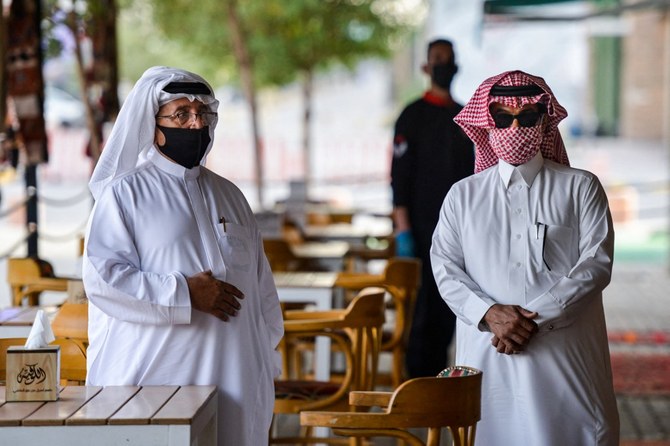
Mask-clad clients wait for their table to be sanitised upon arriving at a cafe in Saudi Arabia's capital Riyadh on June 21, 2020. (File/AFP)
Short Url
Updated 16 October 2021
Follow

The masks are off in public places as Saudi Arabia eases COVID-19 restrictions

  • The Grand Mosque and the Prophet’s Mosque will also be operating at full capacity for those who have been double jabbed

JEDDAH: More than 18 months since the start of the COVID-19 pandemic, the Ministry of Interior announced on Friday that, due to a significant nationwide decline in COVID-19 cases and the Kingdom’s high vaccination rates, a number of restrictions will be relaxed from Sunday, October 17.

The new rules will only apply to those who have been fully vaccinated against COVID-19. So far, that includes 20.6 million of the Kingdom’s 34.8 million residents.

The ministry announced that face masks will no longer be mandatory in outdoor settings, except for certain specific locations — including the Grand Mosque in Makkah and the Prophet’s Mosque in Madinah, where all visitors and staff must still wear masks. The two mosques will return to full capacity, but visits must be reserved through the Ministry of Health-approved apps Eatmarna and Tawakkalna.

In addition, social distancing will no longer be mandatory at social gatherings or in public settings including transport, restaurants, cinemas, and more. Wedding halls will also be allowed to return full capacity.

However, a number of precautionary measures will remain in place for people outside of their homes, including temperature checks upon entry into establishments and health status checks via the Tawakkalna app. Public and private establishments will still be required to make hand sanitizer widely available.

Social distancing and face masks will still be mandatory in locations where Tawakkalna health status checks are not applied.

The MOH will continue to monitor the number of COVID-19 cases resulting in hospitalization or admittance to ICU, it was announced. If red flags are raised due to the relaxation of rules, then precautionary measures will be re-introduced in cities, governorates, or regions as necessary.


AI takes center stage at Absher Conference in Riyadh

Updated 6 sec ago
Follow

AI takes center stage at Absher Conference in Riyadh

  • In-depth dialogue on the Kingdom’s prospering AI industry during second day of Absher Conference

RIYADH: Artificial Intelligence continues to prove itself a valuable, unique long-term asset in Saudi Arabia’s digital transformation, underscored by the Ministry of Interior’s Absher Conference.

After unveiling the success of Tuwaiq Academy’s Tuwaiq Hackathon on the conference’s first day, the second day of the Absher Conference was a platform for in-depth dialogue on the Kingdom’s prospering AI industry. With fundamental discussion building upon the Ministry of Interior’s role in leveraging digital transformation, panel conversations gave voice to training academies, tech startups, and AI in media.

During the panel “Investing in Govtech: Empowering AI Startups to Redefine Government Services,” the bridge of collaboration between government entities and AI start-ups shed light on investments, infrastructure, and talent.

Mohamed El-Abbouri, CEO of Signit, a Saudi technology company, elaborated on the intersection between infrastructure readiness and transformation.

“Saudi ranks as one of the top countries globally when it comes to government technology. In addition to that is the government’s infrastructure readiness … Saudi citizens are digital-first people, so we have the local talent to deliver on that,” he said.

That readiness, which powers people-level progress, does not come without the force of education. Academies and educational institutions are powerhouses of the Kingdom’s AI industry, continually evolving to equip aspiring talent with the tools and technical skills.

During the panel “Technical Academies: Engines of Transformation,” Renad Alkhathiri, general manager of AI at Metaverse Tuwaiq Academy, shared insight on how they turn technology users into technology developers.

“The first approach to the learning methodology is mentorship … the second is that we provide the students with the latest equipment and latest technologies … the third one is practical training — so all the programs and bootcamps that we are offering are 90 percent practical training, they (the students) practice their product from day one,” he said.

As the educational sphere pairs with the investment going into the AI industry in the Kingdom, media takes the role of showcasing the results of this labor step by step. The media industry, the sector that platforms the Kingdom’s achievements both locally and internationally, is also leveraging AI tools. Avneesh Prakash, CEO of Camb.AI, a company focused on AI localization and translation tools, offered insight into the world of AI and media at the Absher Conference.

Prakash took to the stage to speak with Noor Nugali, deputy editor-in-chief at Arab News, on AI in media as a cornerstone of the Kingdom’s technological evolution.

“The Saudi stories need to go to the world in a language that the world understands,” he said.

His statement is backed by his company’s recent partnership with Arab News, which allows readers to choose from over 50 languages.

Camb.AI’s tool is without bounds as it extends its abilities from sports to animations to film, creating shared experiences of consuming art and entertainment in all languages.

Prakash elaborated on the way AI is reshaping media in the Kingdom, stating: “AI will help with speed, scale, and creating the access.”

He reiterated that the company aims to preserve the emotion and nuance in human storytelling.

The second day of the Absher Conference has proven that AI’s ability to sew a thread through government, education, and media in the Kingdom makes the industry not only versatile, but also unifying in progress and transformation.