Disgraced BBC religion editor asked Pakistani PM if he was ‘ashamed’ to be Muslim after 9/11

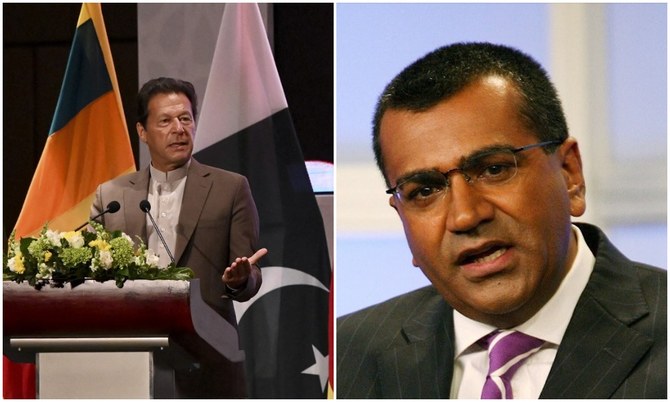
Martin Bashir asked Pakistani PM Imran Khan if he was “ashamed of being a Muslim” after the 9/11 terror attacks. (File/AFP)
Short Url
Updated 15 October 2021
Follow

Disgraced BBC religion editor asked Pakistani PM if he was ‘ashamed’ to be Muslim after 9/11

  • Journalist criticized for “deceitful” treatment of Diana, Princess of Wales
  • Politician said question was part of West's “rising Islamophobia”

LONDON: The BBC’s former religion editor Martin Bashir asked Pakistani Prime Minister Imran Khan if he was “ashamed of being a Muslim” after the 9/11 terror attacks.

Khan revealed in his autobiography that he was “shocked” by Bashir’s line of questioning when he was contacted after the tragedy.

“After 9/11, I will never forget he (Bashir) rang me up and he said: ‘Aren’t you ashamed of being a Muslim,’” said Khan, who was interviewed by the journalist in Pakistan.

“‘As a Muslim, aren’t you embarrassed by the attacks?’ was his immediate question. I was shocked,” Khan wrote.

“Implying all the world’s 1.3 billion Muslims should feel responsible for an act of a handful of criminals is like asking a Christian to feel responsible for Hitler or Stalin’s atrocities, or asking a Catholic if they support the IRA blowing up children at Omagh. I expected a backlash after 9/11, but had not anticipated its ferocity,” he added.

It was part of the “rising Islamophobia” in the West that falsely portrayed all Muslims as “baddies,” said Khan, who was elected as Pakistan’s leader in 2018.

He said the phone call with Bashir, who then worked for ITN, was an example of how some in the West used the Sep. 11 attacks to put “all Muslims on trial” and merely “alienated many normal Muslims.”

Bashir, Khan concluded, was “not the best of journalists.”

The journalist, who retired from the profession in May this year citing health reasons, has also been the subject of significant scrutiny for his reporting methods in other cases, most prominently with his treatment of the late Diana, Princess of Wales.

The UK’s Daily Mail newspaper revealed last year that Bashir had used forgery and deception to trick her into giving him an interview in 1995 that some blamed on her eventual split from Prince Charles. She died in 1997 in a car crash.

Following an inquiry, the BBC found that Bashir had used “deceitful” methods to secure an interview with her and that a “woefully ineffective” internal investigation had covered his tracks.

Khan and Diana were friends and she visited Pakistan numerous times. He attended her funeral alongside Hasnat Khan, her former boyfriend and a distant relative of the cricket star.


Disinformation the new enemy in disaster zones, says Red Cross

Updated 05 March 2026
Follow

Disinformation the new enemy in disaster zones, says Red Cross

  • “Harmful information and dehumanizing narratives” undermines humanitarian aid and putting lives of aid workers at risk
  • Between 2020 and 2024, disasters affected nearly 700 million people, displaced over 105 million, and killed more than 270,000 — doubling the number in need of humanitarian aid

GENEVA: The rise of disinformation is undermining humanitarian aid and putting lives at risk, while disasters are affecting ever more people, the Red Cross warned Thursday.
“Between 2020 and 2024, disasters affected nearly 700 million people, caused more than 105 million displacements, and claimed over 270,000 lives,” the International Federation of Red Cross and Red Crescent Societies said.
The number of people needing humanitarian assistance more than doubled in the same timeframe, the IFRC said in its World Disasters Report 2026.
But the world’s largest humanitarian network said that “harmful information and dehumanizing narratives” were increasingly undermining trust, putting the lives of aid workers at risk.
“In polarized and politically-charged contexts, humanitarian principles such as neutrality and impartiality are increasingly misunderstood, misrepresented or deliberately attacked online,” it said.
The IFRC has more than 17 million volunteers across more than 191 countries.
“In every crisis I have witnessed, information is as essential as food, water and shelter,” said the Geneva-based federation’s secretary general Jagan Chapagain.
“But when information is false, misleading or deliberately manipulated, it can deepen fear, obstruct humanitarian access and cost lives.”
He said harmful information was not a new phenomenon, but it was now moving “with unprecedented speed and reach.”
Chapagain said digital platforms were proving “fertile ground for lies.”
The IFRC report said the challenge nowadays was no longer about the availability of information but its reliability, noting that the production and spread of disinformation was easily amplified by artificial intelligence.

- ‘Life and death’ -

The report cited numerous recent examples of harmful information hampering crisis response.
During the 2024 floods in Valencia, false narratives online accused the Spanish Red Cross of diverting aid to migrants, which in turn fueled “xenophobic attacks on volunteers,” the IFRC said.
In South Sudan, rumors that humanitarian agencies were distributing poisoned food “caused people to avoid life-saving aid” and led to threats against Red Cross staff.
In Lebanon, false claims that volunteers were spreading Covid-19, favoring certain groups with aid and providing unsafe cholera vaccines eroded trust and endangered vulnerable communities, the IFRC said.
And in Bangladesh, during political unrest, volunteers faced “widespread accusations of inaction and political alignment,” leading to harassment and reputational damage, it added.
Similar events were registered by the IFRC in Sudan, Myanmar, Peru, the United States, New Zealand, Canada, Kenya and Bulgaria.
The report underlined that around 94 percent of disasters were handled by national authorities and local communities, without international interventions.
“However, while volunteers, local leaders and community media are often the most trusted messengers, they operate in increasingly hostile and polarized information environments,” the IFRC said.
The federation called on governments, tech firms, humanitarian agencies and local actors to recognize that reliable information “is a matter of life and death.”
“Without trust, people are less likely to prepare, seek help or follow life-saving guidance; with it, communities act together, absorb shocks and recover more effectively,” said Chapagain.
The organization urged technology platforms to prioritize authoritative information from trusted sources in crisis contexts, and transparently moderate harmful content.
And it said humanitarian agencies needed to make preparing to deal with disinformation “a core function” of their operations, with trained teams and analytics.