

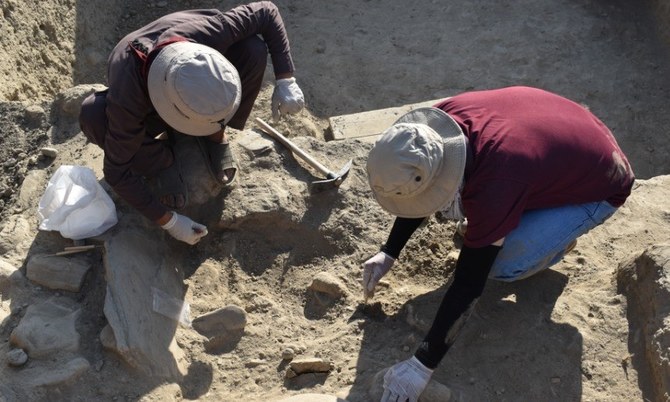

MANSEHRA: In what is being called “the first ever scientific attempt to reconstruct the history of Chitral,” a district in Pakistan’s northwestern Khyber Pakhtunkhwa province, a group of archaeologists has newly excavated a 3,000-year-old burial site, an academic leading the project said this week.
The three-year-long multidisciplinary project carried out by the archaeology department of Hazara University led to the discovery of burial remains of an Iron Age culture, with graves revealing both single and multiple burials along with several artefacts like stone beads, copper and iron earrings, bangles, nails, arrowheads and terracotta vessels.
The Iron Age was a period in human history that started between 1200 BC and 600 BC, depending on the region, and followed the Stone Age and Bronze Age. During the Iron Age, people across much of Europe, Asia and parts of Africa began making tools and weapons from iron and steel.
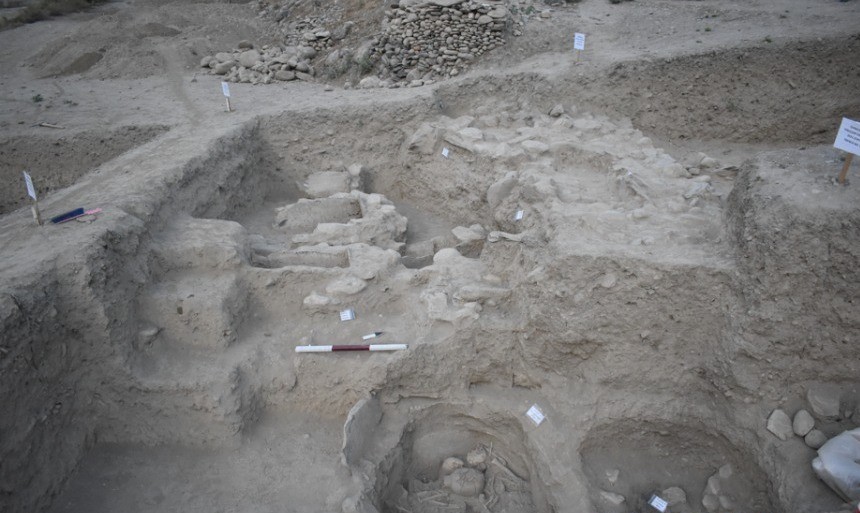
A view of the recently discovered burial site of Gankoriniotek Singoor in Chitral district of Khyber-Pakhtunkhwa, Pakistan, on October 06, 2021. (Photo Courtesy: Dr Abdul Hameed Khan)
“The antiques will be displayed at a museum while the bones found during the excavations will be sent to the United States for DNA tests to relate the connection between the ancient time and the current population of Chitral,” Dr. Abdul Hameed Khan, who is leading the five-member team, told Arab News in Mansehra.
“This research project is unique since we are conducting the first-ever scientific research using ancient DNA and molecular sequencing [in this area] to trace the origins of its people. We are trying to find out whether they came to Chitral from Central Asia or another region.”
The project has three main aims according to a press release: “Characterize Iron Age human genetic diversity and migrations in Chitral; Establish a link between the modern population and the Iron Age People; Reconstruct the human demographic history and health trajectory of the region through molecular analysis.”
The Hazara University project received financial support from the Higher Education Commission of Pakistan under the National Research Program. It has also been carried out in collaboration with the University of Chicago in the United States, Copenhagen University in Denmark and the University of Lahore in Pakistan.
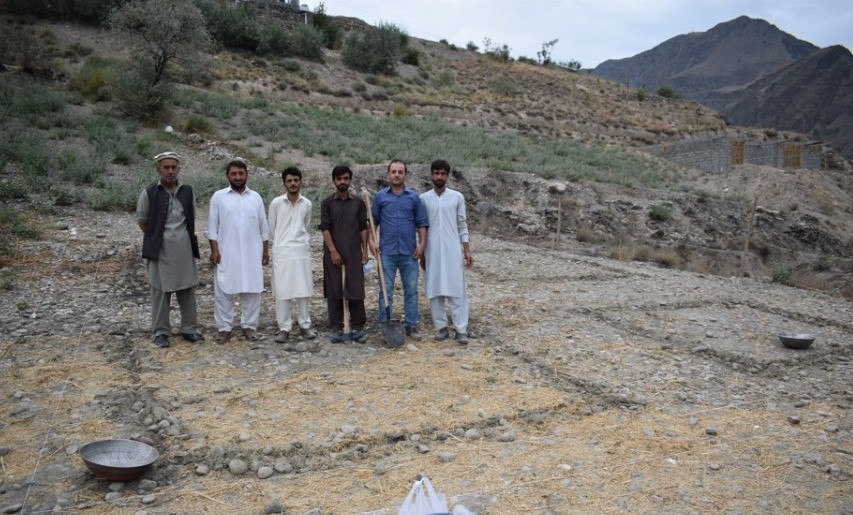
Dr Abdul Hameed, holding a shovel, seen in a group photograph at Gankoriniotek Singoor in Chitral district of Khyber-Pakhtunkhwa, Pakistan, on July 07, 2021. (Photo Courtesy: Dr Abdul Hameed Khan)
“There are almost 35 burial sites in Chitral Valley,” Khan said. “So far, we have excavated 15 graves at Gankoriniotek Singoor. In some graves, we found a single burial and skeleton while in others there were multiple people.
In one of the graves, we found five individuals. In addition to that, evidence of cremation could also be noticed in the form of burnt bones, ashes and charcoals.”
Khan said DNA tests of the remains would also help gather information about past diseases and diet.
Confirming the recent discovery, Dr. Abdul Samad, the top official at the Khyber Pakhtunkhwa Directorate of Archaeology and Museums, told Arab News the Hazara University scholars had “discovered 3,000 years old Aryan period graves.”
The Directorate of Archaeology and Museums had also excavated and discovered ancient cemeteries in the past at different places in Chitral district like Singoor and Kankcorinat.
“All the artefacts discovered through such excavations are placed at museums in Chitral,” Samad said.


