Yemeni troops recapture areas from Houthis in Marib’s Juba district

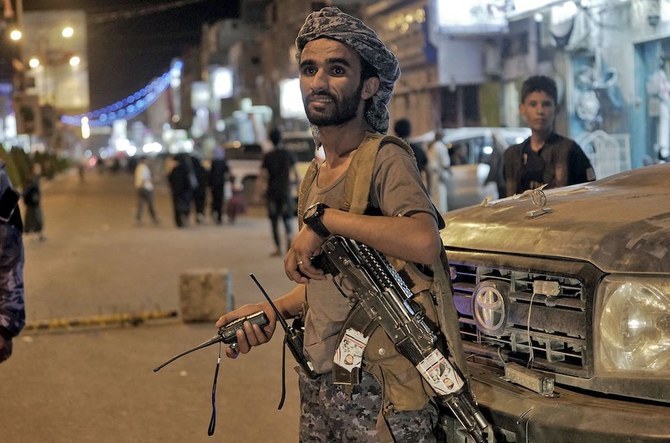
A fighter loyal to the Yemeni government at the approaches to Marib city, Yemen, May 5, 2021. (AFP)
Short Url
Updated 14 October 2021
Follow

Yemeni troops recapture areas from Houthis in Marib’s Juba district

  • Coalition airstrikes alleviated Houthi pressure and allowed loyalists to have the upper hand on the battlefield
  • The fighting in Juba came as the Houthis rejected local and international calls to end their siege of Abedia

AL-MUKALLA: Yemeni troops on Thursday recaptured areas from the Houthis south of Marib province, as the UN demanded that the militia ended its siege of Abedia district and other hostilities in the province.

Col. Yahiya Al-Hatemi, director of the army’s military media, told Arab News at least 108 Houthis were killed in fighting during the past 24 hours and that troops had liberated several locations in Juba district from the militia.

Arab coalition warplanes carried out more than two dozen air raids targeting Houthis outside Abedia, hitting the reinforcements that were heading to the battlefields in Marib province.

Fighting flared on Wednesday as troops launched fresh counterattacks in Juba, and Al-Hatemi said the coalition airstrikes had alleviated Houthi pressure on troops and smoothed the way for loyalists to have an upper hand on the battlefields.

The fighting in Juba came as the Houthis rejected local and international calls to end their Abedia siege, which is pushing thousands of civilians into famine.

Yemeni officials said the Houthis on Wednesday had shelled the district's only functioning hospital even as dozens of patients were being treated.

The militia has also snubbed appeals to allow aid organizations to deliver life-saving humanitarian assistance to more than 35,000 people in the district.

Al-Hatemi said coalition warplanes had carried out many airstrikes in Abedia to shore up troops defending the district and to force the Houthis into ending their siege.

The provincial office of the Health Ministry in Marib declared Abedia a “disaster area” due to the Houthi shelling of residential areas and health facilities, the ongoing siege, and severe shortages of medicine, clean drinking water, food and fuel.

It said that local health workers and patients had been evacuated from the district’s main hospital after it was hit by Houthi shells.

“We express deep disappointment as our distress calls have been unjustifiably ignored since the beginning of the deadly siege that targeted women, children and civilians,” the office added.

The UN on Wednesday urged the Houthis to end their siege, protect civilians, and open safe corridors for humanitarian assistance and fleeing civilians.

“The UN is particularly concerned about the situation in Abedia district, in the south-west of Marib,” Stephane Dujarric, spokesperson for the secretary-general, said. “The district is home to an estimated 35,000 people, including many who had found refuge there after fleeing conflict in neighboring areas. The area has been encircled by Houthi forces since late September.”


Trump says ‘someone from within’ Iranian regime might be best choice to lead once war ends

Updated 8 sec ago
Follow

Trump says ‘someone from within’ Iranian regime might be best choice to lead once war ends

  • Trump had earlier called on Iranians to “take over your government” once the war US-Israel strikes end
  • He now appears to drift away from the idea of putting an end Iran's theocratic rule
WASHINGTON: President Donald Trump on Tuesday said that “someone from within” the Iranian regime might be the best choice to take power once the US-Israel military campaign is completed — but said “most of the people we had in mind are dead.”
The president, who four days ago had emphatically called on Iranians to “take over your government” once the US-Israel bombardment ends, appeared to drift further away from the idea that the war presents an opportunity to end the theocratic rule that has been in place since the country’s 1979 Islamic revolution.
Trump said that many Iranian officials his administration had viewed as potential new leaders for the country had been killed in the US-Israeli campaign that killed Iranian Supreme Leader Ali Khamenei and many other top officials.
Trump has not publicly identified anyone whom he views as a credible future leader for Iran. And it’s unclear what, if any, outreach the White House had with Iranian officials since the war started.
“Most of the people we had in mind are dead,” he said in an exchange with reporters in the Oval Office. “Now we have another group, they may be dead also, based on reports. So you have a third wave coming. Pretty soon we’re not going to know anybody.”
Trump said Reza Pahlavi, the exiled crown prince of Iran’s last shah who is trying to position himself for a return should Iran’s Shiite theocracy fall, is not someone that his administration has considered in depth to take over leadership in Iran.
“It would seem to me that somebody from within maybe would be more appropriate,” Trump said, adding that it may make sense for “somebody that’s there, that’s currently popular, if there is such a person” to emerge from the power vacuum.
Trump’s comments came as he hosted German Chancellor Friedrich Merz for his first in-person engagement with a foreign leader since the US and Israel launched the war against Iran.
Trump said he wanted to avoid a “worst case” scenario where “somebody takes over who’s as bad as the previous person.”
“That could happen. We don’t want that to happen,” Trump added. “You go through this, and then in five years you realize you put somebody in who was no better.”
The White House is trying to counter criticism
The White House has stepped up its push to counter criticism that it moved unnecessarily quickly to launch a war of choice against Iran.
Trump’s decision to strike last week followed lengthy negotiations by the president’s envoy Steve Witkoff and son-in-law Jared Kushner with the Iranians — talks the US increasingly viewed as an effort to stall any progress.
After the most recent round of discussions in Geneva, Switzerland, last week, Witkoff and Kushner told Trump that reaching a nuclear agreement similar to one that former President Barack Obama struck in 2015 was possible, according to a senior administration official.
The official, who briefed journalists on condition of anonymity, described it as a potential “Obama-plus deal” and Witkoff and Kushner believed such an agreement would take months, but was possible.
Still, even as they expressed their willingness to pursue diplomacy and “fight for every point that we can” if that’s what Trump wanted, the negotiators stressed to the president that the Iranians were not willing to make a deal that would be satisfactory to the US
Trump snaps at the UK, Spain over lack of support
Meanwhile, Trump sharply criticized Britain and Spain for their reluctance to aid the US-Israeli strikes on Iran.
“This is not Winston Churchill that we’re dealing with,” Trump fumed about British Prime Minister Keir Starmer.
Starmer had initially blocked American planes from using British bases for the attacks on Iran that started on Saturday. He later agreed to let the United States use bases in England and on Diego Garcia in the Indian Ocean to strike Iran’s ballistic missiles and their storage sites, but not to hit other targets.
Trump also said he was going to “cut off all trade with Spain,” the day after Foreign Minister José Manuel Albares said his country would not allow the US to use jointly operated bases in southern Spain in any strikes not covered by the United Nations’ charter.
Trump disputes that Israel forced his hand
The president also sought to push back on criticism from some of his staunchest allies over the decision to go to war — questions that grew louder after Secretary of State Marco Rubio said on Monday that the US had decided to strike because “we knew that there was going to be an Israeli action.”
“And we knew that if we didn’t preemptively go after them before they launched those attacks, we would suffer higher casualties,” Rubio said.
But Trump rejected the notion that the White House had been dragged into the conflict by Israel. “We were having negotiations with these lunatics, and it was my opinion that they were going to attack,” Trump said. “If anything, I might have forced Israel’s hand.”
Rubio on Tuesday echoed Trump’s insistence that the decision to attack Iran was made independent of Israel.
Merz said during his visit with Trump at the Oval Office that Germany is “looking forward to the day after” the Iran war is over.
He said Berlin wants to work with the US on a strategy for when the current Iranian government no longer exists.
“We are having a high interest in common approach and common work and what we can do,” Merz said. “And this is this is important not just for the Americans,” he said. “This is extremely important for Europe and extremely important for Israel and their security.”
Merz also noted surging oil prices were damaging the world economy, laying down an argument for finding a quick endgame to the conflict.
The president acknowledged that oil and gas prices were going to rise as the US remains engaged in the strikes — yet argued it would be fleeting.
“We have a little high oil prices for a little while, but as soon as this ends, those prices are going to drop, I believe, lower than even before,” Trump said.
The average price for a gallon of gasoline in the US jumped 11 cents overnight Tuesday to about $3.11 in the United States, according to the AAA.