



BEIRUT: At least six people were killed in Beirut on Thursday amid a protest organized by Hezbollah and its allies against the lead judge probing last year’s blast at the city’s port.
Dozens were wounded in the most protracted street fighting in the city in years.
The protest, called by Hezbollah and the Amal Movement, was demanding the removal of Judge Tarek Bitar from the investigation.
But it turned into armed clashes between the groups’ supporters and armed men whose political identity was unknown.
Rocket-propelled grenades and sniper shots were fired during the protest that people called a “genocide against them.” Among the dead was a woman shot in the head while she was sitting in her house.
Serious material damage was also reported in the area, according to preliminary reports from the Lebanese Red Cross.
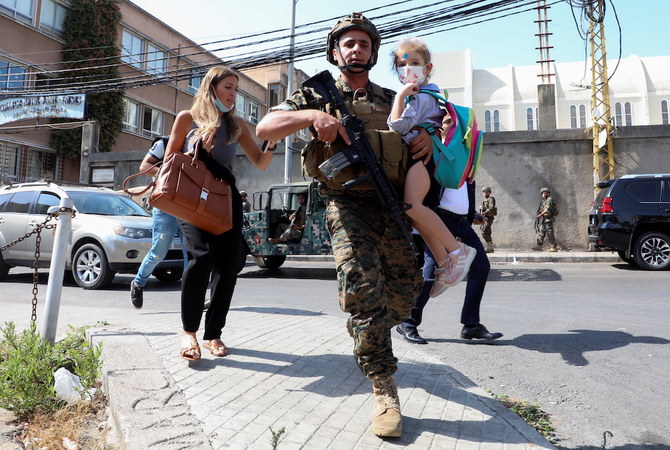
People were trapped inside houses and shops, while hundreds of students were stuck inside their schools near the violence-hit area.
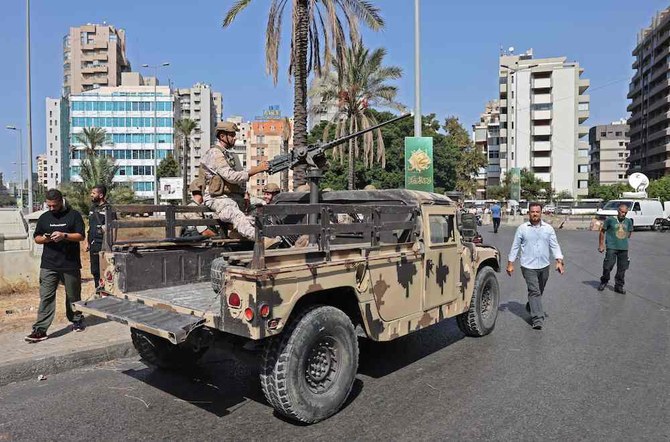
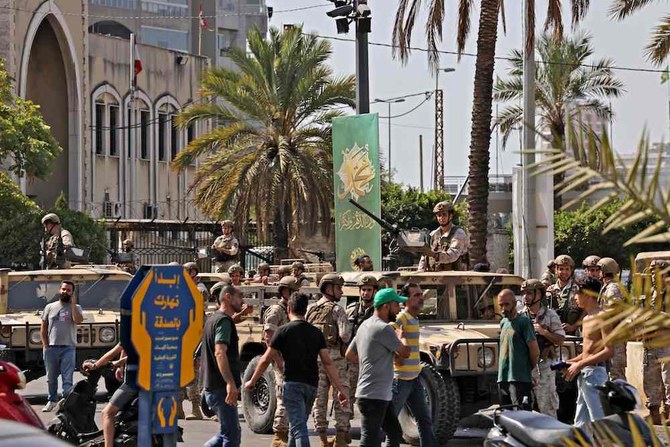
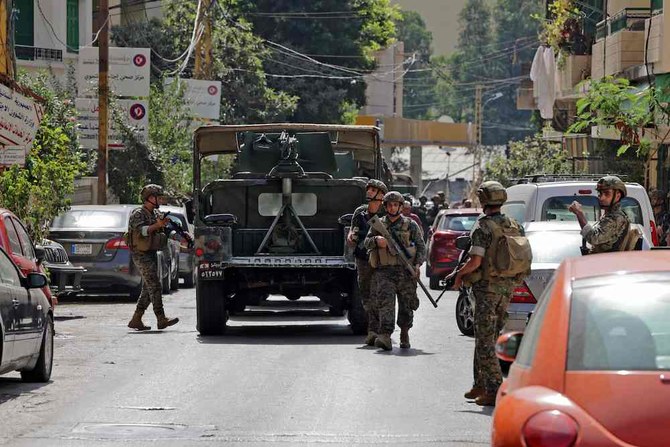
The clashes lasted around three hours, with the Lebanese army failing in its attempts to contain the situation.
The injured and trapped made calls to be evacuated.
Students in schools rushed to the hallways separating classrooms. Several were injured by shattered glass and were taken to hospital.
Lebanon's army said on Thursday evening that it arrested nine people, including a Syrian, over the violence.
The army said on Twitter that it remained deployed in the area to ensure violence did not occur again.
Supporters of Hezbollah and the Amal Movement showed up on Thursday at around 10.30 a.m. in response to a call for a peaceful demonstration outside the Justice Palace to protest against measures taken by Bitar that Hezbollah had objected to.
Hezbollah leader Hassan Nasrallah threatened a few days ago to remove Bitar from the probe.
The protest was called in an attempt to silence Bitar, who issued an arrest warrant against former Finance Minister Ali Hassan Khalil, a member of Amal.
The duo accuses Bitar of bias and singling out politicians for questioning, most of them allied with Hezbollah. Speaking Monday, Hezbollah leader Hassan Nasrallah accused Bitar of using “the blood of victims to serve political interests" while demanding that the investigation be headed by a “transparent judge."
Opinion
This section contains relevant reference points, placed in (Opinion field)
Most protesters wore black shirts. Some wore masks to cover their faces. They chanted slogans against Bitar and in support of Nasrallah and the head of the Amal Movement, Parliament Speaker Nabih Berri.
Some carried the flags of the two parties. Others carried the Lebanese flag. The army took tough measures to prevent the situation from further escalating in an area already considered sensitive on a security and political level.
As they reached the Tayouneh roundabout, and as they were heading to Sami Al-Solh Street on their way to the Justice Palace, they were fired at by snipers from rooftops of buildings, according to a witness.
Duha, who was standing at the roundabout watching the protest, told Arab News: “A person suddenly fell on the ground and was covered in his own blood and people started running in all directions when bullets started raining.”
Protesters panicked and started running in all directions.
Armed members emerged and fired shots at the building. Clashes broke out and B7-RPG anti-tank grenades were launched, targeting the buildings between Shiyah and Ain Al-Remaneh.
Protesters concluded their protest outside the Justice Palace, while the Tayouneh area turned into a war zone. Neighboring buildings were rocked by the missiles and the Lebanese watched the exchange of fire and people being killed live on TV.
A military source told Arab News that “calls were immediately made to contain the situation and prevent an escalation” but the violence continued despite the army’s threats to “open fire against any armed person on the road.”
The clashes ended at around 3 p.m. The army urged citizens to evacuate the streets and arrested several armed men.
A source close to Hezbollah and the Amal Movement said: “What happened in Tayouneh cannot be tolerated.”

The two Shiite parties later issued a joint statement: “When the participants in the peaceful demonstration arrived at Tayouneh, they were attacked by snipers from rooftops, followed by a heavy fire resulting in deaths and injuries. Gunshots targeted the heads.”
They accused groups from the Lebanese Forces party that were present in nearby neighborhoods and on rooftops of using sniper rifles to kill people and “willfully drag the country into a deliberate strife.”
They called on the army “to take responsibility and intervene to stop those criminals,” while also urging their supporters to “remain calm and not to be dragged into this vicious strife.”
The leader of the Lebanese Forces party, Samir Geagea, condemned the events. “The main reason behind them is the lack of gun control threatening the lives of citizens at any moment and any place,” he said.
He called for “full and accurate investigations” to determine what had happened.
The dead and wounded were taken to hospital. But injuries were not limited to one side, with civilians from all religious sects hurt.
There were fires in properties and old men and women were evacuated.
Tensions extended to sensitive areas in the Bekaa Valley, where armed members supporting Hezbollah and the Amal Movement were seen in convoys waving the parties’ flags.
Officials and politicians rushed to contain the situation and condemn it.
The Central Security Council held an emergency meeting, after which Interior Minister Bassam Mawlawi warned: “Civil peace is not to be messed with. The clashes started with gunshots by snipers. Someone was shot in the head, and this is not acceptable. Shooting people in the head is a very dangerous matter. Chaos is not in anyone’s interest. Relevant bodies will start arresting people to allow the law to take its course.”
France on Thursday expressed concern over the deadly unrest and urged all parties to calm the situation.
"France is deeply concerned over the recent hindering of the smooth running of the investigation... and the violence that has occurred in this context. France calls on all parties to bring about a de-escalation," the foreign ministry said in a statement.
On Aug. 4, 2020, some 2750 tons of highly explosive ammonium nitrate blew up in the port of Beirut after being inadequately stored there since 2013, killing more than 200 people and wounding thousands.
* With Agencies