Yemen pressuring Houthis to keep Safer tanker ‘away from political conflict’

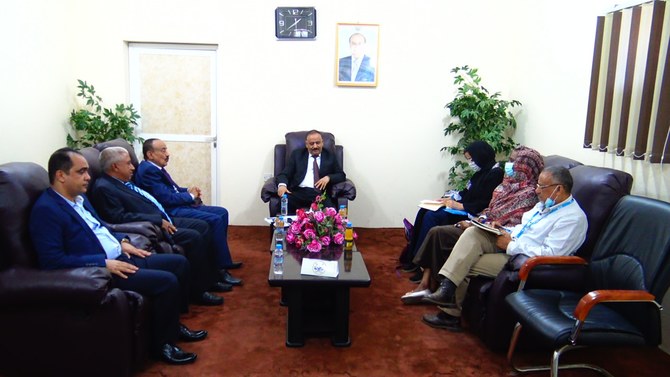
Yemen’s Minister of Transport Abd Al-Salam Hamid meets with officials from the UN Development Program in the interim capital, Aden. (Saba)
Short Url
Updated 13 October 2021
Follow

Yemen pressuring Houthis to keep Safer tanker ‘away from political conflict’

  • Decaying oil tanker moored in the Red Sea has been abandoned since 2017 as an estimated 1.1m barrels of crude oil still remain onboard
  • Yemen’s Minister of Transport says the situation no longer requires maintenance, but the tanker now needs to be permanently offloaded

LONDON: Yemen’s Minister of Transport Abd Al-Salam Hamid called on the UN to exert more pressure on the Houthis to keep a decaying oil tanker moored in the Red Sea “away from the existing political conflict” as its looming threat will affect “everyone without exception.”
The Safer tanker has been abandoned since 2017 as an estimated 1.1 million barrels of crude oil still remain onboard. 
Hamid’s comments came during a meeting on Tuesday in the interim capital, Aden, with Samia Al-Duaij, an environmental consultant and a representative of the UN Development Program, Salma Elhag, director of UNDP office in Aden and Mukallah, and Walid Baharoun, program specialist at UNDP Yemen.
They discussed the potentially catastrophic repercussions on the marine environment if the Safer tanker explodes, breaks up, or starts leaking. The rotting vessel holds four times the oil spilled during the Exxon Valdez incident in 1989 in the Gulf of Alaska.
A potential oil spill in the Red Sea would spread well beyond Yemen and cause environmental havoc affecting Saudi Arabia, Eritrea, Djibouti, and other nearby countries.
According to The Guardian, the UN has been seeking Houthi permission to inspect the ship, but the Iran-backed rebels want undertakings that the vessel will also be repaired, an exercise that requires money the UN does not have available.
Hamid said the situation no longer requires maintenance, but the tanker now needs to be permanently offloaded.
He added that his ministry was ready to provide the required facilities so experts can deal with the tanker crisis in a way that contributes to containing its potential consequences.
Al-Duaij said the UNDP is very concerned about the floating tanker crisis and added that expert teams have held several meetings and discussions about solutions. They all agreed that the Safer should be offloaded.
She also said that the International Maritime Organization has implemented an urgent emergency plan in the case oil starts to leak from the tanker.


Lebanese finance minister denies any plans for a Kushner-run economic zone in the south

Updated 45 min 44 sec ago
Follow

Lebanese finance minister denies any plans for a Kushner-run economic zone in the south

  • Proposal was made by US Envoy Morgan Ortagus but was ‘killed on the spot’
  • Priority is to regain control of state in all aspects, Yassine Jaber tells Arab News

DAVOS: Lebanon’s finance minister dismissed any plans of turning Lebanon’s battered southern region into an economic zone, telling Arab News on the sidelines of the World Economic Forum’s meeting in Davos that the proposal had died “on the spot.”

Yassine Jaber explained that US Envoy to Lebanon Morgan Ortagus had proposed the idea last december for the region, which has faced daily airstrikes by Israel, and it was immediately dismissed.

Jaber’s comments, made to Arab News on the sidelines of the World Economic Forum in Davos, were in response to reports which appeared in Lebanese media in December which suggested that parts of southern Lebanon would be turned into an economic zone, managed by a plan proposed by Jared Kushner, US President Donald Trump’s son in law.

Meanwhile, Jaber also dismissed information which had surfaced in Davos over the past two days of a bilateral meeting between Lebanese ministers, US Middle East Envoy Steve Witkoff and Kushner.

Jaber said that the meeting on Tuesday was a gathering of “all Arab ministers of finance and foreign affairs, where they (Witkoff and Kushner) came in for a small while, and explained to the audience the idea about deciding the board of peace for Gaza.”

He stressed that it did not develop beyond that.

When asked about attracting investment and boosting the economy, Jaber said: “The reality now is that we need to reach the situation where there is stability that will allow the Lebanese army, so the (Israeli) aggression has to stop.”

Over the past few years, Lebanon has witnessed one catastrophe after another: one of the world’s worst economic meltdowns, the largest non-nuclear explosion in its capital’s port, a paralyzed parliament and a war with Israel.

A formal mechanism was put in place between Lebanon and Israel to maintain a ceasefire and the plan to disarm Hezbollah in areas below the Litani river.

But, the minister said, Israel’s next step is not always so predictable.

“They’re actually putting pressure on the whole region. So, a lot of effort is being put on that issue,” he added.

“There are still attacks in the south of the country also, so stability is a top necessity that will really succeed in pushing the economy forward and making the reforms beneficial,” he said.

Lawmakers had also enacted reforms to overhaul the banking sector, curb the cash economy and abolish bank secrecy, alongside a bank resolution framework.

Jaber also stressed that the government had recently passed a “gap law” intended to help depositors recover funds and restore the banking system’s functionality.

“One of the priorities we have is really to deal with all the losses of the war, basically reconstruction … and we have started to get loans for reconstructing the destroyed infrastructure in the attacked areas.”

As Hezbollah was battered during the war, Lebanon had a political breakthrough as the army’s general, Joseph Aoun, was inaugurated as president. His chosen prime minister was the former president of the International Court of Justice, Nawaf Salam.

This year marks the first time a solid delegation from the country makes its way to Davos, with Salam being joined by Jaber, Economy and Trade Minister Amr Bisat, and Telecoms Minister Charles Al-Hage.

“Our priority is to really regain the role of the state in all aspects, and specifically in rebuilding the institutions,” Jaber said.